Removing 131 Cats Sparks Pigeon Boom and Reveals Unexpected Genetic Purging
After predator control saved a near‑collapsed population, DNA shows extreme inbreeding but surprisingly fewer harmful mutations.

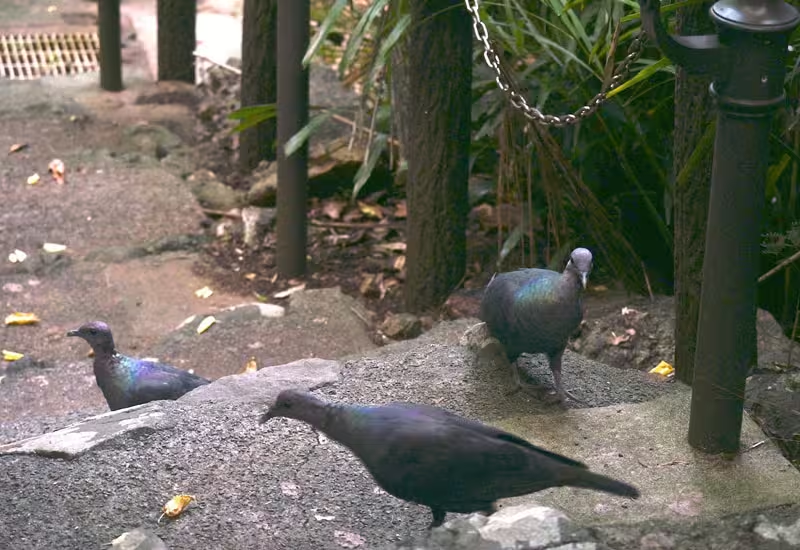
By 2008, fewer than 80 red-headed wood pigeons survived on Japan’s remote Ogasawara archipelago. The birds, found only on Chichijima Island, faced intense pressure from introduced feral cats, prompting conservationists to launch an aggressive trapping program in 2010.
Within three years, teams captured 131 feral cats, slashing the island’s cat population to under 20 individuals. Concurrently, sightings of adult pigeons surged from 111 to 966, while juvenile observations climbed from 9 to 189, signalling a rapid recovery.
Intensive cat removal sparks a dramatic pigeon resurgence
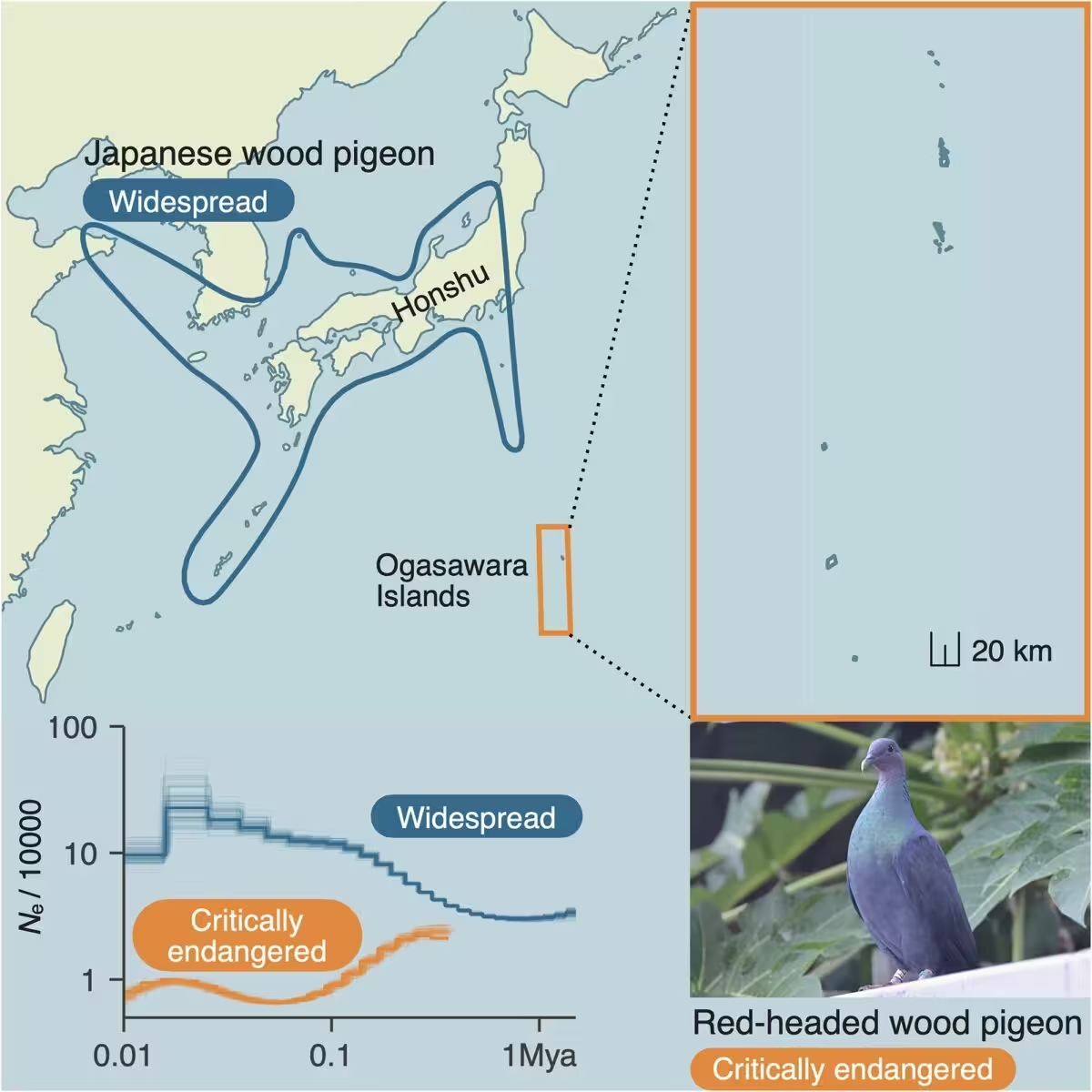
The red-headed wood pigeon (Columba janthina nitens) is endemic to the Ogasawara Islands, a UNESCO World Heritage site since 2011 that comprises more than 30 islands spanning 7,939 hectares and hosts an unusually high proportion of endemic species.
According to a study in Communications Biology, the species’ decline stemmed from habitat loss and predation by feral cats. Although trapping did not eradicate the cats entirely, their numbers fell below 20 between 2010 and 2013, a timeline that closely matches the observed increase in pigeon counts.
Human settlement began on the islands in 1830. Researchers reconstructed the pigeon’s demographic history, finding that its effective population size was already modest before colonization and later experienced a severe bottleneck linked to intensified human activity.
Depending on the assumed recombination rate, genomic analyses suggest the effective population fell to a low of either 88 individuals in 1957 or 56 in 1985, before rebounding to between 117 and 498 by 2007. The authors caution that estimates close to the sampling period are less reliable and may not reflect exact census numbers.
Genomes dominated by homozygosity reveal a tangled past
To explore how such a tiny population could recover, Daichi Tsujimoto and colleagues sequenced 25 genomes: eight wild red-headed wood pigeons, eight captive conspecifics, and nine wild Japanese wood pigeons (Columba janthina).
The endangered birds exhibited extensive runs of homozygosity—stretches where both chromosomes are nearly identical. The average inbreeding coefficient derived from these regions was 0.84 in wild red-headed wood pigeons and 0.88 in captive birds, compared with 0.02 in the more common Japanese wood pigeon.
Longer homozygous segments (>0.1 Mb) point to a small effective population persisting for roughly 895 years. Overall, more than 80% of the red-headed wood pigeon genome fell within homozygous blocks.
When comparing deleterious mutations, the team identified only 13 nonsense single‑nucleotide polymorphisms in the red-headed wood pigeon (wild and captive combined), versus 96 such mutations in the Japanese wood pigeon. Nonsense mutations, which truncate proteins, serve as a proxy for genetic load.
Both wild and captive red-headed birds displayed a markedly lower ratio of nonsense to silent mutations, suggesting that harmful variants were more efficiently purged during the species’ long history of low‑density populations.
Gradual inbreeding may have facilitated genetic purging
The authors describe a process known as genetic purging, wherein recessive deleterious alleles become exposed as homozygosity rises, allowing natural selection to eliminate them. In contrast to rapid inbreeding following a sudden crash, the pigeon’s prolonged small‑population phase likely gave selection time to act.
Nevertheless, eight of the 13 identified nonsense mutations were nearly fixed in both wild and captive groups, meaning they no longer contribute to inbreeding depression but may still reduce overall fitness.
Similar patterns of purging have been documented in other island endemics, such as the island fox, Seychelles paradise flycatcher, northern elephant seal, and Iberian lynx. Long‑term isolation and consistently low census sizes appear to be common factors.
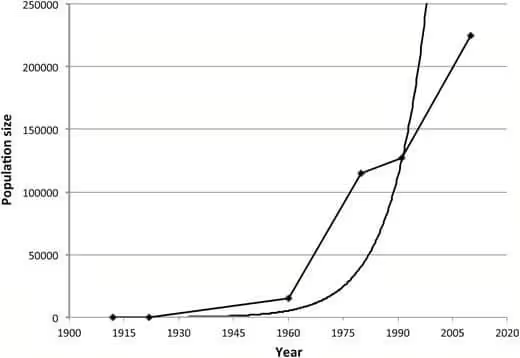
A 2023 analysis of the Seychelles paradise flycatcher provides a parallel case. After dwindling to 28 individuals in the 1960s, the species rebounded to over 250 by the 1990s. Genomic work revealed a tenfold loss of diversity, partial removal of highly deleterious mutations, and accumulation of mildly harmful variants.
Captive breeding shows limited lifespan impact from inbreeding
The researchers also examined 119 captive‑born pigeons with documented pedigrees and lifespans. Statistical analysis found no significant correlation between individual inbreeding coefficients and longevity; the trend even hinted at slightly longer lives in more inbred birds, though the result was not statistically robust.
The study did not assess reproductive fitness, hatching success, or potential differences between captive and wild environments, leaving open the possibility that inbreeding depression could manifest in other fitness components.
At Tokyo’s Ueno Zoological Gardens, a captive program initiated in 2001 with three founders has since incorporated wild individuals (13 added after 2012). By 2022, the fifth generation had been born, and a total of 198 birds have been maintained in the program.
Even with successful captive propagation, low genetic diversity may constrain the species’ capacity to adapt to changing conditions. Continued genetic drift could further erode variation and fix additional deleterious alleles, underscoring the need for ongoing population expansion and rigorous genetic monitoring.
The UNESCO World Heritage Centre lists invasive alien species as a primary threat to the Ogasawara Islands. The red-headed wood pigeon now represents one of the few remaining large seed‑dispersing birds on the archipelago, after the endemic Bonin wood pigeon vanished post‑1889.
This article has been fact checked for accuracy, with information verified against reputable sources. Learn more about us and our editorial process.
Last reviewed on .
Article history
- Latest version
Reference(s)
- Tsujimoto, Daichi. “Genetic purging in an island-endemic pigeon recovering from the brink of extinction - Communications Biology.”, vol. 8, no. 1, July 15, 2025, pp. 1051 Nature, doi: 10.1038/s42003-025-08476-z. <https://www.nature.com/articles/s42003-025-08476-z>.
- <https://academic.oup.com/mbe/article/40/12/msad256/7320915>.
- <https://whc.unesco.org/en/list/1362/>.
Cite this page:
- Posted by Hassan Raza