Engineered Yeast Solves Major Bottleneck for Rare Anti-Cancer Drugs
By combining synthetic biology with a single chemical reaction, researchers bypassed a cumbersome ten-step manufacturing sequence for etoposide and teniposide.
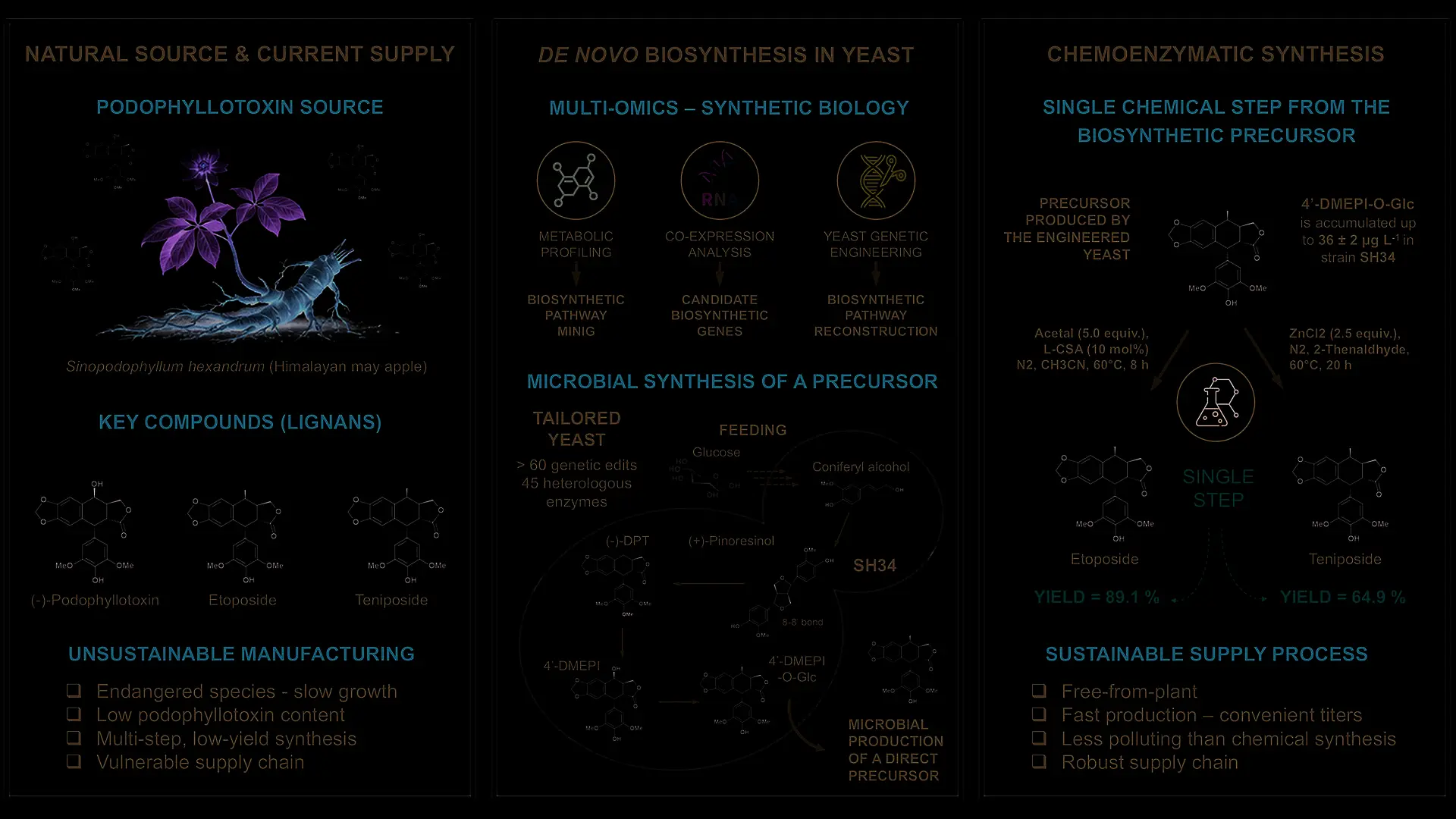
Scientists have engineered common baker’s yeast to manufacture a crucial chemical building block for etoposide and teniposide, two widely used cancer-fighting medications that currently rely on vulnerable supplies of wild Himalayan plants. By reconstructing a complex, multi-step biological assembly line inside Saccharomyces cerevisiae, researchers closed a decade-long scientific gap in how these vital pharmaceutical agents are synthesized.
Medicinal plants such as Sinopodophyllum hexandrum have served as the traditional source for these botanical extracts, but slow growth rates, harvesting pressure, and low natural yields threaten their long-term availability. To address this supply bottleneck, a research team recently developed a modular yeast platform capable of producing an advanced glycosylated precursor, which is a sugar-attached intermediate molecule, directly from simple glucose. This laboratory-scale development, originally published in Cell Discovery by Nicolas Gautron, Nicolas Papon, and Vincent Courdavault, builds upon foundational findings from a study led by Shen and colleagues.

How Researchers Hunted for the Missing Enzyme in Yeast
Replicating plant chemistry inside a single-celled fungus requires introducing dozens of foreign genes from different species. The primary hurdle in creating etoposide precursors had remained unsolved since 2015, specifically the identification of the exact enzyme needed to attach a sugar molecule to a specific chemical position. The authors screened 354 candidate UDP-glycosyltransferase genes from the Himalayan apple plant genome before isolating one specific gene, named UGT709AX1, that performs this exact reaction.
Supplying the necessary starting ingredients posed another major engineering challenge. The natural plant pathway for making a building block called coniferyl alcohol functions very poorly in fungi. To overcome this limitation, the team utilized advanced artificial intelligence protein modeling via AlphaFold3 to design eight functional chimeric carboxylic acid reductases, ultimately selecting an enzyme variant that yielded 89 milligrams per liter of coniferyl alcohol, representing roughly a 45-fold increase over initial baseline strains.
Why Simple Fermentation Is Not Yet Ready for Industrial Factories
Despite these biochemical milestones, the engineered yeast strains do not yet solve the commercial supply problem for pharmaceutical manufacturers. The final precursor titers remain stuck in the low hundreds of micrograms per liter, which sits several orders of magnitude below what industrial fermentation vats require. Furthermore, side reactions continuously divert chemical traffic away from the intended target structure, indicating that simply increasing gene copy numbers has hit a wall of diminishing returns.
Closing these remaining efficiency gaps will likely demand advanced spatial organization, such as physically anchoring cooperating enzymes close to one another inside the cell. Without this structural compartmentalization, the foreign enzymes cannot match the precise cellular architecture found within the original plant tissues.
What This Chemoenzymatic Division of Labor Means for Medicine
While industrial scaling remains distant, the work introduces a powerful hybrid strategy that pairs microbial biotechnology with streamlined chemistry. By shifting the most chemically difficult step, which is attaching the sugar group in the correct spatial orientation, out of the laboratory flask and into living yeast, the team bypassed a traditional manufacturing sequence requiring more than ten separate protection and deprotection steps with very low overall yields.
Instead, the resulting microbial precursor transforms into etoposide through a single mild acetalization reaction with an 89.1 percent yield, or into teniposide with a 64.9 percent yield. Because the genetic modules governing these reactions are fully interchangeable, this modular framework offers a reusable blueprint for producing other ecologically constrained plant medicines without depleting natural ecosystems.
The research was published in Cell discovery on November 9, 2026.
This article has been fact checked for accuracy, with information verified against reputable sources. Learn more about us and our editorial process.
Last reviewed on .
Article history
- Latest version
Reference(s)
- Gautron, Nicolas., et al. “Engineering yeast for anticancer drug biosynthesis.” Cell Discovery, vol. 12, no. 1, November 9, 2026 Springer Science and Business Media LLC, doi: 10.1038/s41421-026-00937-x. <https://doi.org/10.1038/s41421-026-00937-x>.
Cite this page:
- Posted by Robert Brown