Deep-Sea Shrimps Hatch Wrapped in Membranes and Swim Using Giant Antennae
New research reveals that stenopodidean shrimps rely on a brief, temperature-sensitive prezoeal stage to escape tight spaces and disperse after birth.
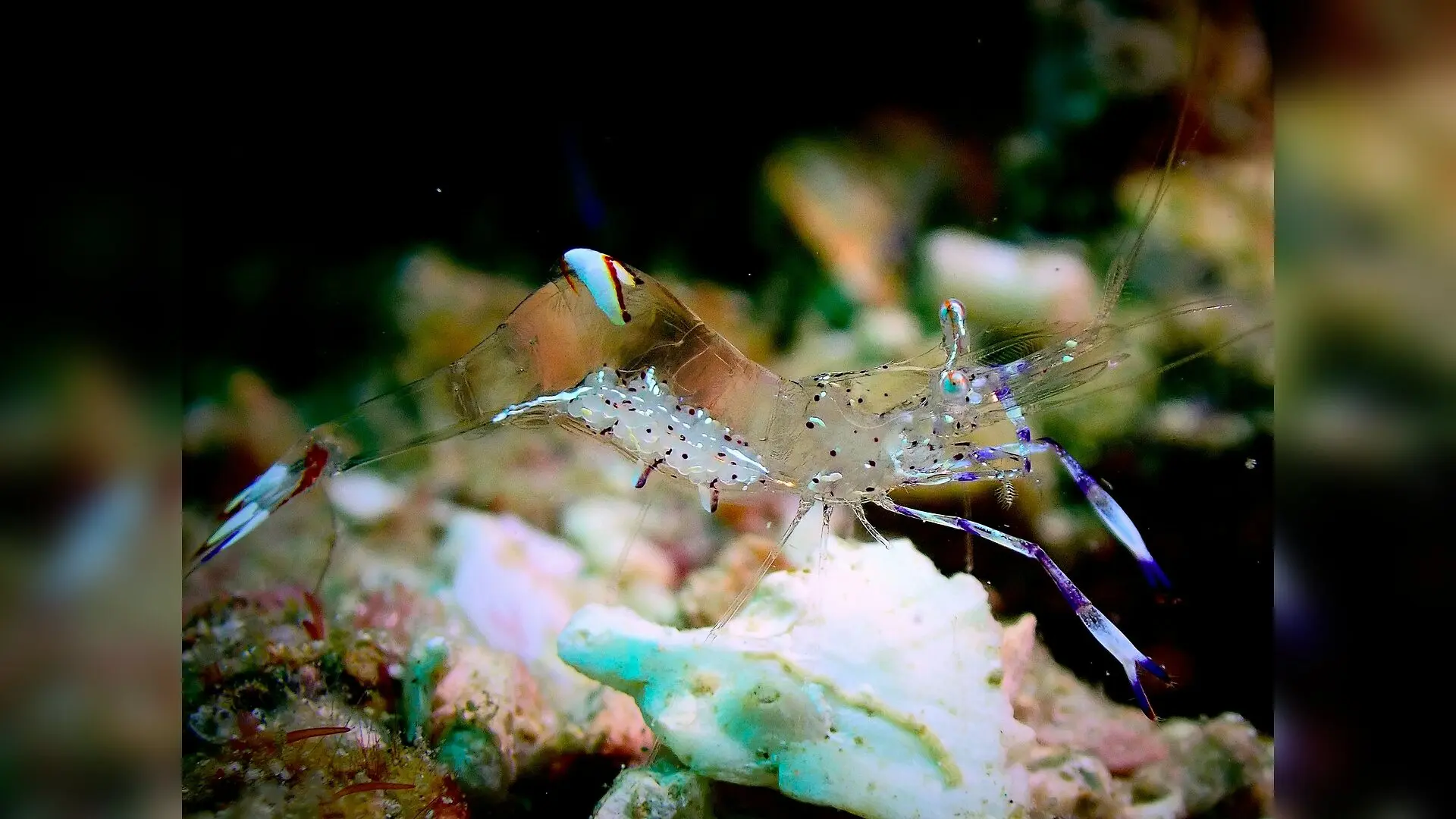
Deep-sea shrimps and their shallow-water relatives hatch into a bizarre, temporary life stage where their entire bodies are wrapped in a tight transparent membrane, allowing them to swim furiously using only their giant antennae before shedding their skin in minutes. Marine biologists discovered that this strange phase, known as the prezoeal stage, is not an accidental birth defect or an abnormal hatching byproduct, but a highly coordinated survival mechanism across vastly different marine habitats. The research illuminates how tiny crustaceans overcome physical traps like dense egg masses or coral reefs right after birth.
The study, published in PloS one, was conducted by researchers M. Nakagawa and T. Saito, who investigated the early development of two distinct shrimp species: Spongicola venustus, a deep-sea creature that lives as an obligate partner inside glass sponges, and Stenopus hispidus, a free-living cleaner shrimp found in shallow coastal waters. Despite living in contrasting environments, both species share this mysterious embryonic wrapping that defines their earliest moments of life.
How Tiny Shrimps Escape Their Egg Cases Using Giant Antennae
When decapod crustaceans hatch, they often face immediate physical obstacles, such as escaping the dense network of maternal pleopods (swimming appendages) or navigating out of a host animal’s narrow chambers. For Spongicola venustus, larvae must squeeze through the intricate skeleton of a glass sponge, while shallow-water Stenopus hispidus must emerge safely from crowded egg clutches. Researchers observed that both species hatch as prezoeae, completely encased in a thin embryonic cuticle with their rostrum and spines folded tightly against their bodies.
This compact shape prevents delicate zoeal structures from snagging on egg cases or surrounding tissues. Immediately after emerging into the water column, the prezoeae begin rhythmic, oar-like strokes using their oversized second antennae. Because their thoracic swimming appendages remain locked away inside the protective membrane, this antennal propulsion acts as a temporary motor, driving the newborns upward toward the surface during their most vulnerable hours.
Why Water Temperature Controls the Speed of Shrimp Metamorphosis
The transformation from a prezoea into the first zoeal stage happens rapidly, but it is heavily influenced by ambient water temperature. The authors measured the time required for complete metamorphosis and discovered a striking inverse relationship. For Spongicola venustus, warming the water from 15°C to 20°C cut the duration of the prezoeal stage almost in half, dropping from an average of 1,802 seconds down to 949 seconds. Similarly, for Stenopus hispidus, increasing the temperature from 20°C to 25°C halved the transition time from 887 seconds to just 421 seconds.
The authors suggest that higher temperatures boost metabolic rates and enzymatic activity, accelerating the hormonal cascades responsible for shedding the embryonic cuticle. This thermal sensitivity means that ocean warming could drastically shorten the window in which these larvae rely on antennal swimming, potentially altering their early dispersal patterns and survival rates in the open ocean.
Parallels Between Marine Crustaceans and Insect Pronymphs
The functional design of the prezoea shares intriguing ecological parallels with the pronymph stage seen in certain hemimetabolous insects, which are insects that undergo incomplete metamorphosis. Both groups feature short-lived post-hatching forms wrapped in a cuticle with folded appendages, designed specifically to overcome immediate environmental barriers. Although these developmental stages are not evolutionarily homologous, they demonstrate how similar selective pressures drive diverse arthropod lineages to evolve specialized transitional phases.
The findings move science past the old view that prezoeae are merely passive embryos or failed molts. Instead, the data confirms that these transient stages are fine-tuned evolutionary strategies for early locomotion and escape. Future research aims to uncover the exact hormonal triggers governing this rapid molt, providing deeper insight into how crustaceans conquer the oceans from the moment they are born.
The research was published in PloS one on November 10, 2026.
This article has been fact checked for accuracy, with information verified against reputable sources. Learn more about us and our editorial process.
Last reviewed on .
Article history
- Latest version
Reference(s)
- Nakagawa, Mikihiro., et al. “Morphology and swimming behavior of prezoeae in two stenopodidean shrimps: Functional implications for early larval life.” PLOS One, vol. 21, no. 11, November 10, 2026, pp. e0361633 Public Library of Science (PLoS), doi: 10.1371/journal.pone.0361633. <https://doi.org/10.1371/journal.pone.0361633>.
Cite this page:
- Posted by Priya Sharma