2,300-Year-Old Caribbean Sponge Filtered 850 Million Gallons Before Its 2012 Demise
Explore the 23‑century‑old giant that lived since Hannibal’s time, stayed in one spot through civilization’s rise and fall, and only now uncovered.
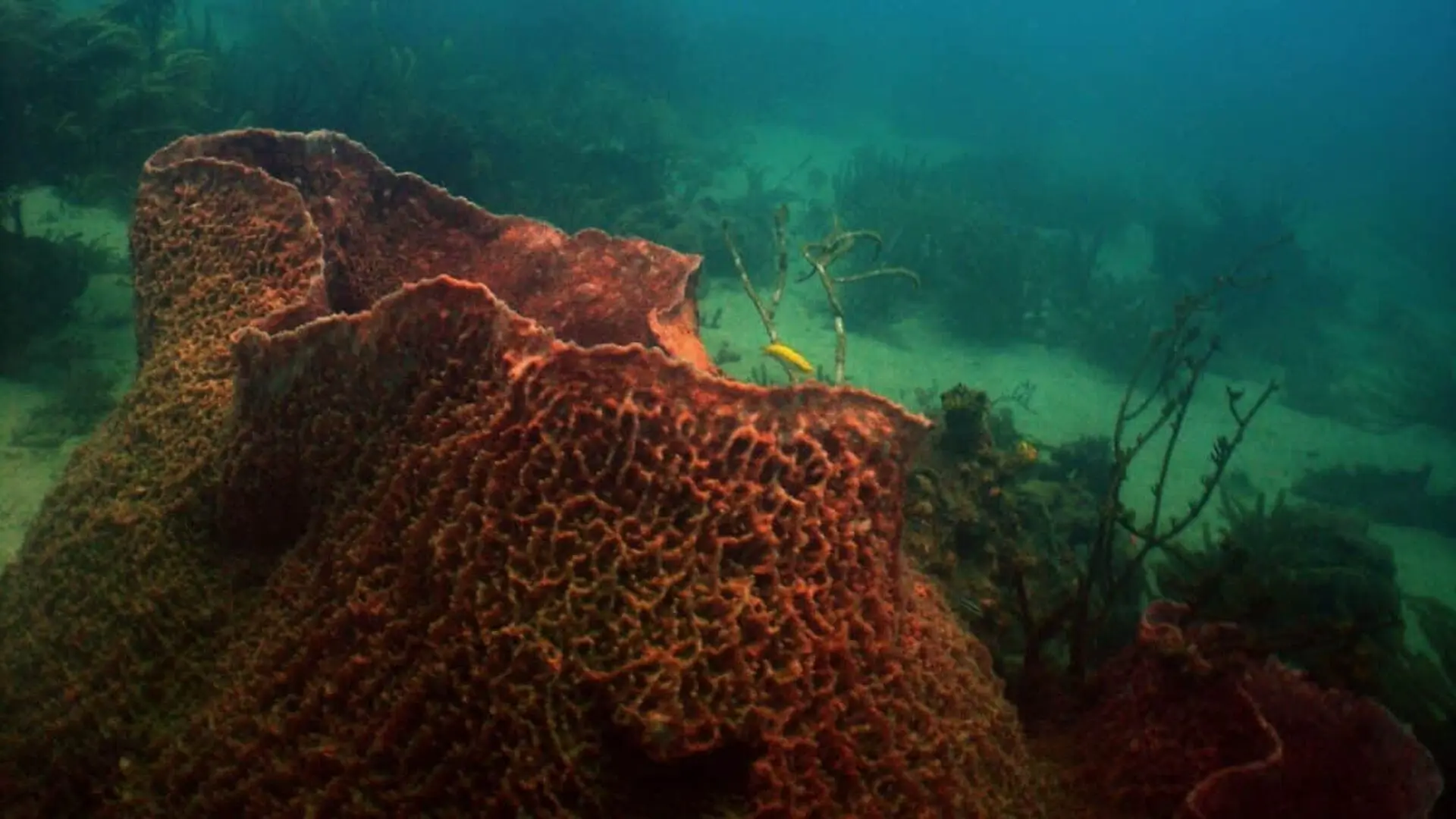
A team of marine researchers off Curaçao has recorded a colossal barrel sponge that survived for more than two millennia before a disease finally killed it in 2012. By the time it was photographed, the organism had already outlasted whole civilizations and ranks among the longest‑lived animals ever documented.
When the sponge first attached to the seabed as a microscopic larva, Hannibal had not yet begun his famed Alpine crossing and the Roman Empire was still centuries away. Over the ensuing centuries the organism quietly filtered seawater while empires rose and fell above the Caribbean surface.
Two‑Thousand‑Year‑Old Reef Resident
The specimen, identified as the giant barrel sponge Xestospongia muta, measured roughly 2.5 metres across when divers captured it on a Curaçao reef. Marine biologist Ivan Nagelkerken and collaborators estimate its age at about 2,300 years.
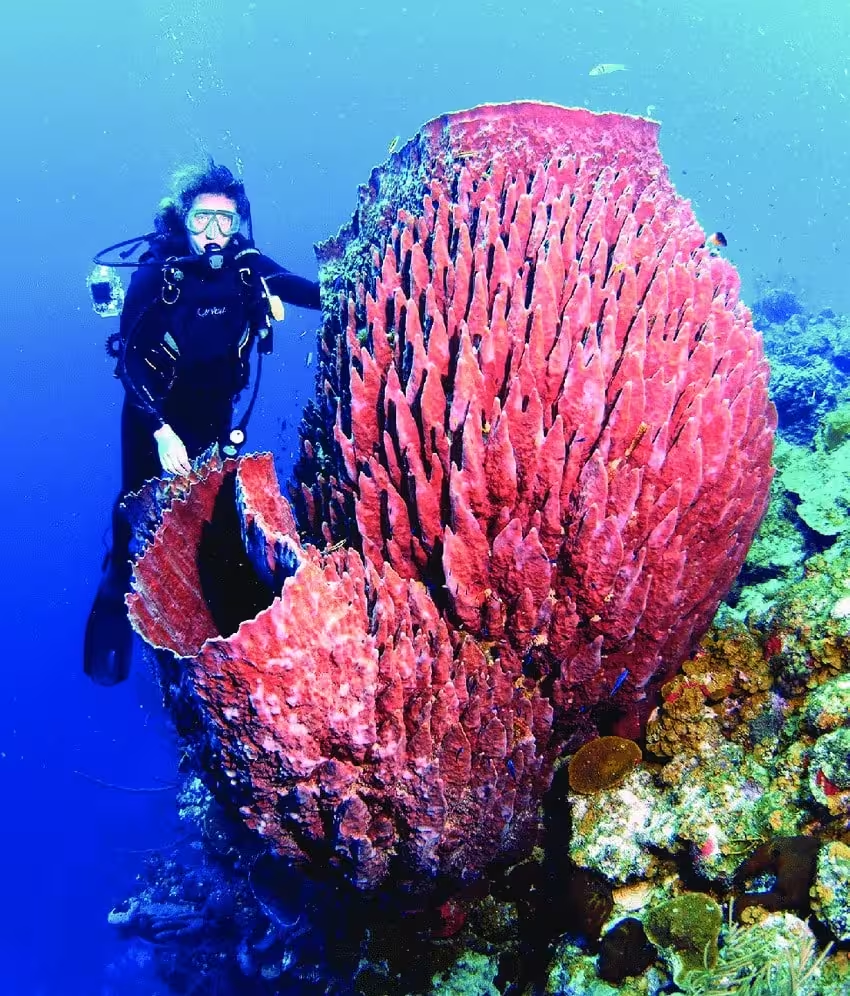
Throughout its life the sponge stayed anchored to the same reef where its larval stage settled, a habit that has earned giant barrel sponges the moniker “redwoods of the reef,” a nod to both their massive dimensions and exceptional longevity.
A Relentless Water Filter
Like all sponges, Xestospongia muta operates as a filter feeder: seawater streams through thousands of minute pores, allowing the animal to capture microscopic plankton and organic particles, then expels the cleaned water through a large opening at its top. Further reading on water filtration.
According to the source material, a mature giant barrel sponge can pump about 1,000 gallons of seawater each day. Over its 2,300‑year lifespan, the Curaçao individual is estimated to have filtered roughly 850 million gallons.
Sponges rank among Earth’s most primitive animals: they lack a brain, heart, nervous system and true organs, relying instead on a network of canals and specialized cells to keep water flowing continuously.
This basic architecture has persisted for roughly 600 million years, weathering multiple mass‑extinction events, ice ages and dramatic shifts in planetary geography.
Estimating Its Age and Tracing Its Demise
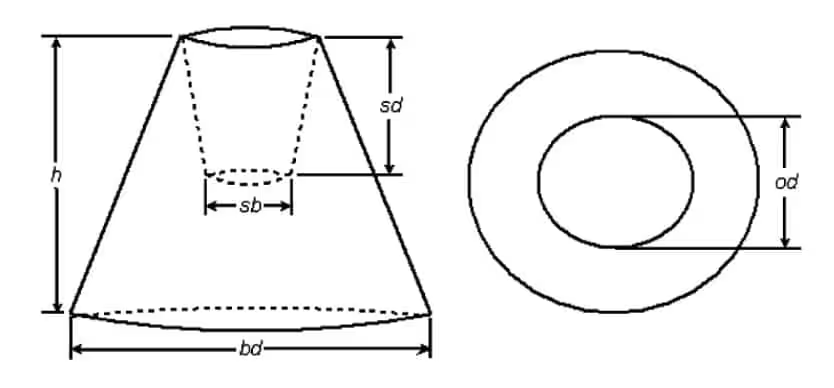
Because sponges do not produce growth rings, researchers infer age by measuring overall size and applying known growth rates for the species.
A 2008 paper in Marine Biology documented highly variable growth patterns in giant barrel sponges, with some individuals expanding slowly and others more rapidly depending on age and environmental factors.
Applying those growth equations to the Curaçao specimen’s dimensions yields an estimated development period of 2,000–2,500 years, supporting the widely cited 2,300‑year age figure.
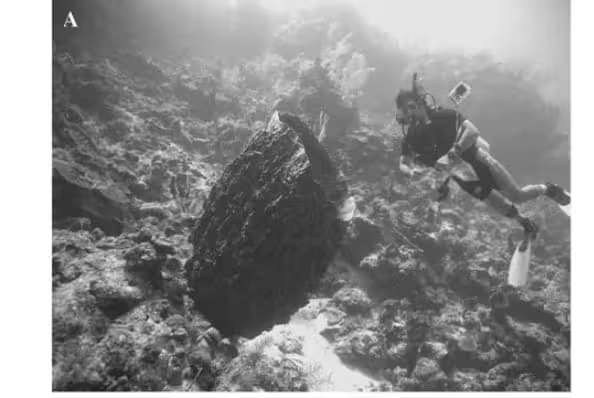
The sponge’s demise was not a consequence of senescence; a condition known as Sponge Orange Band can rapidly afflict giant barrel sponges, producing orange patches of necrotic tissue that eventually kill the organism.
Outbreaks of this disease have been recorded throughout the Caribbean, including Curaçao. The ancient individual succumbed during a recent regional episode, concluding a life that began over two millennia earlier and persisted almost uninterrupted until the early 2000s.
This article has been fact checked for accuracy, with information verified against reputable sources. Learn more about us and our editorial process.
Last reviewed on .
Article history
- Latest version
Reference(s)
- “Ivan.nagelkerken.” <https://researchers.adelaide.edu.au/profile/ivan.nagelkerken>.
- Team, Space. “A giant barrel sponge growing on a Caribbean reef off the island of Curaçao was estimated to be roughly 2,300 years old when it was photographed by researchers — meaning it began growing at the bottom of the ocean during the lifetime of Hannibal and survived as a single continuous living organism, filtering seawater on that exact spot, from before the founding of the Roman Empire until it died of disease in 2012.”, June 22, 2026 Space Daily <https://spacedaily.com/d-a-giant-barrel-sponge-growing-on-a-caribbean-reef-off-the-island-of-curacao-was-estimated-to-be-roughly-2300-years-old-when-it-was-photographed-by-researchers-meaning-it-began-growing-at-th/>.
- McMurray, S. E.., et al. “Redwood of the reef: growth and age of the giant barrel sponge Xestospongia muta in the Florida Keys.” Marine Biology, vol. 155, no. 2, June 20, 2008, pp. 159-171. Springer Science and Business Media LLC, doi: 10.1007/s00227-008-1014-z. <https://link.springer.com/article/10.1007/s00227-008-1014-z>.
- <https://www.researchgate.net/figure/Sponge-orange-band-SOB-on-Xestospongia-muta-Conch-Reef-Florida-a-SOB-advancing_fig1_225579985>.
Cite this page:
- Posted by Hassan Raza