UV Light Reveals 125‑Million‑Year‑Old Crocodylomorph Skin and First Color Pattern
A museum’s hidden crocodile fossil reveals astonishing ancient details after a new investigation uncovers evidence preserved for millions of years.
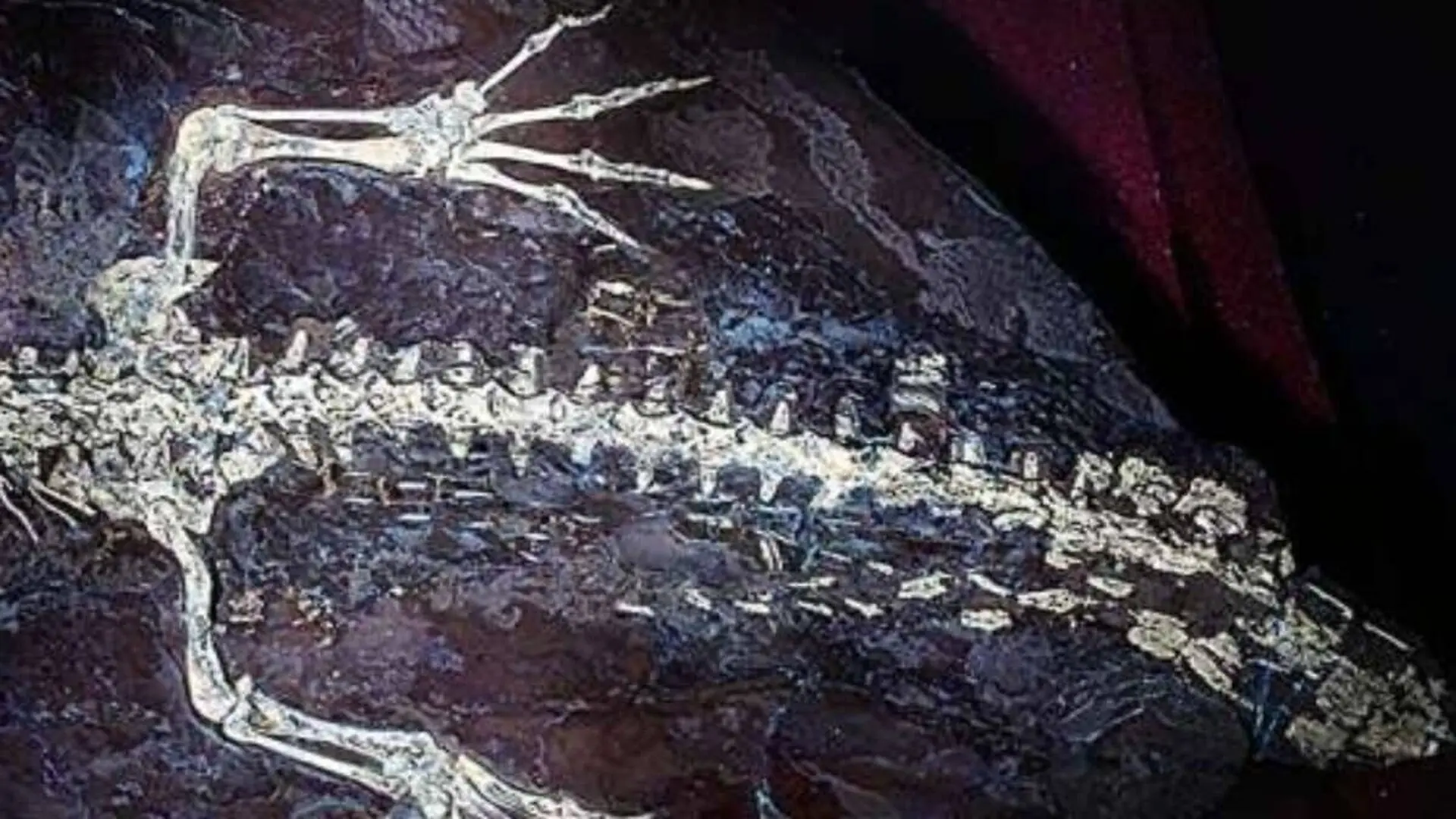
A diminutive, crocodile‑like reptile that roamed Earth 125 million years ago is now offering researchers an unusually clear picture of its integument. By exposing the fossil to ultraviolet radiation, scientists have uncovered remnants of skin, traces of soft tissue, and a possible pigment pattern on the tail of Montsecosuchus depereti, a species first recovered in the Spanish Pyrenees.
Although the specimen has been known for more than a century, it originates from the renowned Pedrera de Meià locality in Catalonia, where the animal perished in a lake and was quickly buried by fine sediments that later lithified into limestone. Those burial conditions protected far more than bone, a rarity in the fossil record.
The findings appear in the Zoological Journal of the Linnean Society. The fossil, roughly 50 centimetres (20 inches) long, resides in the Museum of Natural Sciences of Barcelona and was examined by a team from the Institut Català de Paleontologia Miquel Crusafont.
Hidden Details Emerge from a Century‑Old Specimen
A fresh look under ultraviolet light revealed features that had escaped detection for decades. The researchers note that UV light enhances the contrast between fossilized tissue and surrounding rock, making structures invisible to the naked eye suddenly apparent. This technique exposed a surprisingly rich assortment of soft tissues, including preserved skin scales.
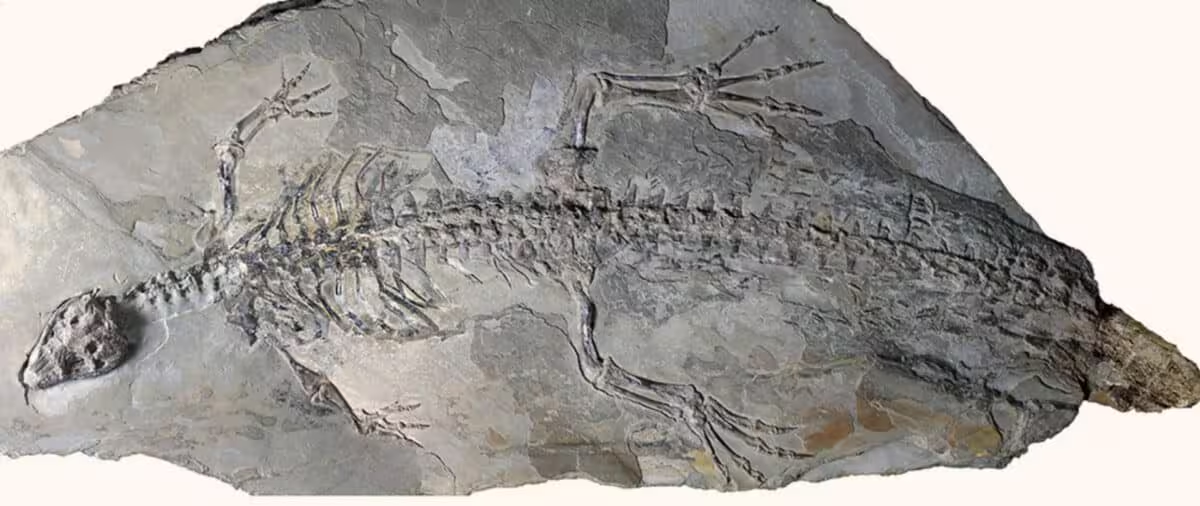
Analysis showed that scale size and shape changed markedly across different body regions, and the animal lacked the tall tail fin typical of modern crocodiles, indicating a distinct body plan.
Scale Microstructures Suggest Early Sensory Functions
The preserved skin also revealed tiny structures that may represent sensory organs embedded within certain scales. These putative receptors were concentrated on the neck, limbs and along the sides of the torso and tail. In living crocodiles, comparable features help detect touch, water movement, temperature shifts and chemical cues.
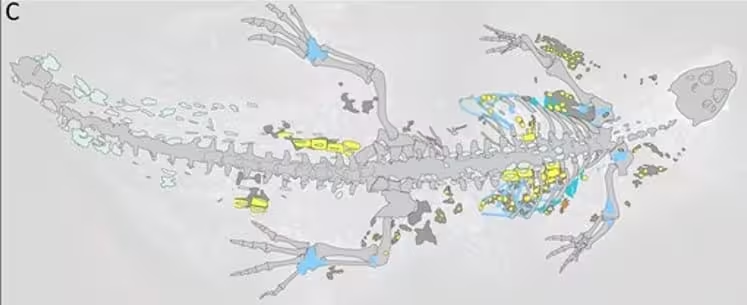
The authors point out that these structures appear only on smaller, peripheral scales, which may indicate an early stage of sensory organ distribution that later expanded in more derived crocodylian lineages.
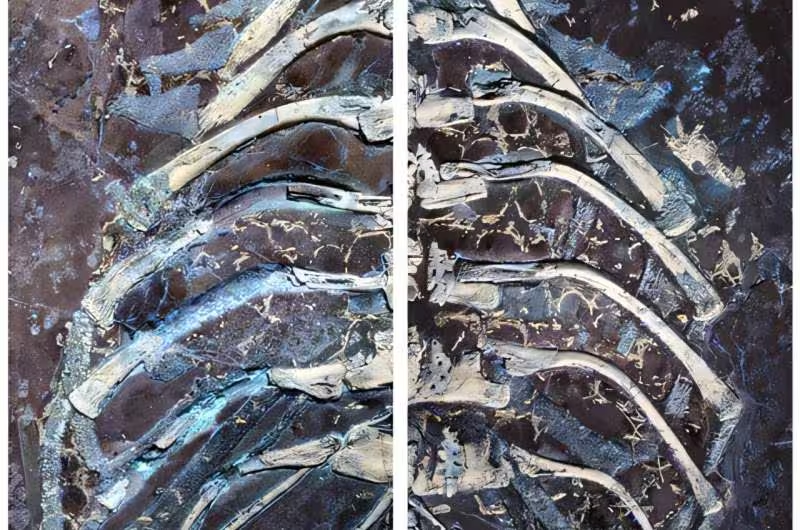
Ultraviolet imaging also exposed cartilage‑like tissue in the chest area, suggesting that Montsecosuchus already possessed an efficient respiratory system with similarities to that of contemporary crocodiles.
“These traits indicate that, despite being a primitive animal, it was already very well adapted to a semiaquatic lifestyle,” Castillo-Visa said.
Evidence of Color Banding on the Tail
The most striking observation comes from the tail. Under UV illumination, alternating light and dark bands become visible across several caudal scales.
According to the study, the pattern likely represents the original pigmentation, potentially serving as disruptive camouflage that broke up the animal’s silhouette in its watery habitat.
If confirmed, Montsecosuchus depereti would become the oldest crocodylomorph with direct evidence of coloration, although the exact hues remain uncertain.
“At the moment we cannot say for sure what color the crocodile’s tail was, but it would be expected that it was not so different from current species, which also show different coloration patterns,” said co-author Albert G. Sellés.
The fossil originates from Pedrera de Meià, a celebrated Konservat‑Lagerstätte that has yielded over 8,000 specimens, ranging from fish and amphibians to plants and insects. This exceptional preservation finally allows scientists to glimpse features of Montsecosuchus that have remained concealed for more than a century.
This article has been fact checked for accuracy, with information verified against reputable sources. Learn more about us and our editorial process.
Last reviewed on .
Article history
- Latest version
Reference(s)
- , doi: 10.1093/zoolinnean/zlag076/8707816. <https://academic.oup.com/zoolinnean/article/doi/10.1093/zoolinnean/zlag076/8707816>.
- <https://www.researchgate.net/profile/Albert-Selles>.
- “The Konservat-Lagerstätte Menat (Paleocene; France) – an overview and new insights | Geologica Acta.” <https://revistes.ub.edu/index.php/GEOACTA/article/view/GeologicaActa2018.16.2.5/41993>.
Cite this page:
- Posted by Hassan Raza