Mystery Deep‑Sea Bloop Sound Finally Traced to Cracking Antarctic Ice
NOAA’s 1997 Pacific mystery sound sparked sea‑monster rumors, but scientists later linked the eerie noise to cracking Antarctic ice.
The darkness of the deep ocean has always invited speculation, and the fact that most of the seafloor remains unmapped only fuels the imagination. When an unusual acoustic event is recorded, the gap between folklore and science can seem surprisingly thin.
In the summer of 1997, while pop culture was dominated by the Spice Girls and the world mourned Princess Diana, researchers from NOAA’s Pacific Marine Environmental Laboratory were monitoring hydrophones for volcanic tremors in the South Pacific. Their equipment captured a single, eerie signal that quickly earned the nickname “the Bloop.” It would take nearly a decade of analysis before scientists could pinpoint its source.
An Unusually Powerful Underwater Noise
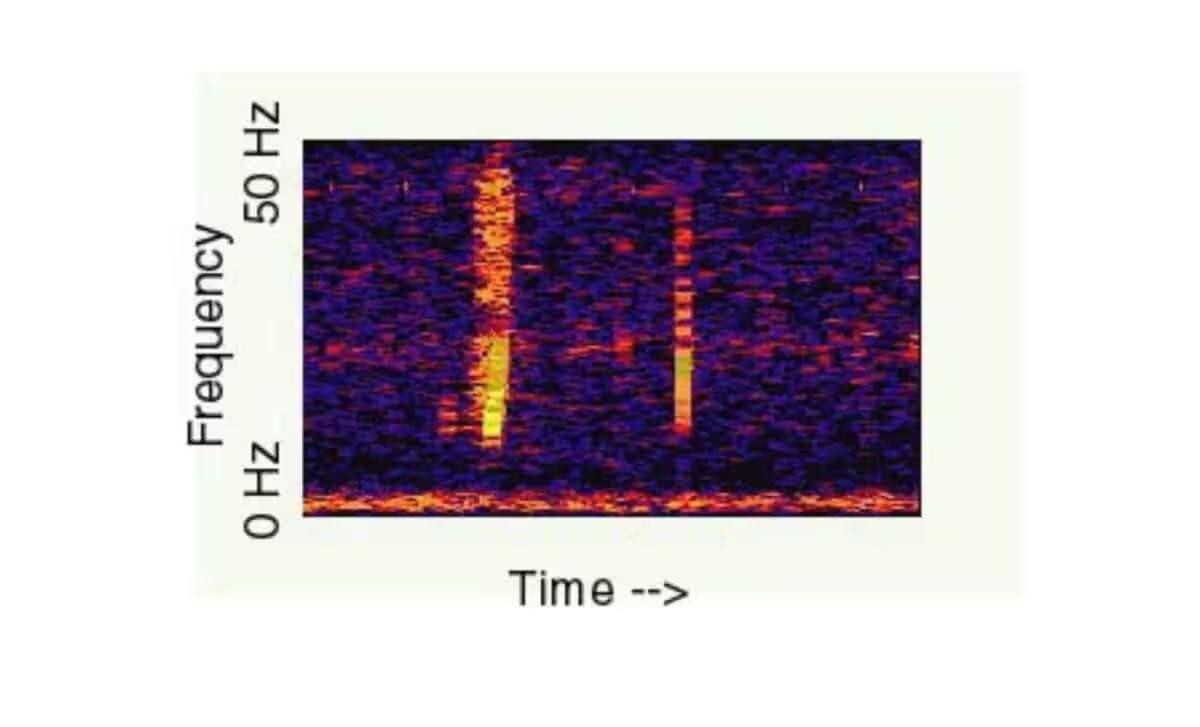
What made the Bloop stand out was not only its strange timbre but also its extraordinary propagation. NOAA acoustics manager Robert Dziak noted that it is rare for a sound to appear on every sensor in the agency’s ocean‑wide network. Most marine sounds—whether from ships or marine mammals—fade before reaching such distant detectors. The Bloop was recorded on devices spaced more than 3,100 miles apart, prompting immediate questions about the energy required to generate it.
The frequency pattern loosely resembled the call of a living organism, a fact that sparked intense public curiosity. Blue whales, the largest known animals, can be heard over long distances, but the Bloop’s amplitude suggested a source potentially twice that size.
Myths and Marine Giants
The idea of a colossal predator resurfaced, with some observers invoking the extinct megashark Megalodon, especially after the coelacanth’s surprising reappearance in 1938 proved that “living fossils” can persist undetected for millions of years. The coincidence that the recorded coordinates lay roughly 1,500 kilometers from the fictional city of R’lyeh—the imagined home of Cthulhu in H.P. Lovecraft’s stories—added a literary twist, turning the Bloop into a shorthand for a possible ancient sea monster.
Scientists also floated a more terrestrial hypothesis involving the colossal squid, an animal that can reach 46 feet. However, the theory faced a fundamental obstacle: squid lack the gas‑filled structures, such as swim bladders, that most marine creatures use to produce loud sounds. Without a known mechanism to generate a noise of the Bloop’s intensity, the squid explanation remained speculative.
Icequake Origin Confirmed in Antarctic Waters
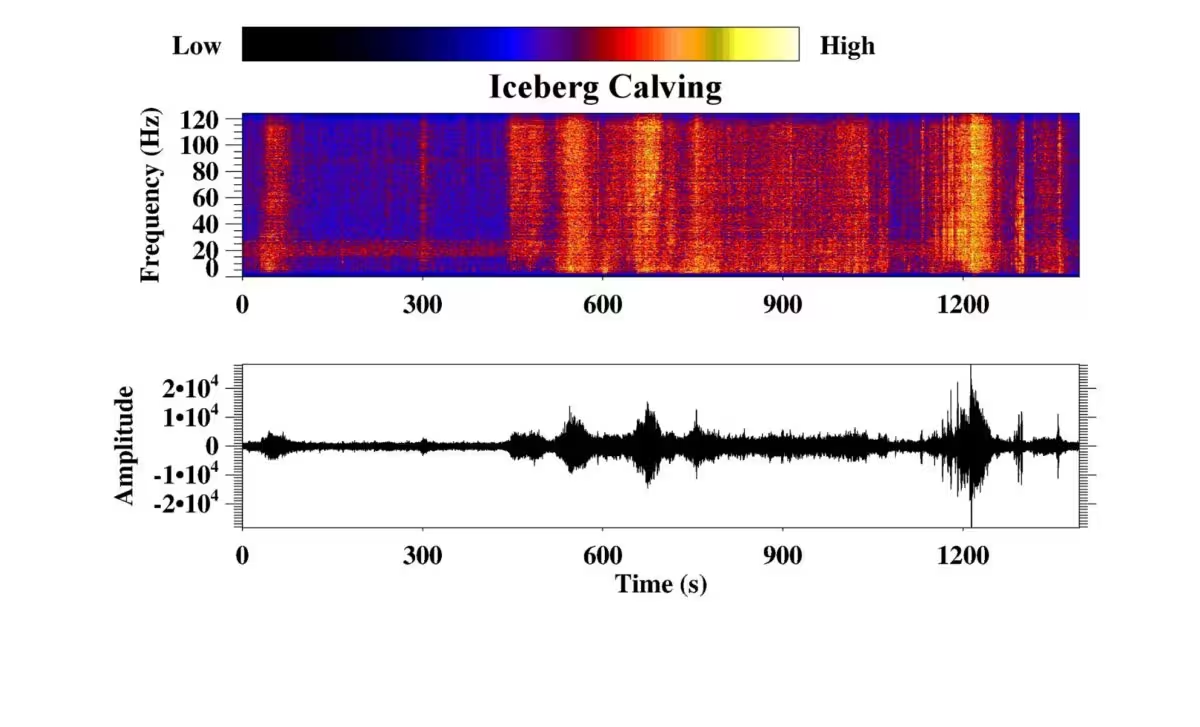
While the public imagination chased legendary beasts, NOAA researchers pursued a more mundane explanation. The South Pacific sits atop a tectonically active basin dotted with faults and submarine volcanoes, leading scientists to suspect a geophysical source—perhaps a cryoseism, or ice quake. When glaciers or ice shelves fracture, they release massive bursts of acoustic energy, and the Bloop’s frequency and amplitude matched that signature.
Progressive monitoring brought the answer into focus. By moving hydrophones closer to Antarctica, the team repeatedly recorded low‑frequency, high‑amplitude events that mirrored the original Bloop. In 2005, they concluded that the sound originated from ice quakes generated by cracking glaciers, a phenomenon that has intensified with climate change. Related acoustic phenomena include calving—the audible breakup of large ice sections—and harmonic tremors produced when icebergs grind against the seafloor or each other.
Analysis of the sound’s propagation direction pointed to a zone between the Bransfield Strait and the Ross Sea, with Cape Adare—a basaltic headland on Antarctica’s edge known for unusual cryogenic noises—identified as a plausible source region. Similar Bloop‑like signatures have also been captured in the Scotia Sea, although the exact glacier responsible for the 1997 event remains unidentified.
The resolution of the mystery did not involve a monster, but it still describes a massive, ancient force: the relentless breaking of Antarctic ice. The discovery underscores how powerful natural processes can produce sounds that, at first glance, seem to belong to the realm of myth.
This article has been fact checked for accuracy, with information verified against reputable sources. Learn more about us and our editorial process.
Last reviewed on .
Article history
- Latest version
Reference(s)
- “Bloop - NOAA Ocean Exploration.”, October 30, 2024 NOAA Ocean Exploration <https://oceanexplorer.noaa.gov/multimedia/okeanos-explorations-okeanos-beyond-the-blue-ex2403-gallery-media-bloop/>.
- “"The Call of Cthulhu" by H. P. Lovecraft.” <https://www.hplovecraft.com/writings/texts/fiction/cc.aspx>.
- “Acoustics Monitoring Program - Icequakes (Bloop).” <https://www.pmel.noaa.gov/acoustics/sounds/bloop.html>.
- “Cape Adare.” Antarctica NZ <https://adam.antarcticanz.govt.nz/nodes/view/20526>.
Cite this page:
- Posted by Hassan Raza