Orexin Neurons Drive Motivation in Rats: Activation Raises Effort, Suppression Lowers Drive
Nagoya University researchers find orexin neurons boost motivation, increasing activity as rats work harder for food rewards.

A recent investigation published in the Proceedings of the National Academy of Sciences offers a detailed view of how the brain might link the anticipation of reward with persistent effort. While the work does not prove that the same circuitry functions identically in humans, it supplies a rigorously controlled animal model for probing motivational deficits that underlie depression, addiction and attention‑deficit/hyperactivity disorder.
Orexin Neurons in the Hypothalamus Drive Goal‑Directed Persistence
Specialized orexin‑producing cells in the hypothalamus are known to influence wakefulness, appetite, energy balance, cognition and mood. Earlier studies hinted at a possible role in motivated behavior, yet their exact contribution remained unclear.
The project was directed by Hiroyuki Mizoguchi, associate professor, and Kiyofumi Yamada, professor emeritus, of Nagoya University’s Graduate School of Medicine. By engineering “orexin‑Cre” rats, the team could selectively manipulate orexin neurons with chemogenetic, fiber‑photometric and optogenetic tools.
Rats were chosen for their aptitude in complex operant tasks, although pinpointing distinct neuronal populations in rodents has historically been technically demanding. The new model enabled simultaneous deployment of multiple techniques to probe orexin circuitry.
In the first series of experiments, chemogenetic activation of orexin cells was paired with a progressive‑ratio schedule, where the number of lever presses required for each food pellet increased stepwise.
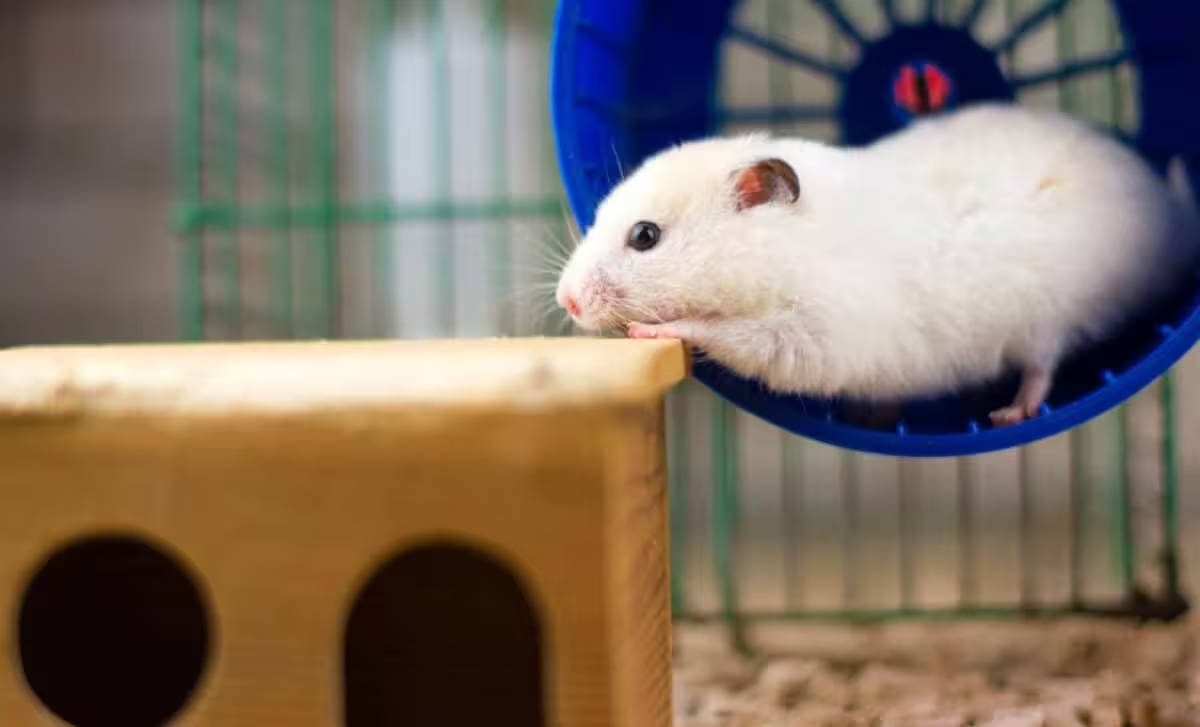
Motivation was quantified by the “breakpoint,” the point at which the animal ceased to pursue the reward. Rats with stimulated orexin neurons achieved higher breakpoints, persisting longer before quitting. Conversely, animals in which orexin cells were selectively ablated displayed reduced breakpoints and gave up earlier.
The PNAS paper reports that orexin activity rose in anticipation of food, fell after delivery, and remained elevated when the expected reward was omitted. Moreover, the signal intensified as the required effort escalated, indicating that orexin neurons encode both reward expectation and the work demanded to obtain it.
These dynamics suggest a mechanism whereby anticipated outcomes are translated into sustained action, with orexin signaling adapting from expectation to receipt or disappointment.
Inhibiting Orexin Cells Dampens Drive; Overactivation Offers No Extra Boost
To probe causality, the researchers employed optogenetics to silence orexin neurons precisely at the moment of reward prediction. Suppression led to slower task performance and lower breakpoints, confirming a drop in reward‑seeking behavior.
Pharmacological blockade of the orexin‑1 receptor produced comparable effects, underscoring the necessity of normal orexin signaling for maintaining motivation during demanding tasks, according to the Nagoya University team.
When the team used an excitatory opsin to heighten orexin activity during the prediction phase, neuronal firing increased, yet the animals did not exert additional effort or display heightened motivation.
The asymmetry between loss and gain of orexin activity forms a central insight of the study. While diminishing orexin signaling hampers effortful behavior, pushing activity beyond its physiological range does not further enhance motivation. The authors suggest that timing, duration or pattern of neuronal firing may dictate the observed effects, warranting deeper investigation.
“Our findings reveal marked fluctuations in orexin neuron activity linked to expected rewards and required effort, pointing to a possible pathway that converts expectations into persistent action,” Mizoguchi explained. The experiments were confined to food‑reward paradigms in rats and do not yet demonstrate that orexin activation can boost human motivation or serve as a therapeutic avenue for psychiatric disorders.
Future work will map the upstream brain circuits that convey information to orexin cells and the downstream pathways they influence. Elucidating these networks could clarify how motivational drive is regulated and why it falters in certain clinical conditions. For related background, see the article on brain circuitry.
This article has been fact checked for accuracy, with information verified against reputable sources. Learn more about us and our editorial process.
Last reviewed on .
Article history
- Latest version
Reference(s)
- “Faculty Profiles - MIZOGUCHI, Hiroyuki.” <https://profs.provost.nagoya-u.ac.jp/html/100000433_en.html>.
- “Kiyofumi Yamada.” Fujita Health University <https://pure.fujita-hu.ac.jp/en/persons/kiyofumi-yamada/>.
- Dong, Yutao., et al. “Reward prediction is encoded by orexin neuron activity during motivated behavior.” Proceedings of the National Academy of Sciences, vol. 123, no. 27, June 29, 2026 National Academy of Sciences, doi: 10.1073/pnas.2520677123. <https://www.pnas.org/doi/10.1073/pnas.2520677123>.
Cite this page:
- Posted by Elizabeth Taylor