Scientists Find 5,000-Year-Old Ice Cave Bacterium Packed With Ancient Antibiotic Resistance Genes
A bacterium trapped in Romanian cave ice for 5,000 years carries multiple antibiotic resistance genes and cold-active enzymes, showing that nature has harbored complex survival tools long before modern medicine.
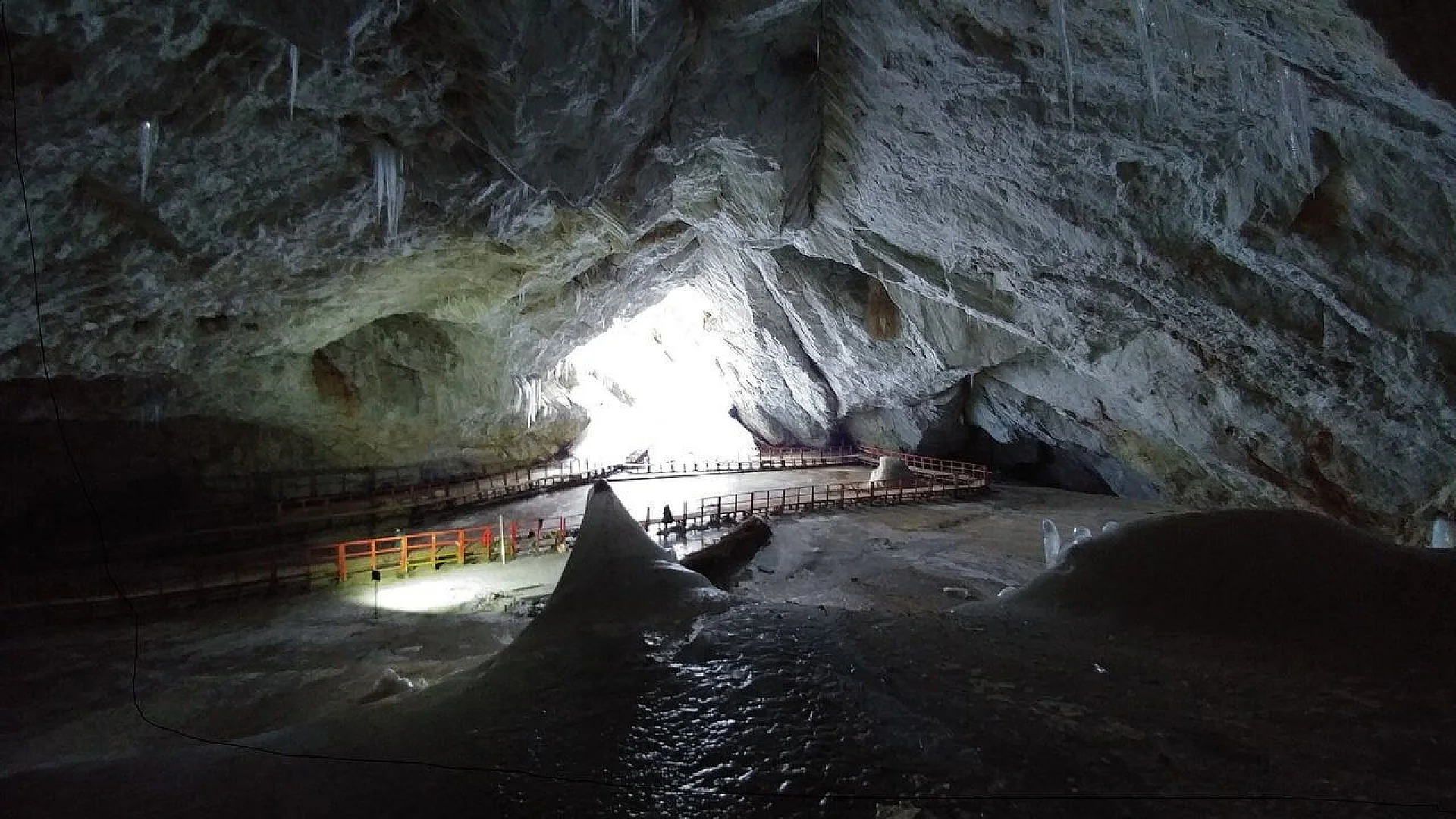
Deep in the Apuseni Mountains of Romania lies Scarisoara Ice Cave, one of Europe’s oldest underground glaciers. For thousands of years, water has frozen layer by layer inside this cave, quietly building a natural archive of the past.
These frozen layers do not just store climate history. They also preserve microscopic life.
From an ice layer estimated to be around 5,000 years old, scientists isolated a bacterium that had survived in the cold for millennia. The strain was named SC65A.3 and belongs to the genus Psychrobacter, a group known for thriving in cold environments.
Now, researchers have sequenced its complete genome. What they found was unexpected.
The study was published in Frontiers in Microbiology on February 17, 2026.
Why Look at Bacteria Trapped in Ancient Ice?
Antibiotic resistance is often described as a crisis created by modern medicine. Overuse and misuse of antibiotics have accelerated the problem. That much is true.
But resistance itself is not new.
Many antibiotics were originally derived from natural compounds produced by microorganisms. In nature, microbes have been competing with each other for millions of years. Some produce antimicrobial substances to gain an advantage. Others evolve ways to survive those attacks.
The collection of all resistance genes in a given environment is called the “resistome.” Scientists are increasingly interested in understanding how old this resistome really is.
Ancient ice provides a rare opportunity. Unlike surface glaciers that melt and refreeze, cave ice can remain stable for thousands of years. That stability allows microorganisms to be preserved in near-isolated conditions.
In other words, ice caves can act like microbial time capsules.
A Cold-Loving Survivor
The strain SC65A.3 was cultured from ice dated to roughly 5,000 years before present. It grows best at low temperatures and is classified as psychrophilic, meaning it prefers cold conditions.
Initial laboratory tests showed that the bacterium produces several active enzymes. Using standardized biochemical testing systems, researchers detected moderate to strong activity of lipases and esterases, enzymes that break down fats and related compounds.
That was only the beginning.
To understand the organism’s full genetic potential, the team performed whole genome sequencing.
Reading the Bacterium’s Genetic Blueprint
The researchers used two sequencing technologies. PacBio long-read sequencing generated large DNA fragments, which helped assemble the genome into a complete structure. Illumina short-read sequencing was then used to correct and refine the sequence with high accuracy.
Advanced bioinformatics tools identified protein-coding genes, ribosomal RNA genes, transfer RNA genes, and other genetic elements.
The final result was the first complete genome sequence of a Psychrobacter strain isolated from millennia-old cave ice.
Comparative analysis showed that SC65A.3 belongs to the species Psychrobacter cryohalolentis, but it also carries distinctive features that set it apart from previously studied strains.
And this is where the story becomes more interesting.
A Wide Range of Antibiotic Resistance Genes
Genome analysis revealed that SC65A.3 carries a broad collection of antimicrobial resistance genes.
These genes are associated with resistance to multiple antibiotic classes, including tetracyclines and rifampicin. Some of these antibiotics are still used in clinical settings today.
Laboratory susceptibility testing confirmed the genomic findings. The strain displayed a multidrug-resistant profile, meaning it was able to tolerate exposure to several different antibiotics under experimental conditions.
This is significant because the bacterium was preserved in ice for around 5,000 years, long before humans began producing antibiotics at an industrial scale.
The researchers describe the resistance system as having two layers. There appears to be a conserved core of resistance-related genes shared across the genus. In addition, there is a more variable accessory set that may reflect adaptation to specific ecological conditions.
This suggests that antibiotic resistance is not simply a modern response to human activity. It is also part of long-standing microbial survival strategies.
Not Just Resistant, But Also Antimicrobial
Interestingly, SC65A.3 does not only resist antibiotics. It also shows antimicrobial activity of its own.
When extracts from the bacterium were tested against 20 clinical bacterial strains and two reference strains, inhibitory effects were observed against several pathogens.
The strain inhibited reference strains of Staphylococcus aureus and Escherichia coli. It also showed activity against multiple Gram-negative bacteria, including Enterobacter, Pseudomonas aeruginosa, and Klebsiella pneumoniae clinical isolates.
In total, 12 out of 20 tested clinical pathogens were inhibited.
This dual behavior, resisting antibiotics while producing substances that inhibit other bacteria, reflects how microbes interact in natural ecosystems. In soil, water, and ice, bacteria compete constantly. Some produce antimicrobial compounds. Others develop defenses. Over time, this leads to a complex genetic arms race.
What we see in hospitals today may be a continuation of that ancient ecological struggle.
Built for Life in the Cold
Beyond resistance genes, the genome of SC65A.3 revealed numerous genes linked to stress response and temperature adaptation.
The researchers identified 45 genes associated with cold and heat stress. Among them were genes such as htpX and htpG, which are involved in maintaining protein stability under stress conditions.
Cold environments create specific challenges. Chemical reactions slow down. Cell membranes can become rigid. Proteins may lose flexibility.
Psychrophilic bacteria compensate by producing enzymes that remain active at low temperatures. These enzymes tend to be more flexible in structure, allowing them to function efficiently in the cold.
That property is valuable beyond the cave.
Enzymes With Industrial Potential
Among the enzymes detected were lipases with both lipolytic and esterase activities. A recombinant enzyme known as Lip2 had previously been cloned from this strain and shown to break down different fat-related molecules.
Lipases are widely used in industries such as food processing, detergent production, pharmaceuticals, and biofuel manufacturing.
Cold-active lipases are particularly useful because they can operate at lower temperatures, which reduces energy consumption and preserves temperature-sensitive materials.
In practical terms, this means that a bacterium preserved in ancient cave ice may contribute to future industrial applications.
Nature, even in frozen isolation, continues to offer biochemical tools.
Environmental Reservoirs of Resistance
The presence of multidrug resistance genes in a remote cave isolate reinforces an important concept.
Resistance genes are not confined to hospitals or agricultural settings. They exist naturally in environmental bacteria.
These environments can serve as reservoirs, storing and circulating resistance determinants long before they appear in human pathogens.
However, this does not mean that ancient cave bacteria are directly causing modern infections. Instead, it highlights the evolutionary depth of resistance mechanisms.
Understanding this background helps scientists trace how resistance genes emerge, move, and diversify.
It also encourages more careful monitoring of environmental microbiomes.
The Challenge of Testing Cold Bacteria
One interesting detail raised by the researchers concerns temperature and antibiotic testing.
Standard antibiotic susceptibility tests are typically performed at 37 degrees Celsius, which reflects human body temperature. But psychrophilic bacteria prefer much lower temperatures.
Testing them at higher temperatures may influence quantitative resistance measurements.
This means that interpreting antibiotic susceptibility in cold-adapted bacteria requires careful methodological consideration.
Small technical details like this matter. They shape how data are understood and compared across different organisms.
A New Reference Genome for Future Studies
The complete genome of SC65A.3 has been deposited in public databases, including GenBank. Its 16S rRNA gene sequence and full genome assembly are now accessible to researchers worldwide.
This makes the strain a reference point for future studies of cold-environment bacteria.
Scientists can compare it with strains from glaciers, permafrost, and polar regions to determine whether similar resistance patterns are common in ancient psychrophiles.
Such comparisons may clarify whether broad resistance profiles are typical features of cold-adapted bacteria or unique to this specific isolate.
What This Discovery Really Means
The genome of SC65A.3 does not announce a medical breakthrough. It does not introduce a new pathogen.
Instead, it quietly expands our understanding of microbial evolution.
It shows that antibiotic resistance is deeply embedded in natural ecosystems. It shows that cold environments harbor organisms with biochemical capabilities relevant to industry. And it reminds us that microbial competition has been ongoing for thousands of years, long before human intervention.
The cave ice did not create these traits. It preserved them.
Questions That Remain
Although the genome reveals many resistance genes, gene presence does not automatically mean constant expression.
Further research is needed to determine how these genes behave under natural cave conditions and whether they are actively expressed or remain dormant.
Another open question concerns survival. Did the bacterium remain metabolically active at very low levels for thousands of years, or did it enter a dormant state?
Understanding these mechanisms could provide insights into microbial longevity and resilience in extreme environments.
Ice as a Biological Archive
Scarisoara Ice Cave functions as more than a geological site. It is a biological archive.
Layer by layer, it stores fragments of past ecosystems. Just as tree rings reveal climate patterns, ice layers can preserve chemical signals and microbial communities.
The discovery of a multidrug-resistant, enzyme-rich bacterium in 5,000-year-old ice adds depth to this archive.
It suggests that ancient environments still hold genetic information relevant to modern challenges.
And as climate change affects frozen habitats worldwide, studying these preserved microorganisms becomes even more important.
A Measured Reminder From the Cold
The findings from SC65A.3 are not dramatic, but they are meaningful.
Antibiotic resistance did not begin in hospitals. It is part of a much older ecological story.
Cold environments are not lifeless. They host organisms with complex survival systems and useful biochemical tools.
And sometimes, when scientists carefully examine a frozen cave, they uncover evidence that the microbial world has been preparing for challenges long before we recognized them.
The ice, in its quiet way, keeps records.
We are only beginning to read them.
The research was published in Frontiers in Microbiology on February 17, 2026.
This content has been reviewed by subject-matter experts to ensure scientific accuracy. Learn more about us and our editorial process.
Last reviewed on .
Article history
- Latest version
- Peer reviewed by Sunita Reddy, MS
Reference(s)
- Paun, Victoria Ioana., et al. “First genome sequence and functional profiling of Psychrobacter SC65A.3 preserved in 5,000-year-old cave ice: insights into ancient resistome, antimicrobial potential, and enzymatic activities.” Frontiers in Microbiology, 17 February 2026, doi: 10.3389/fmicb.2025.1713017. <https://doi.org/10.3389/fmicb.2025.1713017>.
Cite this page:
- Posted by Elizabeth Taylor