Scientists Built a Time Crystal Using Sound and Styrofoam, No Quantum Tricks Needed
A strange form of matter called a time crystal has been created using levitated Styrofoam beads and sound waves, showing that one of physics’ weirdest ideas does not need quantum mechanics at all.
Crystals are easy to understand. You see them everywhere, in salt, sugar, gemstones, even metals. Their atoms line up neatly, repeating the same pattern again and again across space. Move your finger from one part to another, and the structure stays the same.
Now imagine that idea, but replace space with time.
That is the core idea behind a time crystal. Instead of atoms repeating in space, a system repeats its behavior in time. It keeps moving in a steady rhythm, even though nothing is pushing it to do so.
- No ticking clock.
- No shaking.
- No external beat.
For a long time, scientists believed this kind of behavior belonged only to the quantum world, a place ruled by strange rules and fragile experiments. But a new study shows something surprising.
You can make a time crystal using sound waves and tiny Styrofoam beads.
Yes, really.
Time Crystals Sound Like Sci-Fi, But They’re Real
The name “time crystal” sounds dramatic, but the physics idea is very specific.
In normal crystals, the laws of physics allow the structure to repeat in space. Shift the crystal slightly, and everything still lines up.
In a time crystal, the system repeats in time. The motion comes back again and again in a fixed pattern.
The key detail is this. The motion is not forced.
Physicists call this breaking time symmetry. Time flows smoothly, but the system chooses a repeating pattern anyway.
The idea was first proposed in 2012 and caused a lot of debate. Many scientists thought it might not even be possible. Later experiments proved time crystals could exist, but only in quantum systems using lasers, ultra-cold temperatures, and carefully controlled particles.
That made time crystals feel distant and expensive.
This new experiment changes that picture completely.
From Quantum Labs to a Tabletop Experiment
Instead of using atoms or quantum bits, the researchers used polystyrene beads. Each bead was only a millimeter or two wide, about the size of a grain of sand.
Instead of lasers or magnets, they used sound.
The team was not even trying to make a time crystal. They were studying something else, known as non-reciprocal interactions. These are interactions where forces between objects are not equal in both directions.
That detail turned out to be the secret.
How Sound Can Make Objects Float
Sound waves are more powerful than we usually think. Under the right conditions, they can push objects around.
When sound waves bounce back and forth in a controlled way, they form a standing wave. In this kind of wave, some regions stay stable, neither moving forward nor backward.
Light objects can get trapped in these regions.
The polystyrene beads used in the experiment are perfect for this. They are light enough to float on sound waves but strong enough to keep their shape.
Once levitated, the beads are suspended in midair, held in place by sound alone.
It already looks impressive. But the real magic happens when the beads start interacting.
Tiny Differences That Change Everything
The beads are not perfectly identical. Some are slightly larger. Some are a bit more rounded. These tiny differences matter.
Each bead scatters sound waves around it. A larger bead disturbs the sound field more strongly than a smaller one.
This creates an imbalance.
The force that bead A applies to bead B is not the same as the force bead B applies back. This is a non-reciprocal interaction.
These kinds of interactions are common in sound and light systems, but they are usually very weak and hard to isolate. In this setup, they are clean and easy to study.
And under just the right conditions, something unexpected happens.
A Rhythm With No One Setting the Beat
Nothing in the experiment was designed to move rhythmically.
The sound field itself had no beat. No one shook the setup. No timing signal was added.
Yet the beads began to move.
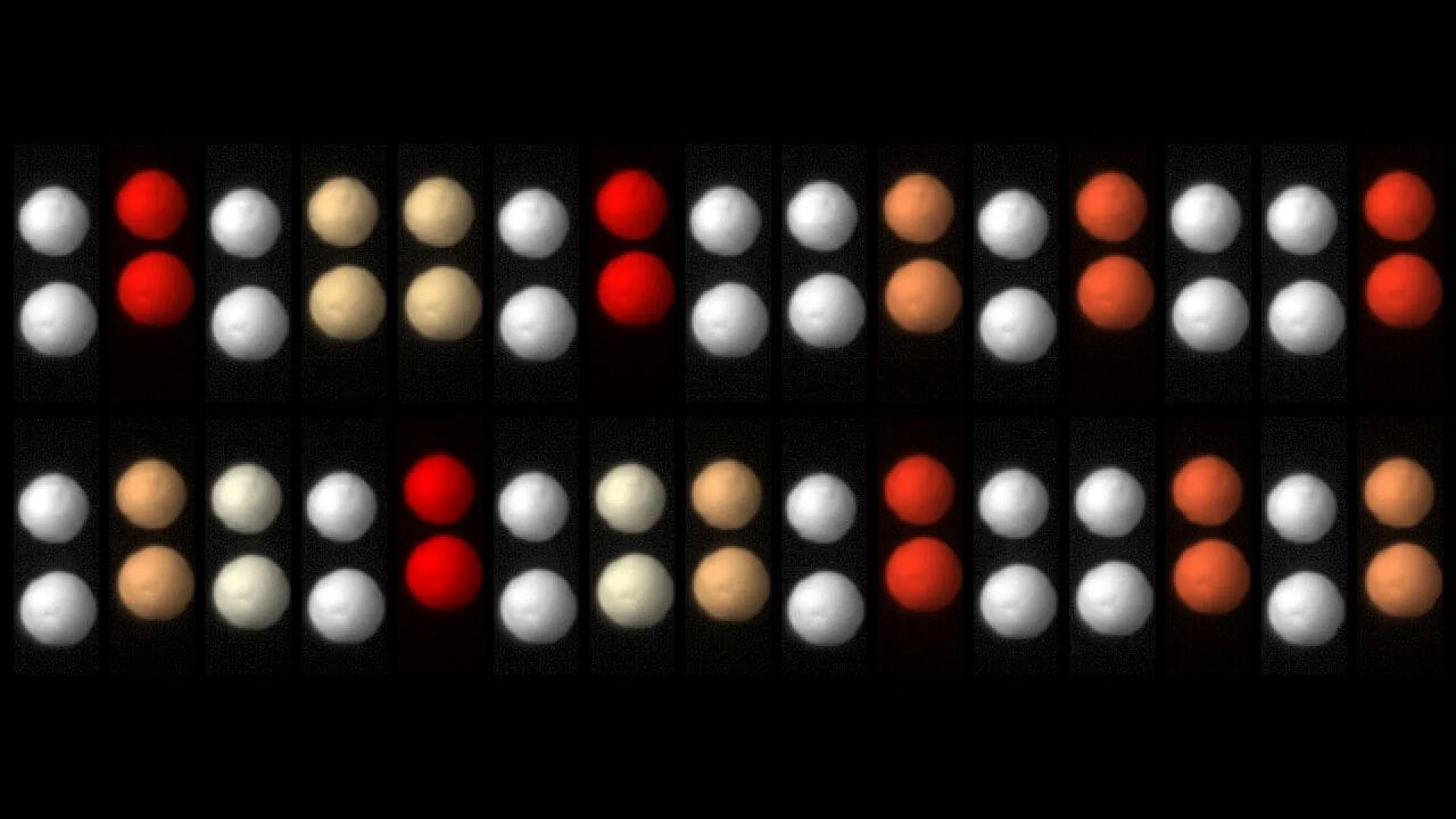
They oscillated back and forth in a repeating pattern. Once the motion started, it did not fade away. The beads settled into a stable rhythm that lasted for hours.
This is the defining feature of a time crystal.
The motion did not come from outside. It emerged naturally from the interaction between the beads and the sound waves.
Time symmetry was broken, all on its own.
Why Two Beads Are Enough
Even more surprising, the time crystal appeared with just two beads.
That is the smallest possible system that could show this behavior.
Usually, scientists expect complex behavior to require many interacting parts. Here, the system is simple enough that every force can be understood.
This makes it a powerful teaching tool and a perfect testing ground for theory.
It also sends a clear message. Time crystals are not rare, fragile oddities. They can emerge from very basic ingredients.
Classical Physics Steps Into the Spotlight
This system is fully classical. It follows everyday physics, not quantum rules.
That is a big deal.
Classical systems are easier to control, easier to observe, and easier to modify. You can see what is happening directly, instead of inferring it from indirect measurements.
The experiment also shows that imperfections are not always a problem. In this case, the small differences between beads are essential. Without them, the time crystal would not exist.
This insight could help scientists find other classical systems that behave in similar ways.
Why Non-Reciprocal Forces Matter
Beyond time crystals, this work highlights the importance of non-reciprocal interactions.
These unbalanced forces appear in many areas of physics. They also show up in chemistry and even biology, where processes do not always reverse cleanly.
This does not mean your body clocks are time crystals. But it does suggest that similar principles might appear in living systems in subtle ways.
By studying clean, simple examples in the lab, scientists can build better intuition for complex real-world systems.
Why This Matters
Big Ideas Don’t Always Need Big Machines
One of the most exciting parts of this discovery is its simplicity.
You do not need billion-dollar equipment to explore deep physical ideas. Sometimes, clever design and basic tools are enough.
That opens the field to more labs, more students, and more creative experiments.
A Broader View of Time Crystals
This work changes how scientists think about time crystals. They are not limited to the quantum world. They are a general kind of order that can appear wherever the conditions are right.
That realization could lead to new discoveries in unexpected places.
What This Discovery Does Not Claim
There are no immediate applications here. The researchers are clear about that.
This is fundamental science, not a new technology. It also does not mean every repeating motion is a time crystal. The key feature is spontaneous motion without an external driver.
Still, history shows that today’s basic discoveries often become tomorrow’s tools.
What Comes Next
Because the system is so simple, many questions are now easy to explore.
- What happens if more beads are added?
- Can the rhythm be tuned or controlled?
- Do more complex patterns appear?
These questions are much easier to test in a classical system than in a fragile quantum one.
Sometimes Physics Is Surprisingly Simple
There is something quietly beautiful about this result.
One of physics’ strangest ideas turns out to work with Styrofoam beads and sound waves. No quantum tricks required.
It is a reminder that nature often hides deep truths in plain sight, waiting for someone curious enough to notice.
The research was published in Physical Review Letters on February 06, 2026.
This content has been reviewed by subject-matter experts to ensure scientific accuracy. Learn more about us and our editorial process.
Last reviewed on .
Article history
- Latest version
Reference(s)
- Morrell, Mia C.., et al. “Nonreciprocal Wave-Mediated Interactions Power a Classical Time Crystal.” Physical Review Letters, 06 February 2026, doi: 10.1103/zjzk-t81n. <https://doi.org/10.1103/zjzk-t81n>.
Cite this page:
- Posted by John Williams