Genius Chimpanzee Who Learned Human Symbols Leaves a Lasting Legacy for Science
A chimpanzee named Ai, famous for recognizing Chinese characters, letters, numbers, and colors, has died at 49, leaving behind decades of research that reshaped how scientists understand animal intelligence.
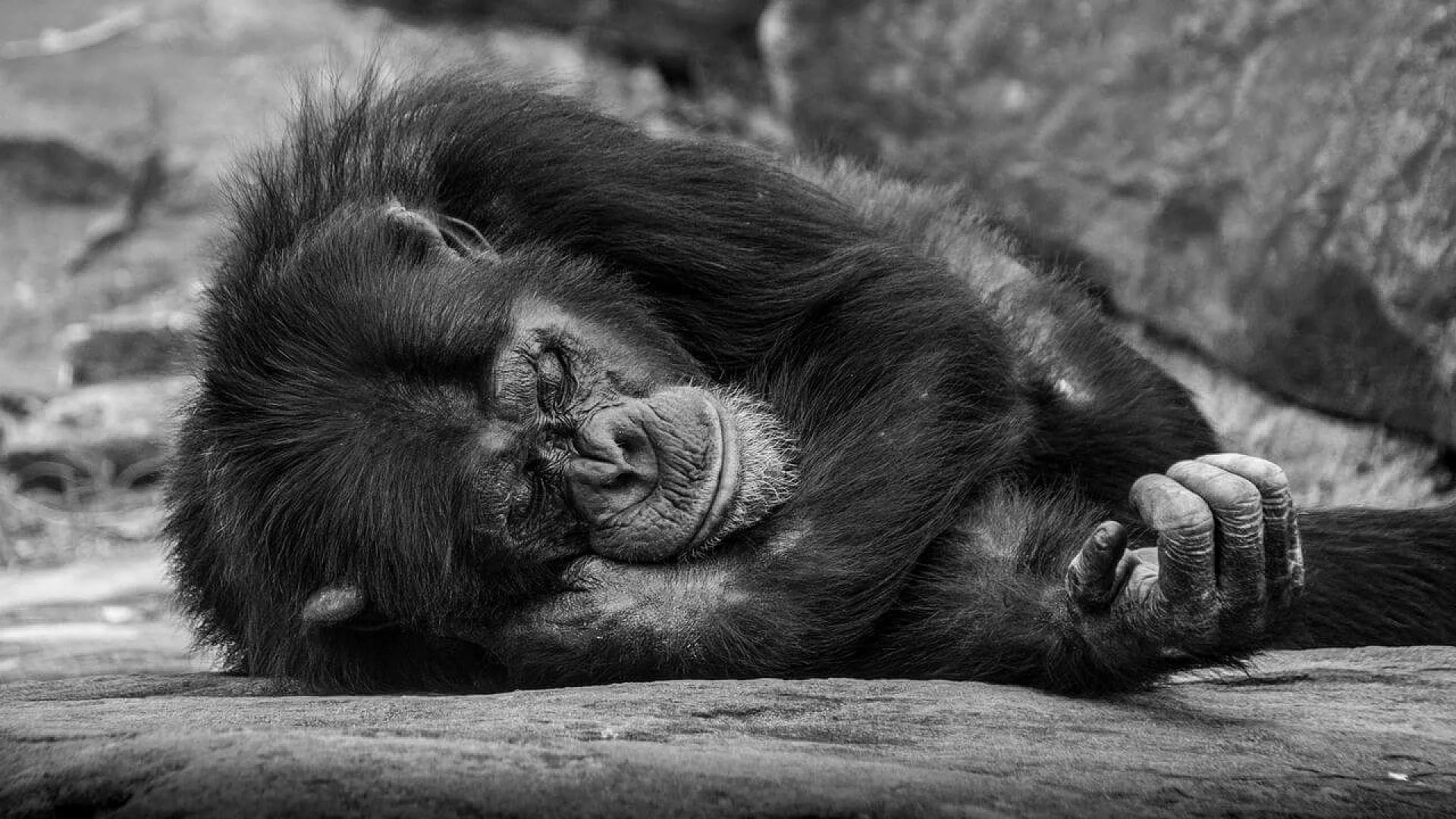
What separates human thinking from the minds of other animals has long been one of science’s most persistent questions. Language, symbols, and abstract reasoning have often been placed at the center of that divide. Yet, for researchers at Kyoto University in Japan, a chimpanzee named Ai steadily blurred those boundaries, not through spectacle, but through years of careful observation and testing.
Ai, described by scientists as exceptionally capable, died at the age of 49 from multiple organ failure related to old age. Her passing was announced by the Center for the Evolutionary Origins of Human Behavior at Kyoto University, where she had lived and participated in research for most of her life. Although her death marks the end of an individual life, it also invites reflection on how profoundly she reshaped scientific understanding of primate cognition.
Rather than serving as a curiosity, Ai became a cornerstone of modern research into how non-human minds perceive, learn, and remember. Her abilities forced scientists to reconsider how symbolic understanding evolved and how much of what humans consider uniquely “ours” may, in fact, have deeper biological roots.
A Life Dedicated to Understanding the Primate Mind
Ai arrived at Kyoto University in 1977, part of a long-term research effort focused on comparative cognition. From the beginning, she was not treated as a trained performer, but as a participant in structured experiments designed to explore how chimpanzees process information.
Over time, her abilities became increasingly apparent. Researchers found that Ai could recognize more than 100 Chinese characters, along with the English alphabet. She was also able to identify Arabic numerals from zero to nine and distinguish at least 11 different colors.
These achievements were not the result of rote conditioning alone. According to primatologist Tetsuro Matsuzawa, who worked closely with Ai, her responses showed flexibility and understanding that went beyond simple stimulus and reward. She did not merely memorize symbols. She demonstrated the capacity to connect symbols with meanings and apply that knowledge in new contexts.
This distinction mattered deeply to scientists. It suggested that chimpanzees are capable of forming mental representations that resemble, in limited but meaningful ways, the symbolic thinking humans rely on for language and mathematics.
Seeing Meaning Where Humans See Symbols
One of the most striking demonstrations of Ai’s abilities involved her interaction with a computer screen. In a well-known experiment, Ai was shown the Chinese character for the color pink. Alongside it appeared two colored squares, one pink and one purple. Ai consistently selected the correct pink square, indicating that she had learned to associate the abstract symbol with a specific visual property.
In another task, researchers showed her an image of an apple. Rather than selecting a single icon, Ai chose a combination of shapes, a rectangle, a circle, and a dot, to construct what scientists described as a “virtual apple” on the screen. This behavior revealed an ability to decompose an object into conceptual parts and then reassemble them symbolically.
Such experiments were designed not to test obedience, but comprehension. They asked whether a chimpanzee could recognize relationships between symbols and real-world objects, a foundational aspect of human cognition.
The results suggested that Ai was not simply responding to familiar patterns. She was engaging with representations, a process central to reading, writing, and abstract thought.
Why These Findings Mattered to Science
Before studies like those involving Ai, many theories of cognition placed a sharp divide between human and animal minds. Symbolic thought, especially the use of written symbols, was often cited as a defining human trait.
Ai’s performance complicated that narrative. While she did not read or write in the human sense, her ability to recognize written characters and associate them with colors, numbers, and objects indicated that the building blocks of symbolic cognition are not exclusive to humans.
This realization had broad implications. It suggested that the evolutionary roots of human intelligence extend further back than previously assumed. Instead of emerging suddenly, symbolic thinking may have developed gradually, building on cognitive capacities already present in common ancestors of humans and chimpanzees.
As the Center for the Evolutionary Origins of Human Behavior noted, Ai’s studies helped establish “an experimental framework for understanding the chimpanzee mind,” one that provided a crucial foundation for considering how the human mind evolved.
A Research Subject, Not a Performer
Popular media often labeled Ai a “genius,” a term that helped capture public attention but risked oversimplifying her role in science. Researchers were careful to emphasize that Ai was not exceptional because she mimicked humans, but because her behavior revealed what chimpanzees are capable of under the right conditions.
Her participation in experiments was voluntary and marked by curiosity. According to researchers, she actively engaged with tasks, often appearing motivated by the challenge itself rather than by rewards alone. This willingness allowed scientists to design increasingly sophisticated experiments that probed perception, memory, and learning.
Over the years, Ai became the subject of numerous scholarly papers, including studies published in the journal Nature. Her work also featured in documentaries and media programs, helping to bring complex questions about cognition to a broader audience.
Yet within the research community, her significance lay less in headlines and more in data. Each experiment added a small but critical piece to a larger puzzle about how minds work across species.
The Role of Memory and Learning
Beyond symbol recognition, Ai contributed to a deeper understanding of memory in chimpanzees. Tasks often required her to recall symbols, colors, or sequences after delays, providing insights into how information is stored and retrieved.
These studies showed that chimpanzee memory can be both robust and flexible. Rather than relying on a single strategy, Ai adapted her responses depending on the task, a sign of cognitive control.
Such findings helped challenge simplistic views of animal learning as purely associative. Instead, they supported the idea that primates use multiple cognitive strategies, some of which parallel those used by humans.
A Mother and a New Generation of Research
Ai’s influence extended beyond her own performance. In 2000, she gave birth to a son, Ayumu, whose abilities soon attracted scientific attention. Studies involving mother and child provided rare opportunities to examine how knowledge and skills might be transferred across generations in non-human primates.
Researchers observed interactions between Ai and Ayumu to explore whether learning occurred through observation, imitation, or shared experience. These studies contributed to a growing body of evidence that social learning plays a significant role in chimpanzee development.
Understanding how young chimpanzees acquire cognitive skills has important implications for evolutionary biology. It sheds light on how early humans may have passed knowledge from one generation to the next, long before the emergence of written language.
Why This Matters
The story of Ai matters because it reframes a fundamental question: what does it mean to think symbolically? By demonstrating that a chimpanzee could engage with written characters and abstract representations, Ai showed that the cognitive gap between humans and other primates is narrower and more nuanced than once believed.
This does not diminish human intelligence. Instead, it enriches it by placing human cognition within an evolutionary continuum. Recognizing shared capacities helps scientists better understand both where humans come from and what makes them distinctive.
Ai’s life also highlights the value of long-term research. Her achievements were not the result of a single experiment, but of decades of patient, ethical scientific inquiry. Such work requires sustained commitment, careful methodology, and respect for the animals involved.
The End of a Remarkable Life
Ai died from multiple organ failure and age-related ailments, a natural end to a long life by chimpanzee standards. She was 49 years old, an age that reflects both good care and the relatively long lifespan chimpanzees can achieve in research settings.
In a statement, the Center for the Evolutionary Origins of Human Behavior described her as “highly curious” and noted that she revealed “various aspects of the chimpanzee mind for the first time.” These words underscore how central she was to the institution’s scientific mission.
Her death was reported by Japanese researchers and covered by Kyodo News, reminding the public that behind every data point is a living being whose experiences shape scientific understanding.
An Enduring Scientific Legacy
Although Ai is gone, the questions she helped raise remain active areas of research. Scientists continue to explore how animals perceive symbols, how memory operates across species, and how cognitive abilities evolve.
Data collected from Ai’s decades of participation will likely be analyzed and reinterpreted for years to come, especially as new theories and technologies emerge. In this way, her contributions continue to inform science long after her passing.
Perhaps most importantly, Ai’s life serves as a reminder that intelligence is not a simple hierarchy with humans at the top and all other species below. Instead, it is a complex landscape shaped by evolution, environment, and opportunity.
This article has been fact checked for accuracy, with information verified against reputable sources. Learn more about us and our editorial process.
Last reviewed on .
Article history
- Latest version
- Last updated by Dayyal Dungrela, MLT, BSc, BS
Reference(s)
- Matsuzawa, Tetsuro. “Use of numbers by a chimpanzee.” Nature, vol. 315, no. 6014, 02 May 1985, pp. 57-59., doi: 10.1038/315057a0. <https://www.nature.com/articles/315057a0>.
- 井上. “Genius Chimpanzee Ai Dies at Age 49, Primate Known for Enthusiastic Role in Research on Learning, Memory.”, 11 January 2026 The Japan News <https://japannews.yomiuri.co.jp/society/general-news/20260111-303426>.
Cite this page:
- Posted by Zara Tariq