A Wolf Pup’s Last Meal Revealed a Stunning Truth About the Woolly Rhinoceros’ Extinction
A genome recovered from a 14,400-year-old wolf pup’s stomach shows woolly rhinoceroses were not genetically collapsing before extinction, pointing instead to a rapid environmental tipping point.
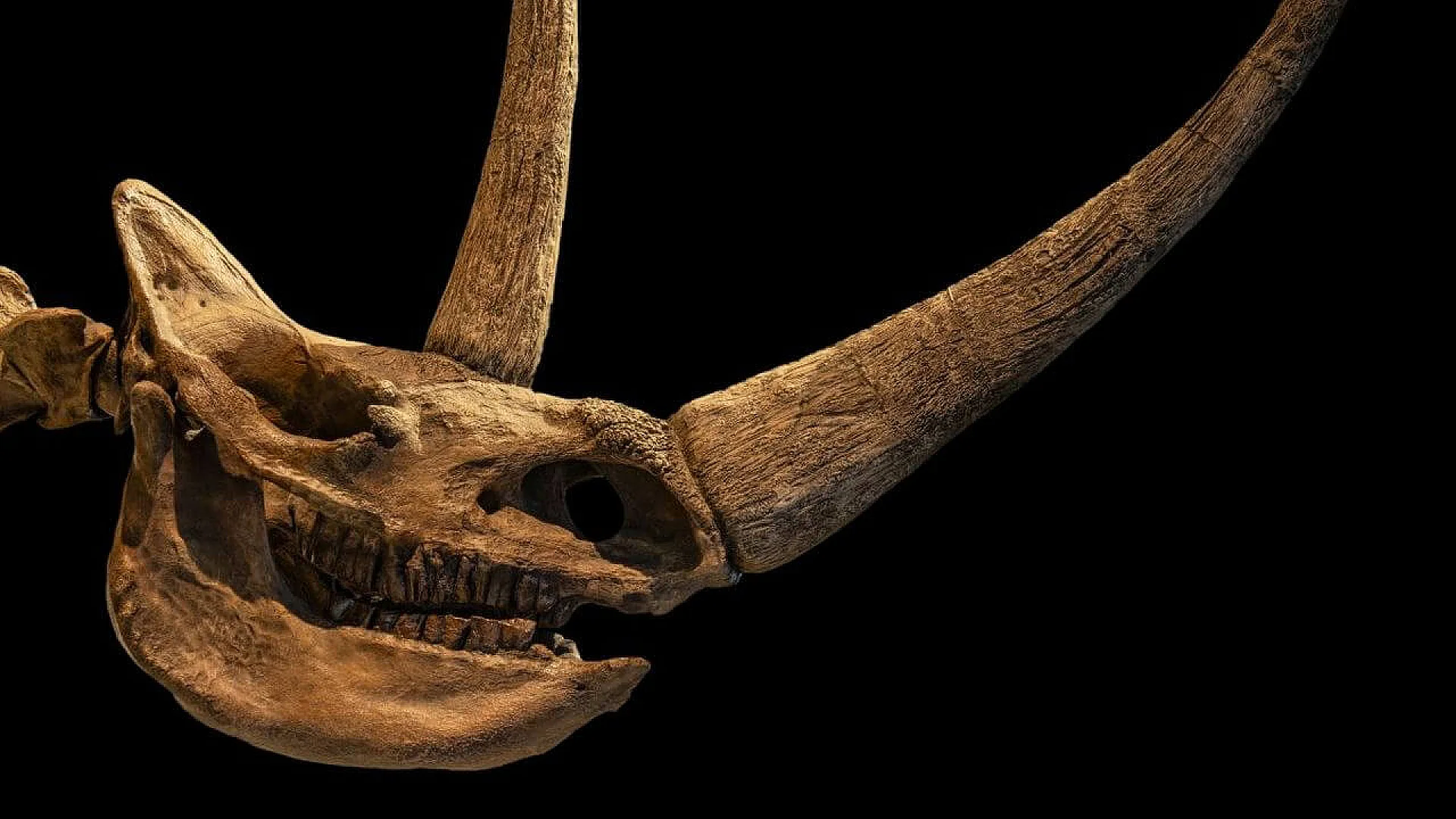
Fourteen thousand years ago, a young wolf prowled the frozen lowlands of what is now northeastern Siberia. It fed, as wolves do, on the flesh of large herbivores that roamed the Ice Age steppe. Shortly after its last meal, the pup died and was entombed in permafrost, its body sealed away from decay.
That final meal would wait millennia to tell its story.
When scientists later examined the mummified wolf, they found something extraordinary inside its stomach, a small piece of tissue that did not belong to a wolf at all. Genetic testing revealed it came from a woolly rhinoceros, one of the most iconic megafauna of the Ice Age. Radiocarbon dating placed the tissue at about 14,400 years old, perilously close to the time when woolly rhinoceroses vanished from the fossil record.
What followed was a rare scientific opportunity. Using this unexpected biological time capsule, researchers were able to reconstruct a high-quality genome from a woolly rhinoceros that lived near the very end of the species’ existence. The genetic portrait that emerged challenges long-standing ideas about why these massive animals disappeared.
The Usual Story of Extinction, and Why It Matters
When species edge toward extinction, their populations typically shrink and fragment. With fewer individuals left to mate, genetic diversity declines. Harmful mutations accumulate. Inbreeding increases. Over time, this process, known as genomic erosion, can weaken populations and accelerate their collapse.
This pattern has been observed in many endangered and extinct animals, from island birds to mammoths and modern rhinoceros species. It has shaped how scientists think about extinction, not as a sudden event, but as a long genetic unraveling.
For the woolly rhinoceros, which survived multiple ice ages only to disappear near the end of the last one, many researchers assumed a similar slow genetic decline preceded its extinction. Until now, there was no way to test that idea using genomes from individuals that lived right at the brink.
The wolf pup’s stomach changed that.
Extracting a Genome From an Unlikely Source
Recovering ancient DNA is notoriously difficult, especially from samples that are degraded or contaminated. The tissue inside the wolf’s stomach was no exception. It had endured digestion, freeze-thaw cycles, and thousands of years underground.
To overcome this, scientists divided the tissue into dozens of tiny fragments and performed multiple DNA extractions, carefully selecting those with the highest quality genetic material. They then sequenced the DNA at high coverage, meaning each part of the genome was read many times, reducing errors and increasing confidence in the results.
The recovered genome, known as Tumat_14k, became one of the youngest and most complete woolly rhinoceros genomes ever assembled. To place it in context, researchers compared it with two older woolly rhinoceros genomes from Siberia, dated to about 18,000 and 49,000 years ago.
Together, these genomes offered a rare window into how the species changed, or did not change, as extinction approached.
A Genetic Stability That Defied Expectations
What the researchers found was startling.
Across all three genomes, genetic diversity was remarkably similar. The near-extinction rhinoceros showed no signs of the genetic deterioration typically expected in a species on the verge of disappearing. Measures of genome-wide heterozygosity, a key indicator of genetic variation, remained stable across tens of thousands of years.
Even more striking was the lack of evidence for recent inbreeding. Scientists examined long stretches of identical DNA, known as runs of homozygosity, which can indicate mating between close relatives. In many endangered species, these stretches grow longer and more frequent as populations shrink.
In the woolly rhinoceros genomes, most homozygous regions were short, consistent with ancient population history rather than recent inbreeding. Long segments that would signal close kin mating were rare, even in the individual that lived closest to extinction.
The genetic load, meaning the accumulation of potentially harmful mutations, also showed no increase over time. In short, the woolly rhinoceros genome near extinction looked surprisingly healthy.
If Not Genetics, Then What Killed the Woolly Rhinoceros?
The findings force a reevaluation of what drove the woolly rhinoceros to extinction.
If genetic collapse was not underway, then the species likely did not fade away slowly under the weight of inbreeding and mutation. Instead, the evidence points toward a rapid and severe external pressure.
Climate is the leading suspect.
Around 14,700 years ago, Earth entered a period known as the Bølling–Allerød interstadial, a time of abrupt warming near the end of the last Ice Age. In Siberia, this warming transformed cold, dry grasslands into wetter landscapes with expanding shrubs and forests.
For animals like the woolly rhinoceros, which were highly adapted to open steppe environments, these changes would have been devastating. Food sources shifted. Suitable habitat shrank. Even large, genetically stable populations can collapse quickly when their ecological niche disappears.
The genomic data suggest that when extinction came, it came fast, too fast to leave a detectable genetic scar.
A Stable Population Until the Very End
By reconstructing past population sizes from the genomes, the researchers found that woolly rhinoceroses maintained a relatively stable, though low, effective population size from about 30,000 years ago until close to extinction.
There was no gradual slide into genetic isolation. No slow tightening of the evolutionary noose.
Instead, the population appears to have persisted, genetically intact, until environmental conditions crossed a critical threshold. Once that threshold was breached, extinction likely followed within a few centuries or less.
This pattern mirrors what is increasingly seen in other Ice Age extinctions, where rapid climate shifts, rather than long-term genetic decay, seem to have played a decisive role.
Rethinking How Extinction Unfolds
The woolly rhinoceros genome adds nuance to our understanding of extinction. It shows that genetic health alone cannot guarantee survival. A species can be genetically stable and still be vulnerable to sudden environmental upheaval.
This has important implications for modern conservation.
Many endangered species today are monitored for signs of inbreeding and genetic erosion, and rightly so. But the woolly rhinoceros serves as a reminder that preserving habitat and buffering ecosystems against rapid change may be just as critical.
Extinction does not always announce itself through a slow genetic decline. Sometimes, it arrives abruptly, triggered by forces outside a species’ evolutionary control.
Lessons Frozen in the Permafrost
The study also highlights the growing power of ancient DNA research. Recovering a high-quality genome from such an unlikely source demonstrates that valuable genetic information may be hiding in unexpected places, from stomach contents to sediments and beyond.
As permafrost thaws and new discoveries emerge, scientists may uncover more genetic snapshots from pivotal moments in evolutionary history. Each one has the potential to reshape how we understand the past, and how we plan for the future.
In the case of the woolly rhinoceros, a wolf pup’s last meal has revealed that extinction can be swift, unforgiving, and driven by sudden change rather than slow decline.
It is a sobering lesson, written not in bones or fossils, but in ancient DNA.
The research was published in Genome Biology and Evolution on January 14, 2026.
This article has been fact checked for accuracy, with information verified against reputable sources. Learn more about us and our editorial process.
Last reviewed on .
Article history
- Latest version
- Last updated by Dayyal Dungrela, MLT, BSc, BS
Reference(s)
- Guðjónsdóttir, Sólveig M., et al. “Genome Shows no Recent Inbreeding in Near-Extinction Woolly Rhinoceros Sample Found in Ancient Wolf's Stomach.” Genome Biology and Evolution, vol. 18, no. 1, 14 January 2026, doi: 10.1093/gbe/evaf239. <https://academic.oup.com/gbe/article/18/1/evaf239/8414728>.
Cite this page:
- Posted by Zara Tariq