Uranus’ Magnetic Shield Breathes Daily, Changing Bow Shock as Planet Spins
Study shows Uranus’s odd rotation stretches its bow shock, causing it to expand and contract every planetary day.
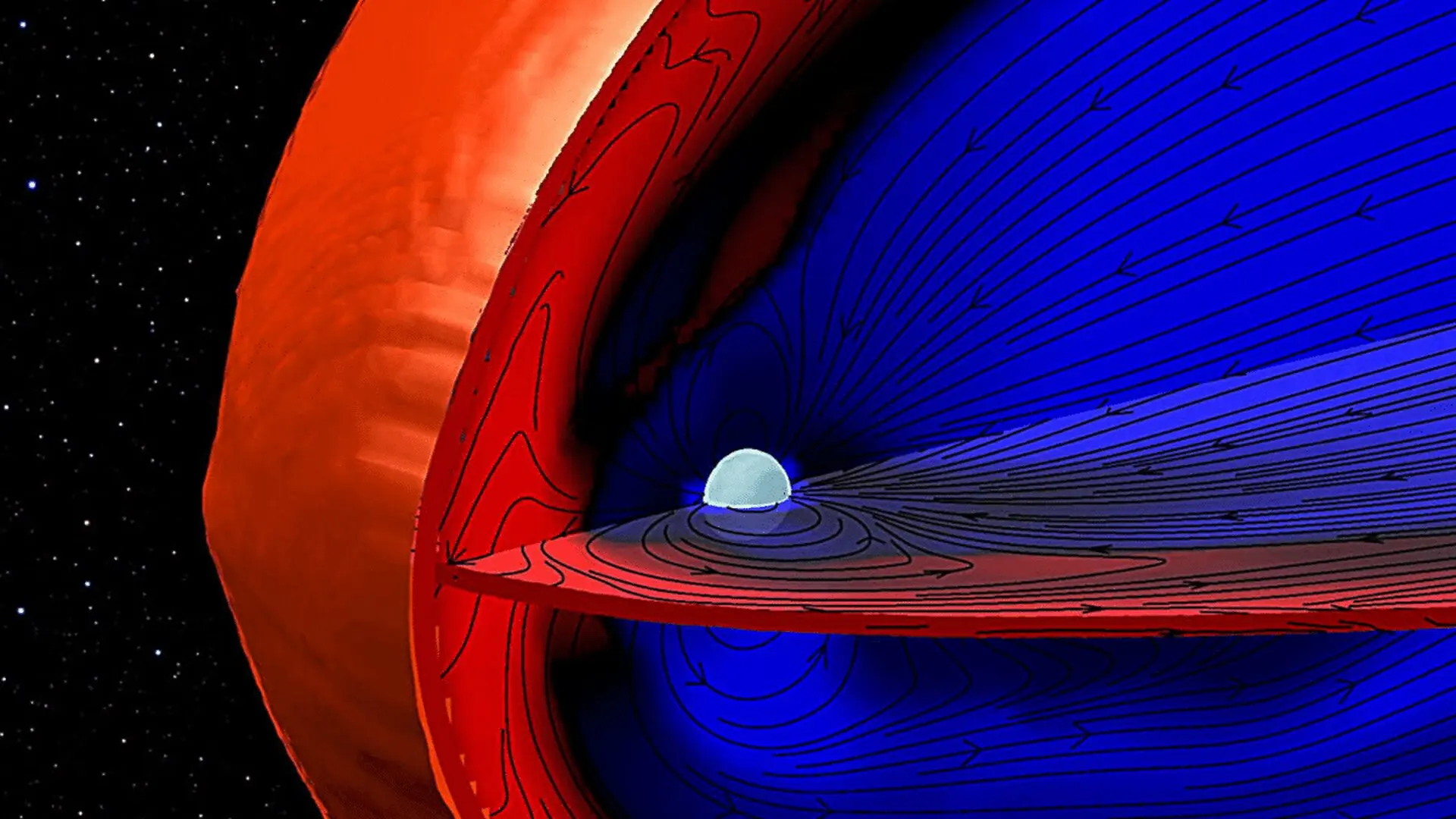
New simulations reveal that the ice giant Uranus reshapes its bow shock on a daily basis, driven by the planet’s extreme axial tilt and an offset magnetic field. The study, appearing in AGU Advances, demonstrates that Uranus’s interaction with the solar wind is far more variable than the comparatively stable boundaries observed around Earth and many other worlds.
Uranus spins nearly on its side, with an axial tilt exceeding 90 degrees relative to its orbital plane, while its magnetic dipole is both highly inclined and displaced from the planetary core. By coupling high‑resolution computer models with data gathered by NASA’s Voyager 2, researchers tracked how these peculiar conditions reshape the planet’s bow shock over the span of a single Uranian day.
The analysis portrays a system that behaves like a breathing magnetosphere, with the outermost shield expanding and contracting as the planet rotates through interplanetary space.
Unique Magnetic Geometry Generates a Shifting Bow Shock
A bow shock forms where the solar wind—a continuous stream of charged particles from the Sun—encounters a planet’s magnetic field and decelerates sharply. On Earth, this boundary remains relatively steady, fluctuating mainly in response to solar activity.
Uranus, however, presents a starkly different scenario. The planet’s rapid rotation continuously alters the angle between its magnetic field and the incoming solar wind. Because the magnetic axis is both tilted and offset, distinct portions of the field face the solar wind at different times during each rotation.
The researchers discovered that this geometry forces the bow shock to reconfigure repeatedly, producing a regular pattern that persists even when solar wind conditions stay constant.
These dynamics position Uranus as a natural laboratory for probing how planetary magnetospheres respond to extreme tilts and rotations, offering clues about the behavior of similarly misaligned worlds throughout the galaxy.
Voyager 2 Data Unlocks Uranus’s Hidden Magnetospheric Rhythm
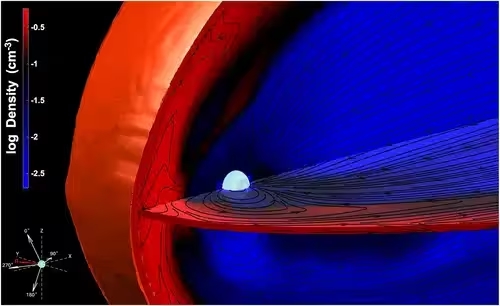
Published in AGU Advances, the work by X. Cao and collaborators employed those measurements to construct a three‑dimensional multifluid magnetohydrodynamic model that simulates how a planet’s magnetosphere confronts the solar wind. The model focused on the equinox configuration, when solar illumination aligns directly over the equator and bow shock variability becomes most pronounced.
Running the model over an entire Uranian rotation, the team compared scenarios with constant solar wind conditions to isolate the driver of the observed changes.
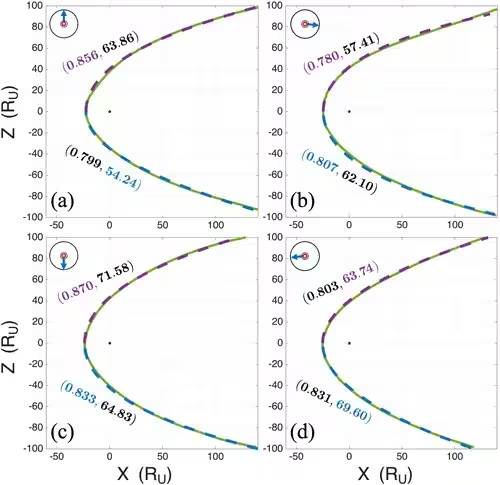
Findings indicate that the planet’s rotation alone can generate the daily expansion‑contraction cycle of the bow shock, separating internal geometric effects from external solar influences and clarifying the operation of Uranus’s magnetic shield.
Rotation‑Driven Magnetospheric Breathing, Not Solar Storms
The simulations demonstrate that the daily shift of Uranus’s magnetic field dictates the movement of its bow shock. As the planet turns, the magnetic orientation changes, pushing the magnetospheric boundary outward and pulling it back inward.
By contrast, Earth’s magnetic axis aligns closely with its rotation axis, limiting daily effects on its bow shock; variations in solar wind pressure dominate the Earth’s boundary dynamics.
Uranus thus exemplifies how extreme misalignments between magnetic and rotational axes can produce repetitive, internally driven magnetospheric patterns that are independent of solar conditions.
These insights broaden our grasp of planetary magnetic environments and provide a benchmark for interpreting the magnetospheres of distant ice‑giant exoplanets that may share similar tilted fields and rapid spins.
This article has been fact checked for accuracy, with information verified against reputable sources. Learn more about us and our editorial process.
Last reviewed on .
Article history
- Latest version
Reference(s)
- Cao, X.., et al. “Rotation‐Controlled Diurnal Evolution of Uranus' Asymmetric Bow Shock at Equinox.” AGU Advances, vol. 7, no. 3, June 24, 2026 American Geophysical Union (AGU), doi: 10.1029/2026AV002307. <https://agupubs.onlinelibrary.wiley.com/doi/10.1029/2026AV002307>.
Cite this page:
- Posted by Karan Das