Galaxy Blurring Reveals How Telescope Resolution Distorts Our View of Star Formation
A new study of the Magellanic Clouds shows that coarse telescope views erase extreme gas structures and shift chemical diagnostics.
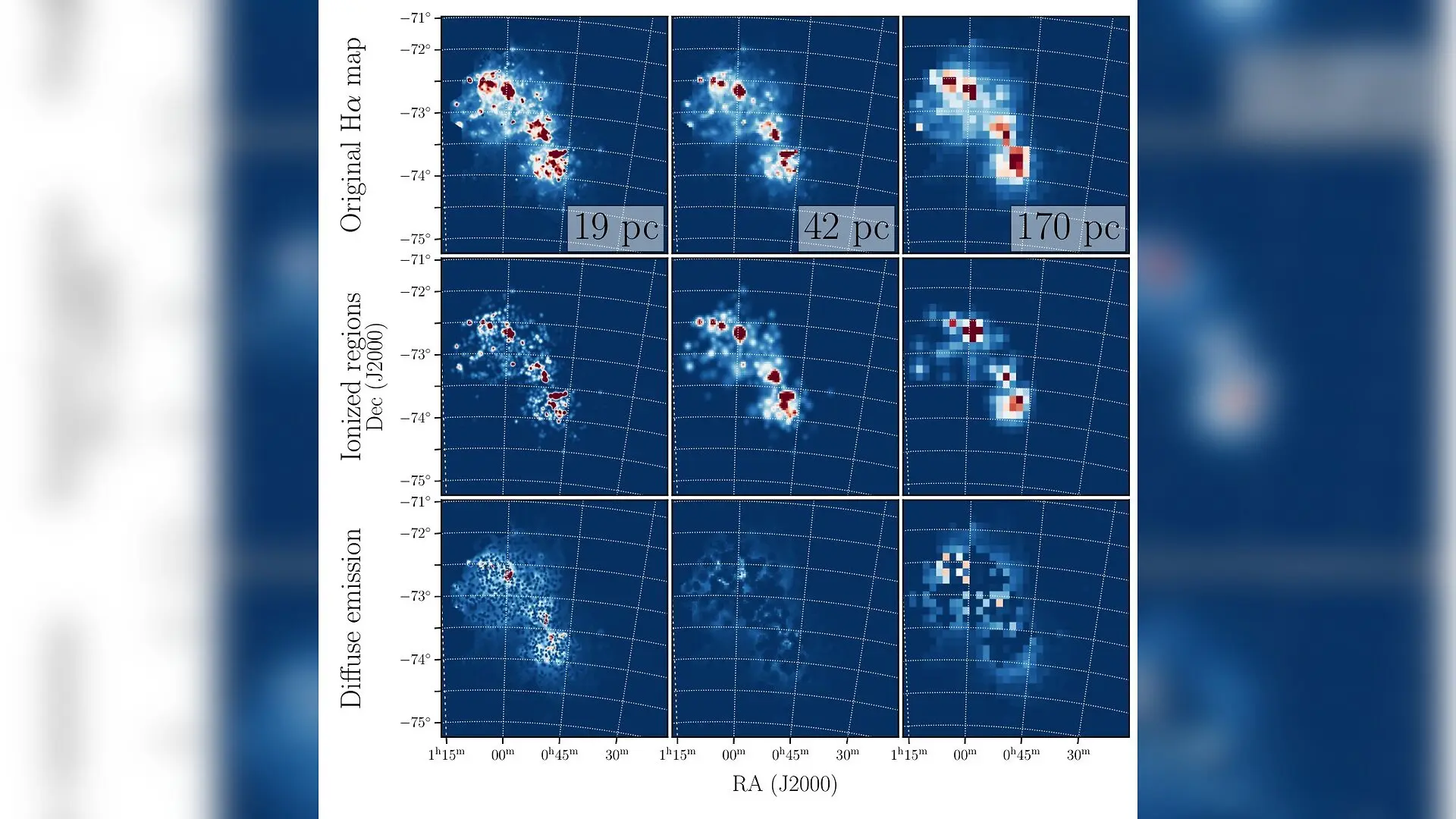
When astronomers blur the view of nearby dwarf galaxies down to coarser resolutions, the fine details of their ionized gas vanish, revealing how distance distorts our view of the early Universe. A team of researchers investigated how spatial resolution affects the chemical and physical diagnostics of the interstellar medium in the Large Magellanic Cloud and the Small Magellanic Cloud, two metal-poor satellite galaxies orbiting the Milky Way at distances of roughly 50,000 to 60,000 light-years. By using wide-field integral-field spectroscopy data from the Local Volume Mapper survey, available on the arXiv preprint server, the authors tested how degrading the view from sub-parsec scales up to hundreds of parsecs alters standard diagnostic charts.
How Blurring Erases Cosmic Extremes
The Small Magellanic Cloud is roughly 200,000 light-years across in volume terms and sits at a distance of about 62,440 light-years, while the larger Large Magellanic Cloud spans about 49,970 light-years away. At the sharpest views of 17 to 19 parsecs, the telescope data exposes a complex web of compact star-forming clumps surrounded by glowing diffuse gas. But when the scientists artificially degraded those maps to simulate coarser views of 170 to 272 parsecs, individual structures merged together into smooth, averaged zones. On average, about 82 percent of discrete region detections vanished at each step of degradation as neighboring structures blended into the background.
This spatial averaging creates a strong homogenization effect across diagnostic charts. Extreme values present at fine scales, such as intense ionization spikes or rapid gas velocities, are diluted. As a result, the data points collapse toward the mean values of the distribution, masking the true physical diversity happening inside the gas clouds.
Why Low-Ionization Ratios Suffer Most
The team analyzed six standard diagnostic frameworks, including classical BPT diagrams that compare hydrogen recombination lines against collisionally excited forbidden lines like ionized oxygen and nitrogen. The results indicate that ionization and density sensitive ratios, particularly those involving oxygen, sulfur, and nitrogen relative to hydrogen, are the most heavily impacted by resolution loss. For instance, low-ionization sulfur and nitrogen lines show significant deviations even at intermediate scales of around 42 parsecs in the Small Magellanic Cloud.
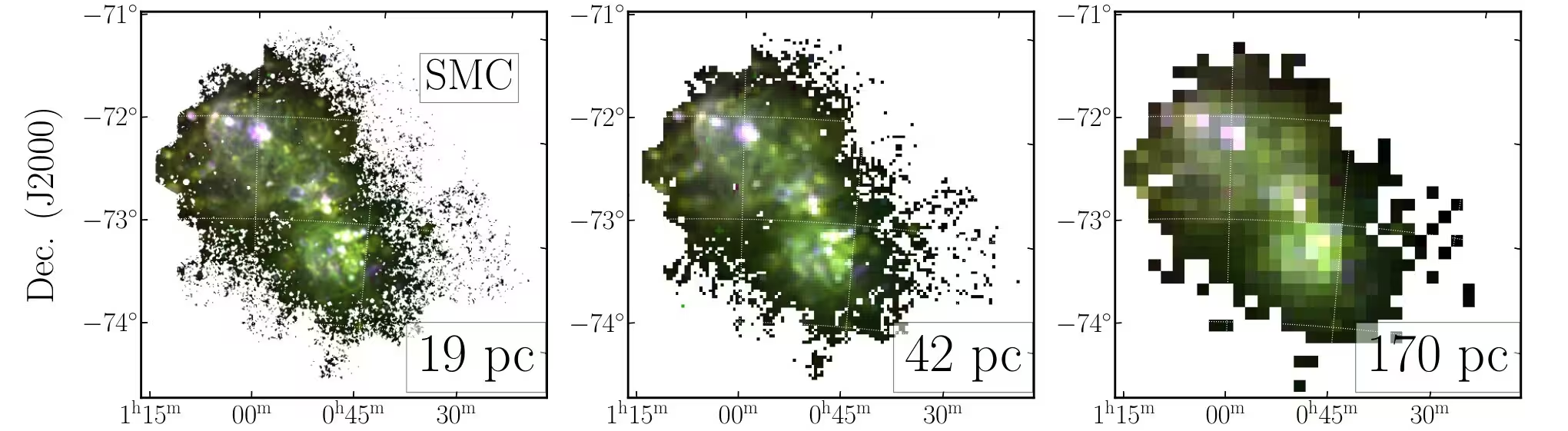
The diffuse ionized gas outside bright star-forming clusters proves especially sensitive to this mixing. Its filamentary structures blend into surrounding regions, artificially shifting diagnostic line ratios toward harder ionization signatures. Meanwhile, equivalent widths and gas velocity dispersions remain relatively more stable across different scales, though the Small Magellanic Cloud displays notable velocity tails that researchers attribute to rotational broadening from massive Be-type stars.
What This Means for Distant Galaxy Studies
Because telescopes observing distant galaxies at high redshifts cannot resolve individual star-forming knots, astronomers must interpret light that has been heavily averaged across kiloparsec scales. These findings suggest that sub-50 parsec resolution is required to properly capture the true physical conditions of low-metallicity galaxies. Without accounting for the smoothing effects of coarse spatial resolution, emission-line diagnostics can easily mislead researchers trying to untangle star formation from shocks or active galactic nuclei in the early Universe.
The study was posted to the arXiv preprint server on November 5, 2026.
This article has been fact checked for accuracy, with information verified against reputable sources. Learn more about us and our editorial process.
Last reviewed on .
Article history
- Latest version
Reference(s)
- Lugo-Aranda, A.. “SDSS-V LVM: Spatial Resolution Effects on Diagnostic Diagrams in the Magellanic Clouds.” arXiv.org <http://arxiv.org/abs/2611.08336v1>.
Cite this page:
- Posted by Karan Das