JWST Reveals Most Distant Parallax-Measured Y Dwarf in Deep Field
Astronomy

JWST Reveals Most Distant Parallax-Measured Y Dwarf in Deep Field

A drifting substellar world located 200 light-years away provides a pristine atmospheric benchmark for isolated planetary-mass objects.
By Aisha Ahmed
Published:
Email this Article
JWST Reveals Most Distant Parallax-Measured Y Dwarf in Deep Field
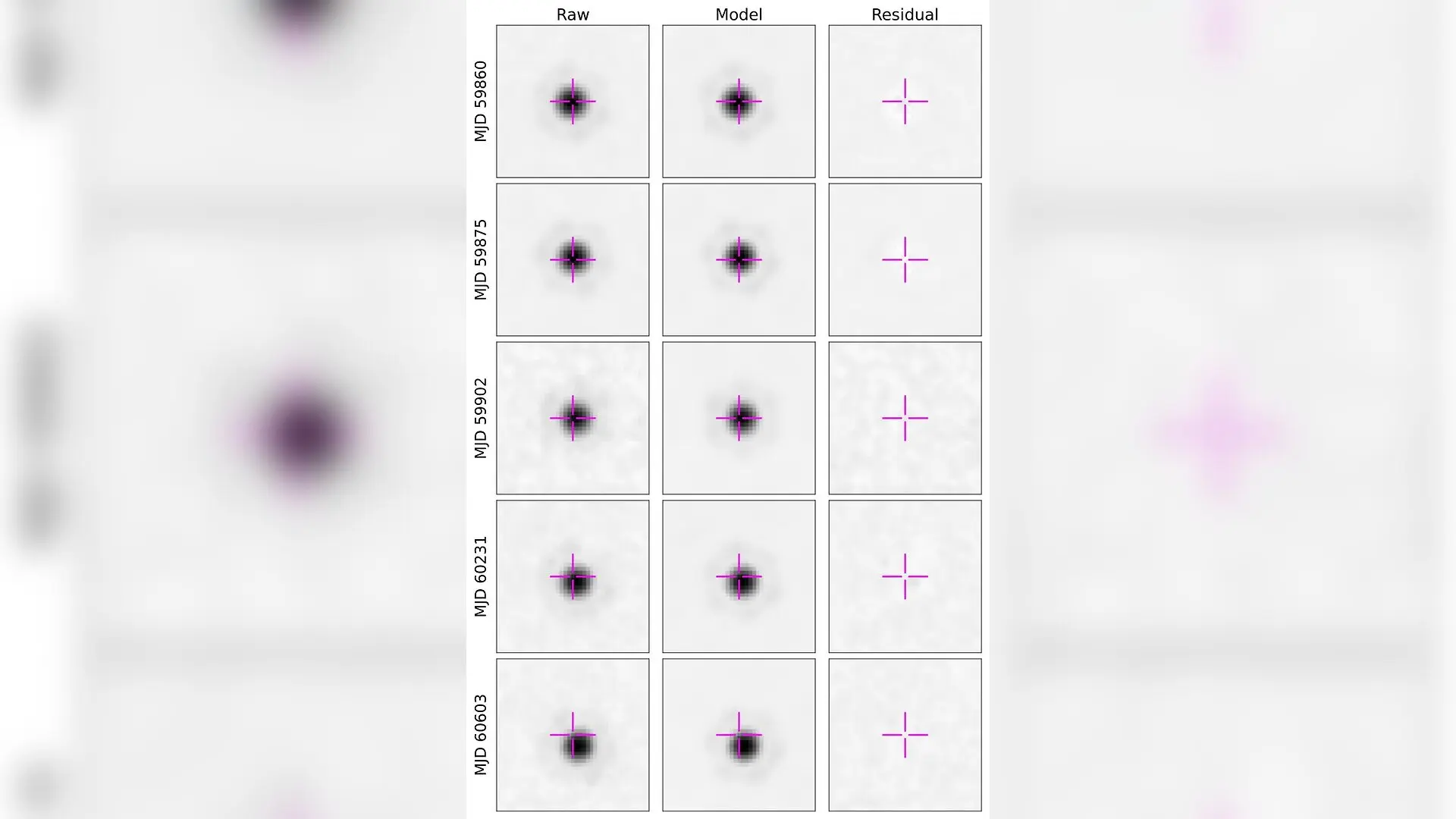
Raw JWST images, hybrid PSF models, and the residual images for the F444W observations of GSBD5 in five epochs (rounded to the nearest day). Individual exposures are co-added to produce the 1.2​″×1.2​″1.2″\times 1.2″ cutouts here. The magenta crosshairs mark the target position reported by Hainline et al. (2026b) for GSBD5. All panels are plotted at the same colour scale. The hybrid PSF models provide excellent source extraction, and the centroids of GSBD5 display visible apparent motions. Feng-Yuan Frey Liu et al. / arXiv

An extremely cold, drifting world known as JADES-GS-BD-5, lurking deep in an extragalactic field observed by the James Webb Space Telescope (JWST), has yielded the first precise trigonometric distance measurement for a brown dwarf found outside our immediate cosmic neighborhood. Located roughly 64 parsecs away in the Milky Way, this isolated planetary-mass object sits about three times further than any previously parallax-measured Y dwarf.

Brown dwarfs are failed stars that never accumulated enough mass to trigger stable hydrogen fusion, instead cooling continuously over billions of years. Because they radiate most of their faint light in the mid-infrared, astronomers have traditionally struggled to measure their distances beyond the local solar bubble of 20 parsecs. The findings were detailed in a study published on arXiv by Feng-Yuan Frey Liu and colleagues.

Tracing Astrometric Motion Across Five Epochs

To capture the precise motion of JADES-GS-BD-5, the research team analyzed multi-epoch imaging captured by JWST’s Near-Infrared Camera (NIRCam) spanning a two-year baseline between October 2022 and October 2024. By combining 50 individual F444W exposures, the authors calibrated the astrometry against a robust reference network of Gaia stars and distant background galaxies.
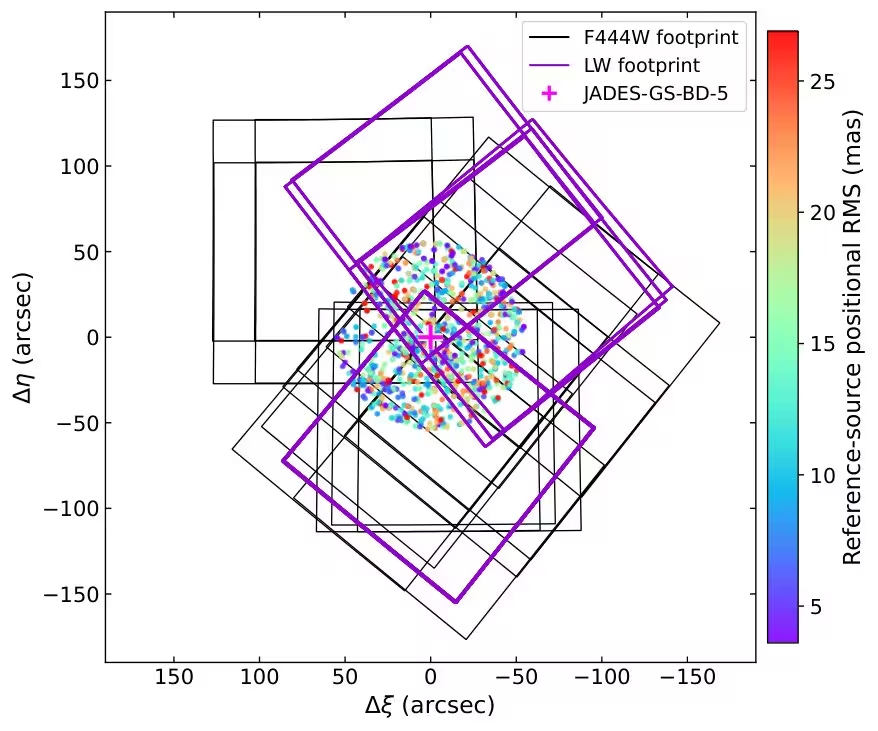
Figure 1: Per-exposure footprints and astrometric reference sources. Thin black outlines show the WCS footprints of the 50 F444W exposures, while thin purple frames show the 130 exposures obtained in other three detection LW bands, F277W, F356W, and F410M. The footprints in these three additional long-wavelength filters are almost entirely contained within the combined F444W footprint. Coloured points mark the 850 sources retained in the F444W reference-frame solution. Their colours indicate the 2-D rms positional residuals after fitting the relative astrometric network, providing an empirical measure of each source’s cross-exposure positional stability. The pink cross marks the position of JADES-GS-BD-5.
Per-exposure footprints and astrometric reference sources. Thin black outlines show the WCS footprints of the 50 F444W exposures, while thin purple frames show the 130 exposures obtained in other three detection LW bands, F277W, F356W, and F410M. The footprints in these three additional long-wavelength filters are almost entirely contained within the combined F444W footprint. Coloured points mark the 850 sources retained in the F444W reference-frame solution. Their colours indicate the 2-D rms positional residuals after fitting the relative astrometric network, providing an empirical measure of each source’s cross-exposure positional stability. The pink cross marks the position of JADES-GS-BD-5. Credit: Feng-Yuan Frey Liu et al. / arXiv

The resulting astrometric fit revealed an absolute proper motion of 49.75 milliarcseconds per year and a significant parallax of 15.7 milliarcseconds. This translates to a geometric distance of 64 parsecs, or about 208 light-years, entirely independent of physical assumptions about the brown dwarf’s internal atmosphere. The data also yielded a tangential velocity of 15.0 kilometers per second, aligning comfortably with a standard Galactic thin-disk population.

Weighing a Free-Floating Planetary Analog

By integrating the object’s JWST NIRSpec prism spectrum alongside mid-infrared photometry from the Mid-Infrared Instrument (MIRI), the researchers calculated a bolometric luminosity of log(L_bol/L_sun) = -7.08. Passing this luminosity through evolutionary models such as ATMO2020 and Sonora Flame Skimmer yielded a mass of approximately 8 Jupiter masses, an effective temperature around 300 Kelvin, and a radius close to 1.0 Jupiter radii.

Because more than 90 percent of its mass posterior falls below the 13-Jupiter-mass deuterium-burning threshold, the object qualifies as an isolated planetary-mass object or free-floating planet. Searches for stellar or substellar companions within the surrounding images revealed no evidence of a wide binary host or rapid orbital acceleration, confirming its solitary nature.
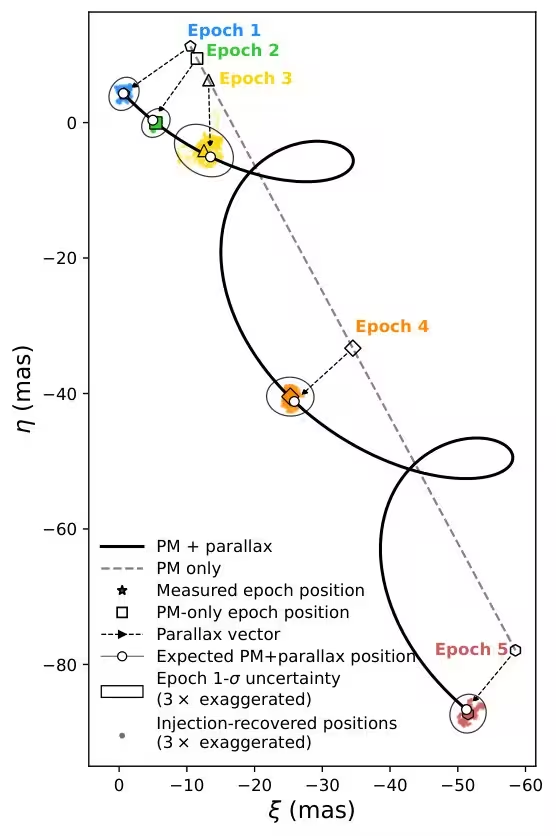
Figure 3: F444W positions and the fitted trajectory of JADES-GS-BD-5, after the relative and absolute reference-frame calibrations. Left: Five-epoch astrometry, where exposures observed within a two-day gap are synthesized into one epoch. The solid black curve shows the best-fitting trajectory joining proper motion (PM) and parallax, while the dashed grey line shows the proper motion. The open symbols mark the PM-only positions and the colour-filled symbols mark the measured apparent centroid positions; matching marker shapes identify the same epoch. The dotted arrow shows the fitted parallax displacement, pointing to the trajectory-model positions (white-filled circles). The translucent coloured clouds show injection-recovery target positional offsets. For visibility, these clouds and the corresponding 1-σ\sigma uncertainty envelopes (open black ellipses) are both exaggerated by a factor of 3 from the centroids. Right: Per-exposure view of the same astrometric solution, showing all 50 calibrate
F444W positions and the fitted trajectory of JADES-GS-BD-5, after the relative and absolute reference-frame calibrations. Left: Five-epoch astrometry, where exposures observed within a two-day gap are synthesized into one epoch. The solid black curve shows the best-fitting trajectory joining proper motion (PM) and parallax, while the dashed grey line shows the proper motion. The open symbols mark the PM-only positions and the colour-filled symbols mark the measured apparent centroid positions; matching marker shapes identify the same epoch. The dotted arrow shows the fitted parallax displacement, pointing to the trajectory-model positions (white-filled circles). The translucent coloured clouds show injection-recovery target positional offsets. For visibility, these clouds and the corresponding 1-σ\sigma uncertainty envelopes (open black ellipses) are both exaggerated by a factor of 3 from the centroids. Right: Per-exposure view of the same astrometric solution, showing all 50 calibrate Credit: Feng-Yuan Frey Liu et al. / arXiv

Atmospheric Mismatches and Future Prospects

Comparing the observed spectral energy distribution with various atmospheric models highlighted ongoing challenges in replicating ultra-cool Y-dwarf atmospheres. Standard models tend to overestimate effective temperatures and distances when forced to match high-resolution prism spectra alone. The authors suggest that disequilibrium chemistry, vertical mixing, and complex cloud structures play major roles in shaping the light emitted by these frigid worlds.

Extending these astrometric techniques to other candidates identified in surveys like JADES and CEERS promises to transform our understanding of the lowest-mass objects in the galaxy. With dozens of similar targets hidden among deep extragalactic exposures, JWST is opening a new window onto the coldest frontiers of star and planet formation.

The study was posted to the arXiv preprint server on November 5, 2026.

Fact Checked

This article has been fact checked for accuracy, with information verified against reputable sources. Learn more about us and our editorial process.

Last reviewed on .

Article history

  • Latest version

Cite this page:

Ahmed, Aisha. “JWST Reveals Most Distant Parallax-Measured Y Dwarf in Deep Field.” BioScience. BioScience ISSN 2521-5760, 06 November 2026. <https://www.bioscience.com.pk/en/subject/astronomy/the-cold-substellar-frontier-in-jwst-extragalactic-surveys-a-robust-parallax-measurement-yields-the-most-distant-known-ultra-cold-y-dwarf>. Ahmed, A. (2026, November 06). “JWST Reveals Most Distant Parallax-Measured Y Dwarf in Deep Field.” BioScience. ISSN 2521-5760. Retrieved November 06, 2026 from https://www.bioscience.com.pk/en/subject/astronomy/the-cold-substellar-frontier-in-jwst-extragalactic-surveys-a-robust-parallax-measurement-yields-the-most-distant-known-ultra-cold-y-dwarf Ahmed, Aisha. “JWST Reveals Most Distant Parallax-Measured Y Dwarf in Deep Field.” BioScience. ISSN 2521-5760. https://www.bioscience.com.pk/en/subject/astronomy/the-cold-substellar-frontier-in-jwst-extragalactic-surveys-a-robust-parallax-measurement-yields-the-most-distant-known-ultra-cold-y-dwarf (accessed November 06, 2026).
End of the article