Earth’s Pacific
Scientists probe a puzzling shift in Earth’s molten core 2,200 km beneath the Pacific, where flow reversed then weakened, sparking new deep‑earth research.
A team of geophysicists has identified a dramatic change in the flow of liquid iron beneath the equatorial Pacific that began in 2010. The region switched from a modest westward drift to a pronounced eastward motion, a pattern that appears to be fading again after 2020.
The discovery relies on an extensive set of magnetic measurements collected between 1997 and 2025, combining ground‑based observatories with data from several space‑borne missions. The results were published on May 6 2026 in the Journal of Studies of Earth’s Deep Interior by Frederik Dahl Madsen, Isobel Howard, William Brown and Kathryn Whaler.
Eastward Pulse Detected in Pacific Core Flow
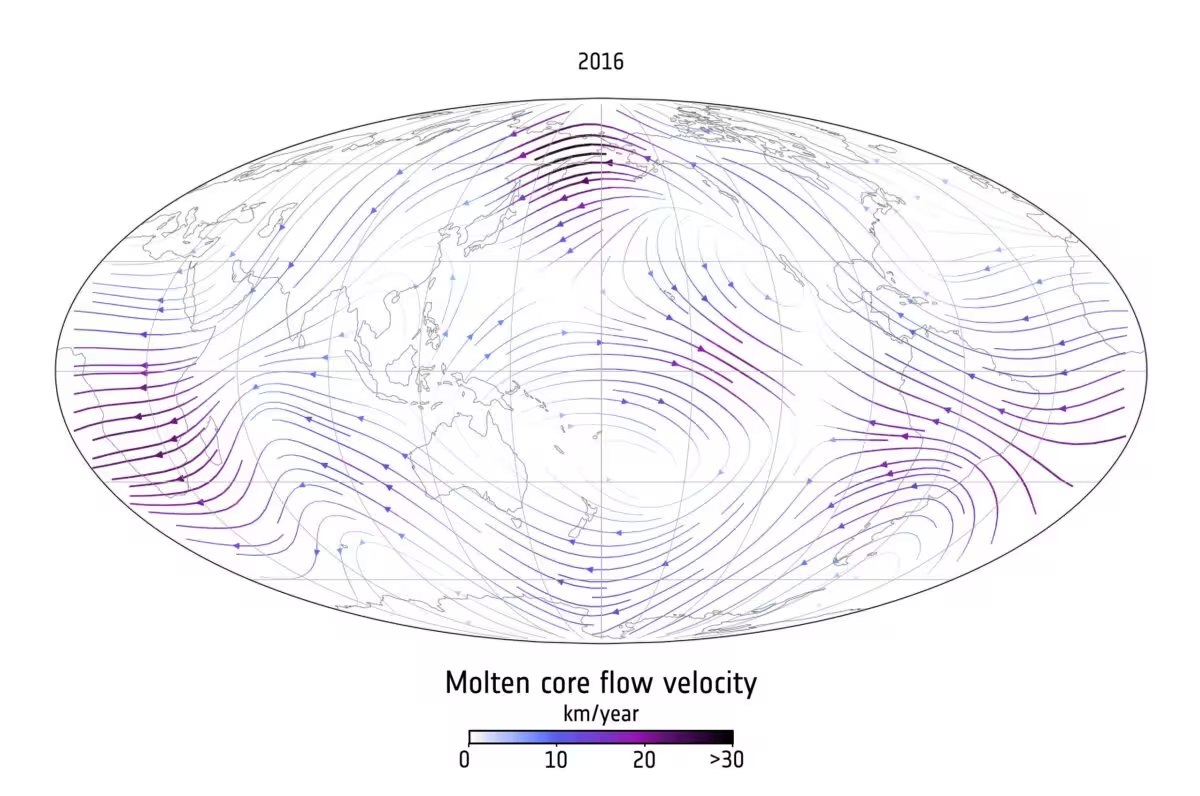
Historically, the flow at the top of Earth’s outer core has been dominated by westward currents, a feature tied to a large‑scale gyre that is slightly misaligned with the planet’s rotation axis. The equatorial Pacific lies beyond the reach of that gyre, allowing a separate flow regime to develop. In 2010 the researchers observed a shift in this Pacific sector from a weak westward drift to a strong eastward surge.
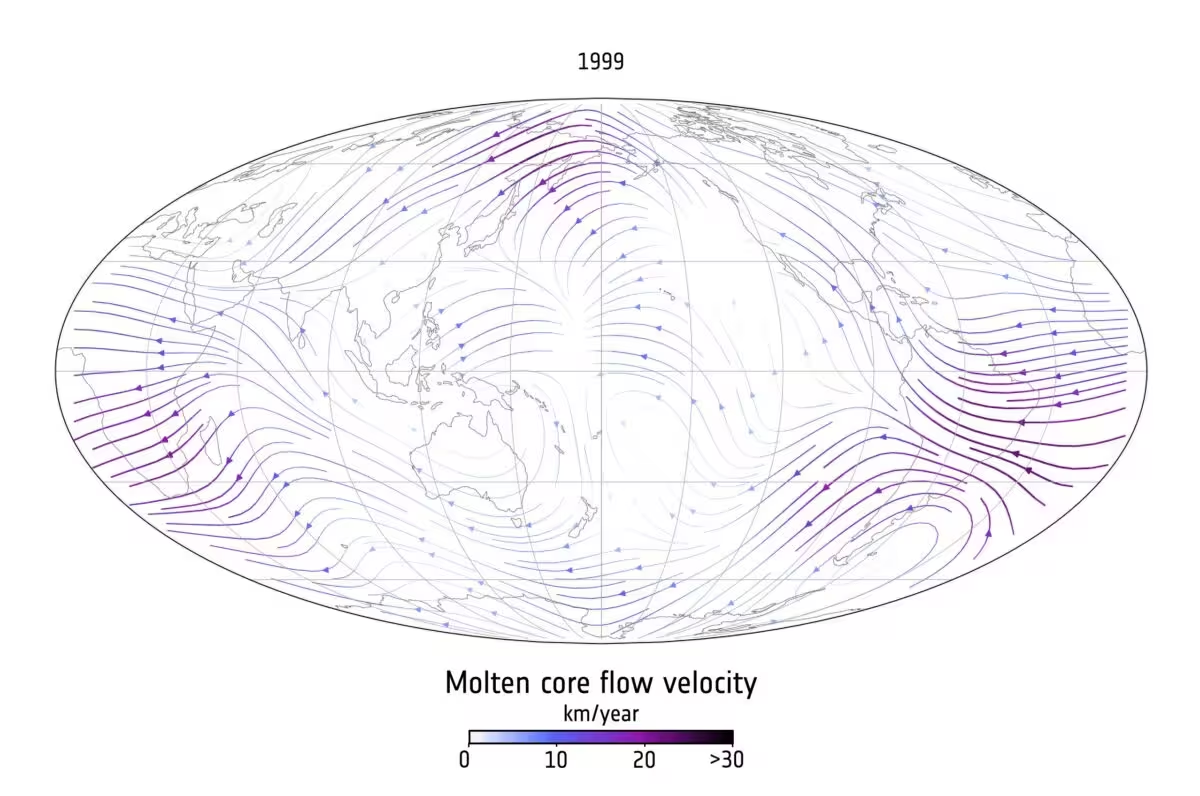
The authors emphasize that the 2010 event represents a regional alteration rather than a wholesale reversal of the entire outer core. Their models, built on secular variation—the slow change of Earth’s magnetic field—assume that magnetic diffusion is negligible on sub‑century timescales, enabling the conversion of field changes into flow patterns at the core‑mantle boundary.
Satellite Constellation Sheds Light on Post‑Reversal Dynamics
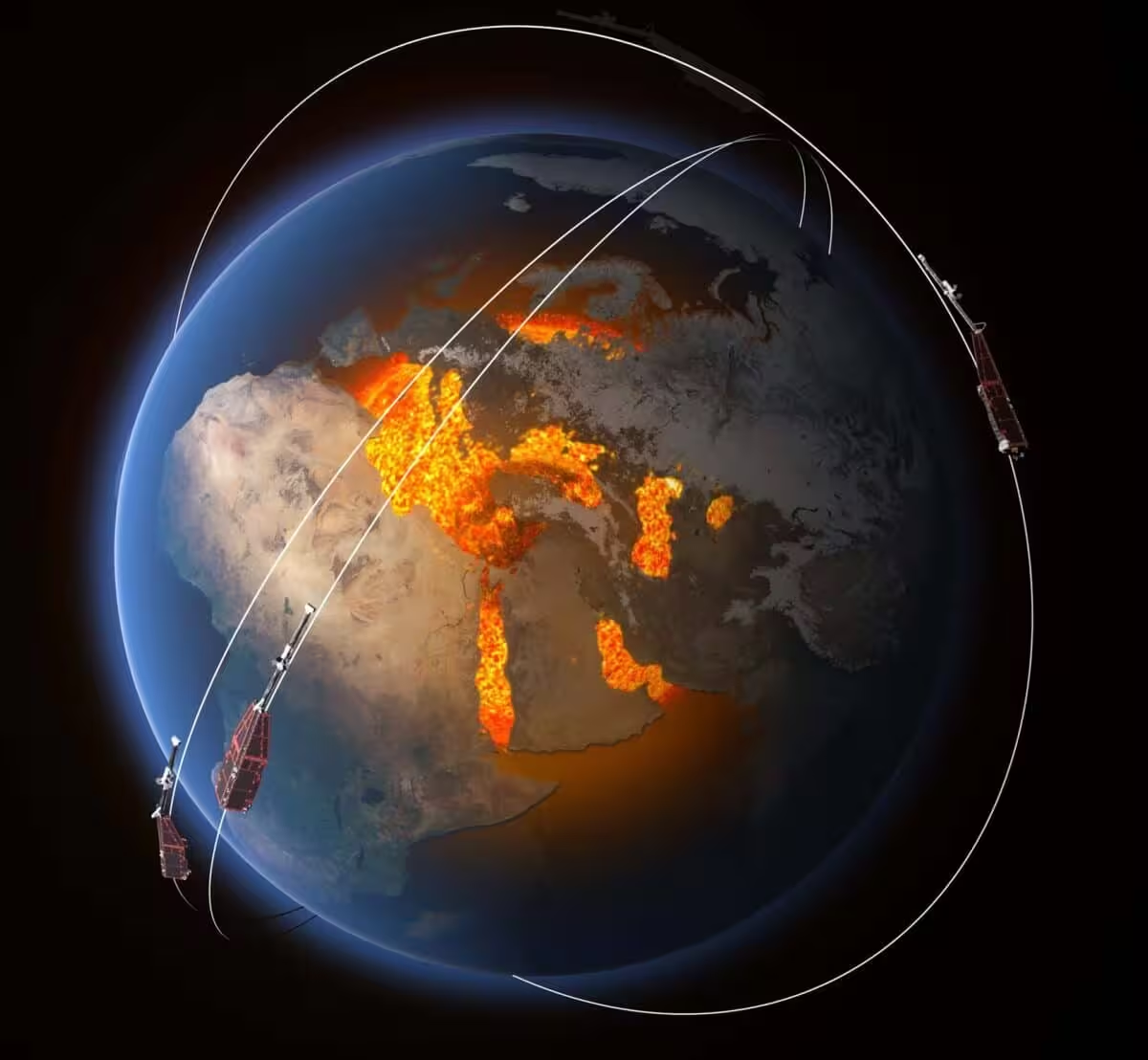
The European Space Agency’s Swarm mission, launched in 2013, provided high‑resolution magnetic maps that clarified the core’s behavior after the 2010 shift. Operating three satellites equipped with ultra‑sensitive magnetometers, Swarm distinguished magnetic contributions from the core, crust, oceans, ionosphere and magnetosphere.
Combined with data from CryoSat, Germany’s CHAMP and the Ørsted satellite, the suite of observations enabled the team to track subtle, wave‑like accelerations and rapidly evolving flow structures that would be lost in noisier records. ESA also linked these features to a pronounced geomagnetic jerk observed in 2017.
Possible Connection to Inner‑Core Dynamics
Around the same time the Pacific flow accelerated eastward, independent geodesy and seismic studies reported a change in the behavior of Earth’s solid inner core. Madsen’s group proposes that such deep‑seated adjustments could have triggered the observed surface flow shift, though the link remains speculative.
The model also indicates that the strong eastward current has been losing momentum since roughly 2020. Whether this reflects a brief fluctuation, a longer‑term oscillation, or a more permanent reorganization of core circulation is still open to interpretation.
“Continued monitoring will be essential to determine how the flow evolves over the coming years,” Madsen remarked, underscoring the need for ongoing magnetic observations.
Impacts on Earth’s Magnetic Shield
While the processes unfold thousands of kilometres beneath the surface and pose no direct risk to humans, they are central to the generation of Earth’s magnetic field. Changes in core flow can alter the field’s strength and configuration, with downstream effects on navigation systems, satellite operations and space‑weather forecasting.
The Pacific reversal provides a concrete case study of how quickly regional flow patterns can evolve. By extending the dataset through 2025, the researchers have captured both the onset of the eastward surge and its subsequent attenuation, offering a valuable benchmark for future geodynamo models.
This article has been fact checked for accuracy, with information verified against reputable sources. Learn more about us and our editorial process.
Last reviewed on .
Article history
- Latest version
Reference(s)
- Madsen, Frederik. “Principal component analysis of the 2010 reversal of core-surface flow beneath the Pacific Ocean.”, vol. 2, May 6, 2026 Episciences.org, doi: 10.46298/jsedi.17268. <https://jsedi.episciences.org/articles/17268?utm_source=chatgpt.com>.
Cite this page:
- Posted by Karan Das