NASA PUNCH Tracks Solar Eruption to Earth, Predicts Arrival Within 30 Minutes
NASA’s PUNCH mission will monitor the Sun, revealing solar storms in transit and helping scientists better prepare for Earth impacts.
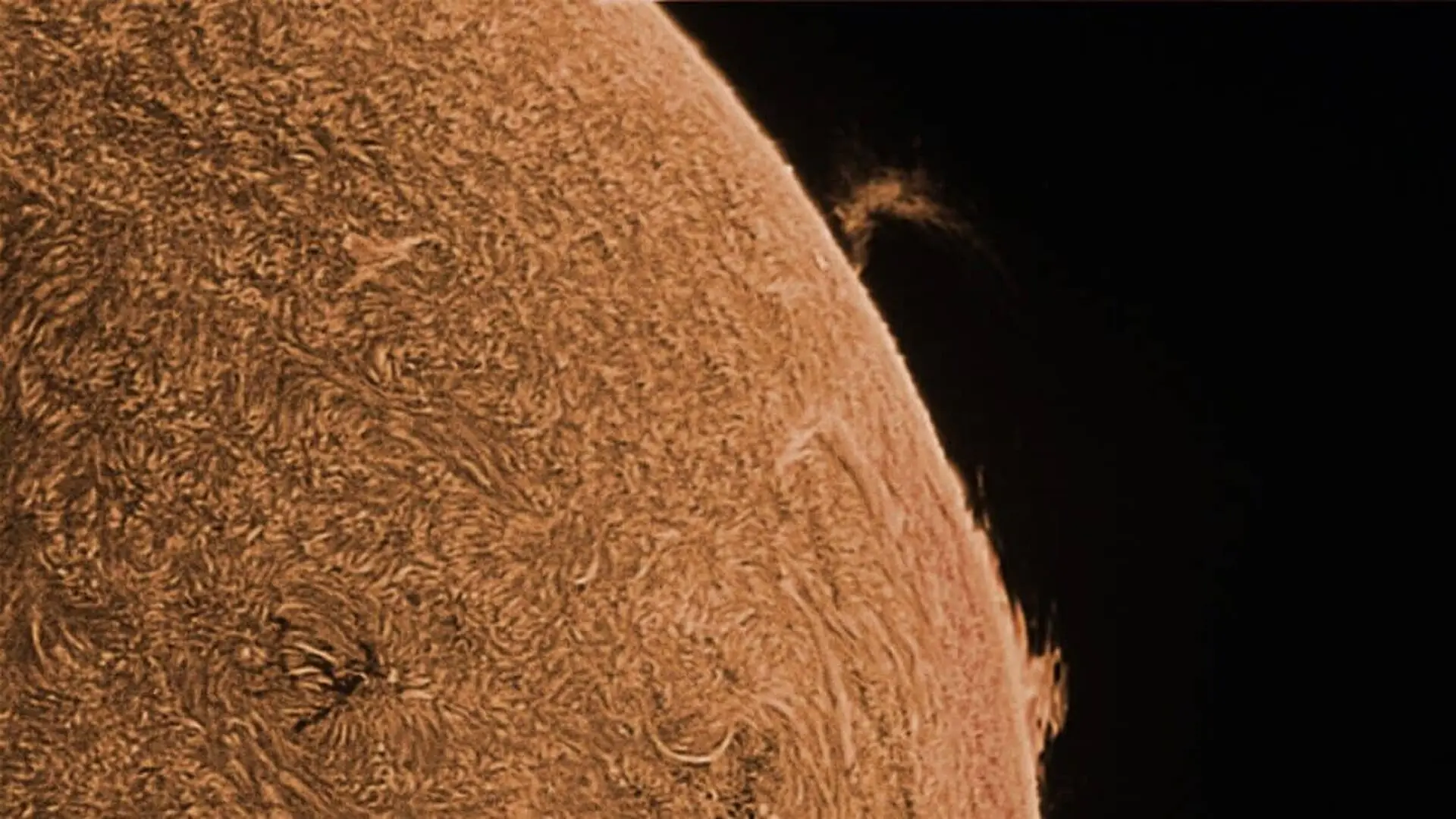
NASA’s Polarimeter to Unify the Corona and Heliosphere (PUNCH) mission has demonstrated a novel forecasting technique that can pinpoint the arrival of a coronal mass ejection (CME) at Earth within a half‑hour margin. The breakthrough, demonstrated in a proof‑of‑concept analysis, could reshape how space‑weather threats are monitored.
Accurate CME forecasts are vital for protecting satellites, power‑grid infrastructure, and crewed missions beyond low Earth orbit. The results were unveiled at the Committee on Space Research Scientific Meeting and are pending publication in the journal Space Weather.
Historically, scientists could only observe a CME for roughly 20 % of its Sun‑to‑Earth trajectory, leaving a large portion of the flight path untracked and forcing reliance on extrapolations.
Launched in 2025, PUNCH’s quartet of spacecraft orbiting Earth now delivers uninterrupted three‑dimensional imaging of the inner solar system, snapping a new frame every four minutes and dramatically extending the observable portion of a CME’s journey.
Continuous Imaging Boosts Forecast Accuracy
Prior to PUNCH, the limited field of view meant that predictions were based on a brief glimpse of an eruption, often resulting in arrival windows spanning five hours. With its expansive view, PUNCH can follow a CME much farther downstream, as illustrated by a recent case study of an eruption that erupted on May 31 2025. Researchers fed the continuous image series into a computational model that tracked the leading edge’s speed and geometry throughout the inner heliosphere.
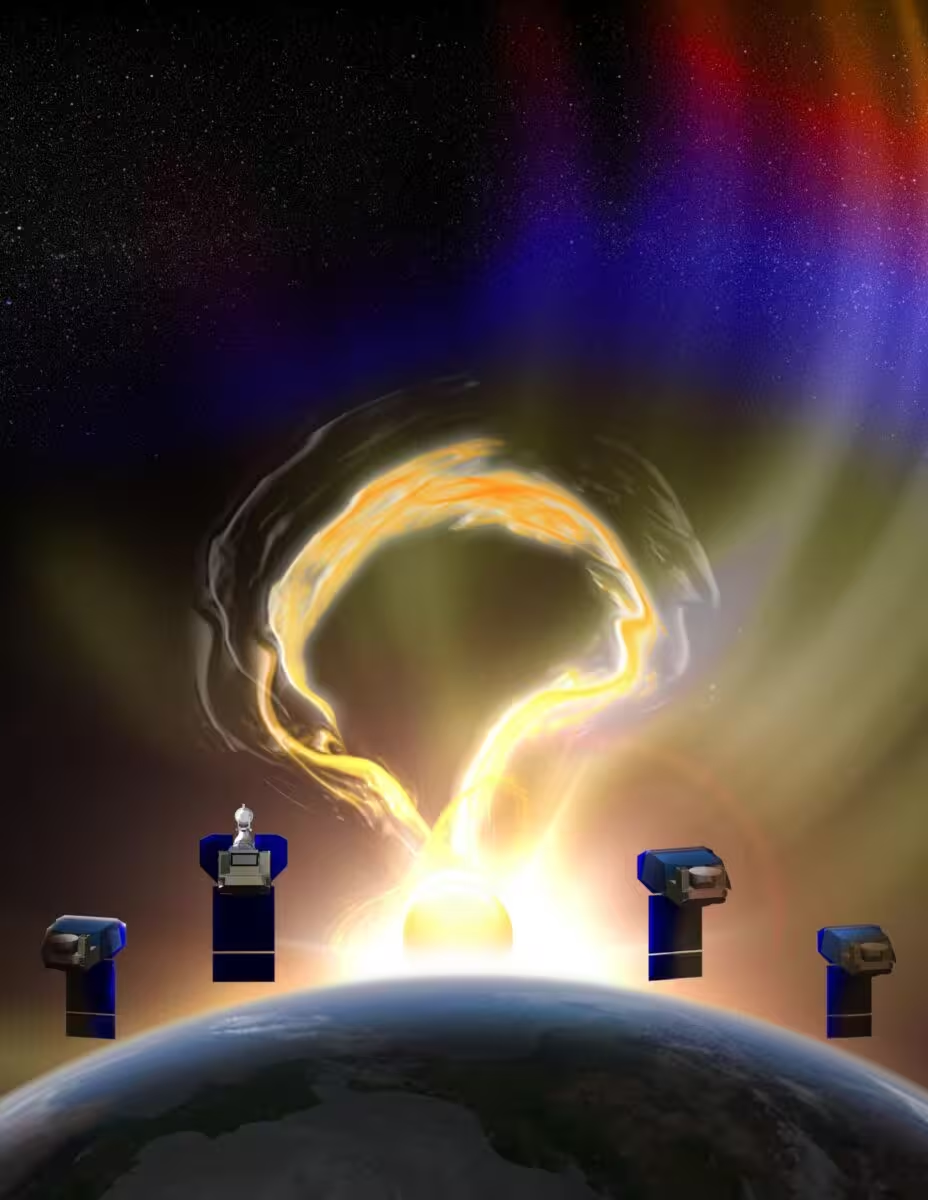
Twelve hours after launch, the model produced a definitive arrival estimate predicting the CME would impact Earth eight hours later. The final forecast was within 30 minutes of the actual arrival, representing a ten‑fold improvement over conventional techniques.
Half‑Hour Precision Sets New Benchmark
The research team reported that the new approach achieved accuracy levels an order of magnitude better than the state of the art, which typically provides a five‑hour uncertainty window. Craig DeForest, principal investigator for PUNCH at the Southwest Research Institute, described the outcome as “beyond expectations.”
“We thought PUNCH would be good at this, but it’s a stunning result,” he said. “To put it in perspective, this could be the space weather equivalent of going from a steam engine to a modern internal combustion engine.”
DeForest emphasized that the gain stemmed from a straightforward methodology that relied on uninterrupted CME tracking, allowing the model to recognize when its prediction stabilized and could be trusted.
“We accomplished an order of magnitude better result than the state‑of‑the‑art method with a really basic process, just informed by the fact that the coronal mass ejection could be tracked continuously across the solar system.”
Unrivaled Views of Solar Plasma
Beyond forecasting, PUNCH is revealing the intricate structure and evolution of CMEs. High‑resolution images show that these plasma clouds possess clumpy, dynamic features that continue to morph as they travel outward.
The Southwest Research Institute notes that these observations provide fresh insight into plasma behavior not only in our heliosphere but also in distant star‑forming regions, potentially informing broader astrophysical models.
“These first results demonstrate the power of PUNCH’s wide‑field imagery to track the solar events as they travel out from the Sun,” stated the U.S. Space Agency.
NASA’s PUNCH Sharpens Solar Storm Forecasting in First Test: Using continuous imagery from NASA’s PUNCH (Polarimeter to Unify the Corona and Heliosphere) mission, scientists predicted the near‑Earth arrival of a solar eruption to within 30 minutes in an … https://t.co/ucISaT522Epic.twitter.com/alfw19gyHW
— Elysia Segal (@elysiasegal) August 4, 2026
As PUNCH continues to collect data, scientists anticipate further refinements to CME models and deeper understanding of how solar plasma propagates through interplanetary space.
This article has been fact checked for accuracy, with information verified against reputable sources. Learn more about us and our editorial process.
Last reviewed on .
Article history
- Latest version
Reference(s)
- “https://ift.tt/FKUyZNA.” <https://t.co/ucISaT522E>.
- “https://twitter.com/elysiasegal/status/2084727719644828078/photo/1.” <https://t.co/alfw19gyHW>.
Cite this page:
- Posted by Karan Das