South Korea’s Danuri Captures Fresh Crater From SpaceX Falcon 9 Upper Stage Impact on Moon
After months in space, a rocket finally reaches the Moon, delivering new orbital images that capture the aftermath of a rare lunar event.

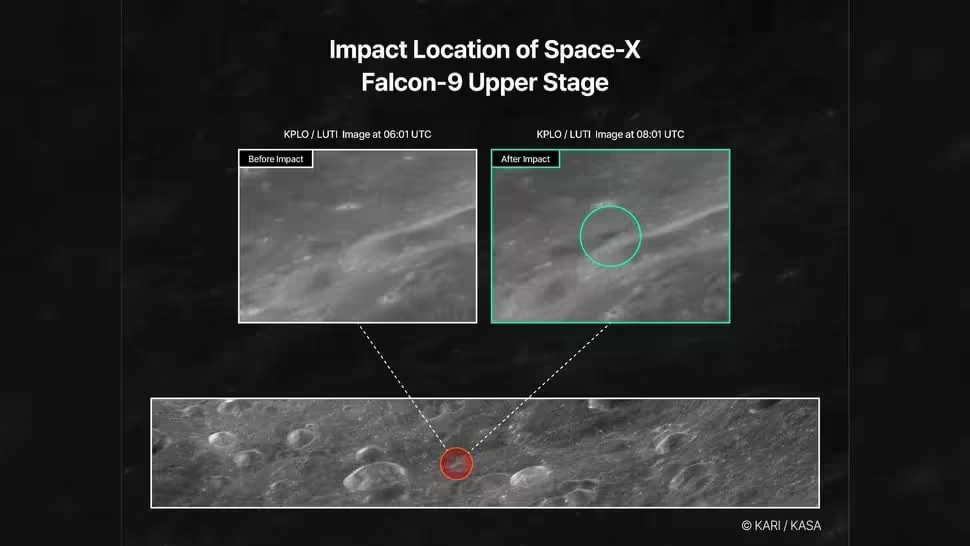
In the pre‑dawn hours of 5 August 2026, South Korea’s Korea Pathfinder Lunar Orbiter, better known as Danuri, recorded a surprise impact of a SpaceX Falcon 9 upper stage on the Moon’s surface, delivering a before‑and‑after visual record of the event.
Danuri’s Rapid Imaging Sequence Captures a Lunar Collision
About thirty minutes prior to the strike, Danuri began a focused observation of the target area. Over the next hour, the orbiter performed eight separate imaging passes, securing high‑resolution photographs that show the terrain before the impact and the freshly‑formed crater moments afterward. The Korea Aerospace Research Institute (KARI) highlighted that these data will allow scientists to isolate changes caused solely by the collision, separating them from pre‑existing lunar features.
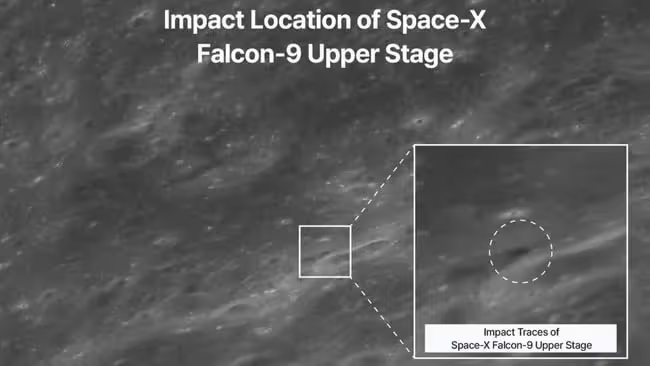
The impact was recorded at 2:34 a.m. EDT (0634 GMT), matching orbital predictions. Analysts estimate the upper stage struck the Moon at roughly 5,400 mph (8,690 kph), carving a crater up to 89 feet (27 meters) across and scattering ejecta across the surrounding terrain.
From Earth Orbit to Lunar Impact: The Upper Stage’s Journey
The wayward component originated from a Falcon 9 launch on 15 January 2025 that delivered two commercial landers—Firefly Aerospace’s Blue Ghost and ispace’s Resilience—to lunar vicinity. While Blue Ghost achieved a successful touchdown, Resilience suffered a crash during its landing attempt. After completing its primary mission, the upper stage was left in a high‑energy Earth orbit with insufficient propellant for a controlled deorbit.
Gradual influences from solar radiation pressure and Earth‑Moon gravitational dynamics altered its trajectory over several months. Ultimately, the 8,800‑pound (4,000‑kilogram) booster intersected the Moon’s surface, creating the unplanned impact that Danuri documented.
Human Artifacts Accumulate on the Moon
The Falcon 9 stage adds to a growing inventory of artificial objects on the lunar surface. In March 2022, a third stage from China’s Long March 3C rocket impacted the Moon, and several Saturn V stages from NASA’s Apollo program were deliberately sent into lunar orbit to study the Moon’s interior. Ongoing observations from Danuri will be cross‑referenced with data from NASA’s Lunar Reconnaissance Orbiter, enhancing our understanding of how such impacts modify the regolith.
Danuri itself, launched on 4 August 2022 aboard a Falcon 9, became South Korea’s first lunar probe after entering lunar orbit four months later. The spacecraft carries six scientific instruments, including NASA’s ShadowCam, which searches for water ice in permanently shadowed polar craters.
“Danuri began observations about 30 minutes before the collision and, through orbit control, passed over the impact site multiple times, conducting a total of 8 imaging sessions,” stated the Korea Aerospace Research Institute (KARI) via X. “Through this observation, changes in the terrain around the impact site and traces of ejecta spread were confirmed.”
Our team at @iaa_csic has captured the impact on the Moon of the upper stage of a Falcon 9 rocket. We attach a preliminary video showing the evolution of the ejected material. The black area corresponds to the lunar disk @SpaceX@JuanLuisRizos@elonmusk@tiempobrasero@A3Noticias… pic.twitter.com/5Ry7hRdCeS
— Jose Maria Madiedo (@jmmadiedo) August 6, 2026
This article has been fact checked for accuracy, with information verified against reputable sources. Learn more about us and our editorial process.
Last reviewed on .
Article history
- Latest version
Reference(s)
- “https://twitter.com/jmmadiedo/status/2085344665562165293/video/1.” <https://t.co/5Ry7hRdCeS>.
Cite this page:
- Posted by Karan Das