Lucy Captures First Glimpses of Trojan Asteroids to Fine‑Tune Cameras for 2027 High‑Speed Flybys
NASA’s Lucy probe is studying four Trojan asteroids now and gearing up for high‑speed flybys beginning in 2027.
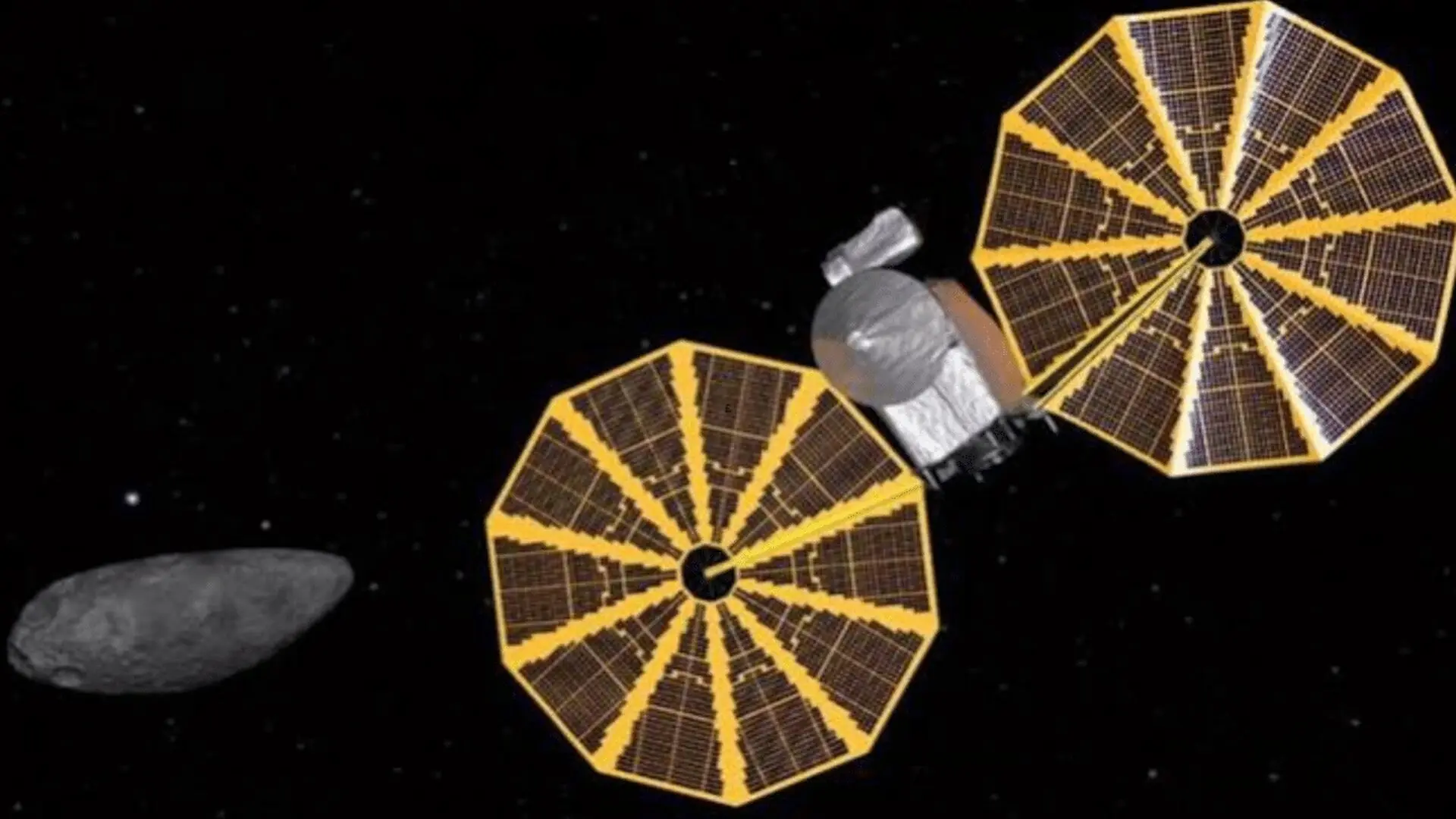
The Lucy probe has started capturing images of four distant Trojan asteroids from hundreds of millions of miles away, using these faint snapshots to fine‑tune its cameras ahead of a series of close flybys slated for 2027 and beyond. While the objects now appear only as tiny points of light, the data give mission engineers a rare preview of the illumination angles Lucy will encounter when it whizzes past these ancient remnants at speeds up to 16,000 mph. This marks a practical transition for a spacecraft that is five years into a mission aimed at probing some of the solar system’s most primitive building blocks.
Early Imaging of Remote Trojan Candidates
In the spring of 2026, Lucy pointed its high‑resolution L’LORRI camera at four asteroids that will later become primary targets: Eurybates, Polymele, Leucus and Orus. At the spacecraft’s current range, none of these bodies reveal the surface detail expected during the upcoming encounters; instead they show up as faint glints against the star‑filled background.
This apparent lack of detail is precisely why the images are valuable. Scientists are not trying to conduct the mission’s core science ahead of schedule; they are using the data to evaluate how the imaging system behaves under lighting conditions that increasingly resemble the eventual flybys.
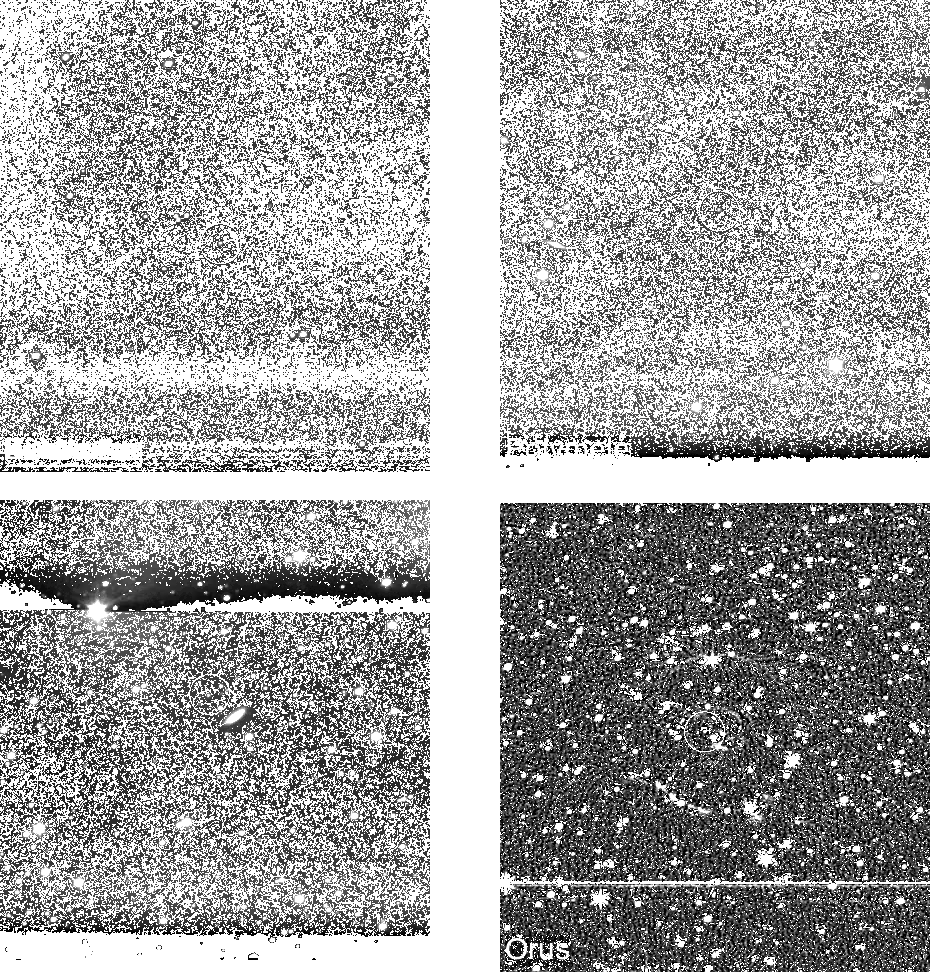
According to NASA, the observations were taken in spring, with the mission team completing download and processing in July 2026. The resulting datasets now inform the selection of camera parameters for the upcoming Trojan campaign.
Lucy will not visit all four objects simultaneously; the flybys are spaced between August 2027 and November 2028. Two of the asteroids host small moons, adding extra scientific interest as Lucy traverses the Trojan swarm.
Because each encounter lasts only a few minutes, pre‑flight testing reduces uncertainty. During a flyby the spacecraft cannot pause to retake images, so exposure settings must be chosen in advance to accommodate rapidly shifting distances, angles, illumination, and surface brightness.
Tackling the Lighting Challenge Ahead of the Flybys
From Earth, Trojan asteroids are typically observed with the Sun roughly behind the viewer, making them appear largely illuminated—much like a near‑full Moon. Lucy, however, will approach the same bodies from very different perspectives.
As the probe closes in, some portions of an asteroid’s surface will bask in sunlight while others plunge into shadow, creating a demanding photographic environment. An exposure optimized for the brightest terrain could wash out darker features, whereas settings favoring shadowed regions might underexpose the illuminated side.
At closest approach, Lucy will pass within 300 to 600 miles of each target. At those ranges the faint points seen today will expand into resolved surfaces, with lighting conditions changing from moment to moment.
The recent imaging campaign lets engineers evaluate L’LORRI under illumination scenarios that more closely mimic the upcoming encounters than typical Earth‑based observations. The goal is to identify exposure configurations that retain surface detail without producing images that are overly dark or over‑bright.
Additional observation windows will be scheduled as Lucy proceeds toward the outer solar system, providing progressively better data for refining the final encounter sequences.
High‑Speed Passes at Approximately 16,000 mph
During the flybys, Lucy will zip past each Trojan at velocities approaching 16,000 mph, relying on tightly choreographed observation windows to gather as much information as possible.
The spacecraft’s instruments will record visible‑light and infrared images while simultaneously collecting other scientific measurements. Close‑range snapshots could reveal surface textures and physical properties that remain invisible in the current long‑distance pictures.
Because the mission depends on brief, high‑speed passages rather than long‑duration orbital surveys, preparation is critical. Once Lucy is within a few hundred miles of an asteroid, the target will transition from an unresolved speck to a detailed object and then recede again, all within a matter of minutes.
Commands from Earth cannot be issued in real time; instead, observation sequences must be pre‑programmed to capture the optimal moments when geometry and distance align for the best scientific return.
The early reconnaissance images therefore serve to increase the likelihood that the final, close‑range data sets will be scientifically valuable, turning a fleeting encounter into a wealth of new knowledge about these primordial solar‑system remnants.
This article has been fact checked for accuracy, with information verified against reputable sources. Learn more about us and our editorial process.
Last reviewed on .
Article history
- Latest version
Reference(s)
- Shekhtman, Lonnie. “NASA’s Lucy Begins Camera Tests Ahead of 2027 Trojan Flybys - NASA Science.”, August 6, 2026 NASA <https://science.nasa.gov/blogs/lucy/2026/08/06/nasas-lucy-begins-camera-tests-ahead-of-2027-trojan-flybys/>.
Cite this page:
- Posted by Karan Das