NASA Crew Emerges After Spending Over A Year Locked Inside A Simulated Mars Habitat
Four volunteers have emerged from NASA’s simulated Mars habitat after 378 days, providing critical new data on the challenges of future human space missions.
Four volunteers have successfully concluded an intense 378-day mission, emerging from a sealed, 3D-printed habitat at NASA’s Johnson Space Center in Houston. The mission, known as the second Crew Health and Performance Exploration Analog (CHAPEA), was designed to replicate the extreme conditions of a Martian outpost, providing critical data on how humans manage isolation, resource scarcity, and significant communication lags.
Stepping Out After More Than a Year in Isolation
On October 31, 2026, the crew members—Ross Elder, Ellen Ellis, James Spicer, and Matthew Montgomery—finally stepped outside their simulated Martian home. Having entered the 1,700-square-foot facility on October 19, 2025, the team spent over a year living under highly structured, controlled conditions. Their emergence was met by NASA officials, including Johnson Space Center Director Vanessa Wyche and astronaut Jack Hathaway, who marked the Halloween conclusion of the experiment with a lighthearted greeting.
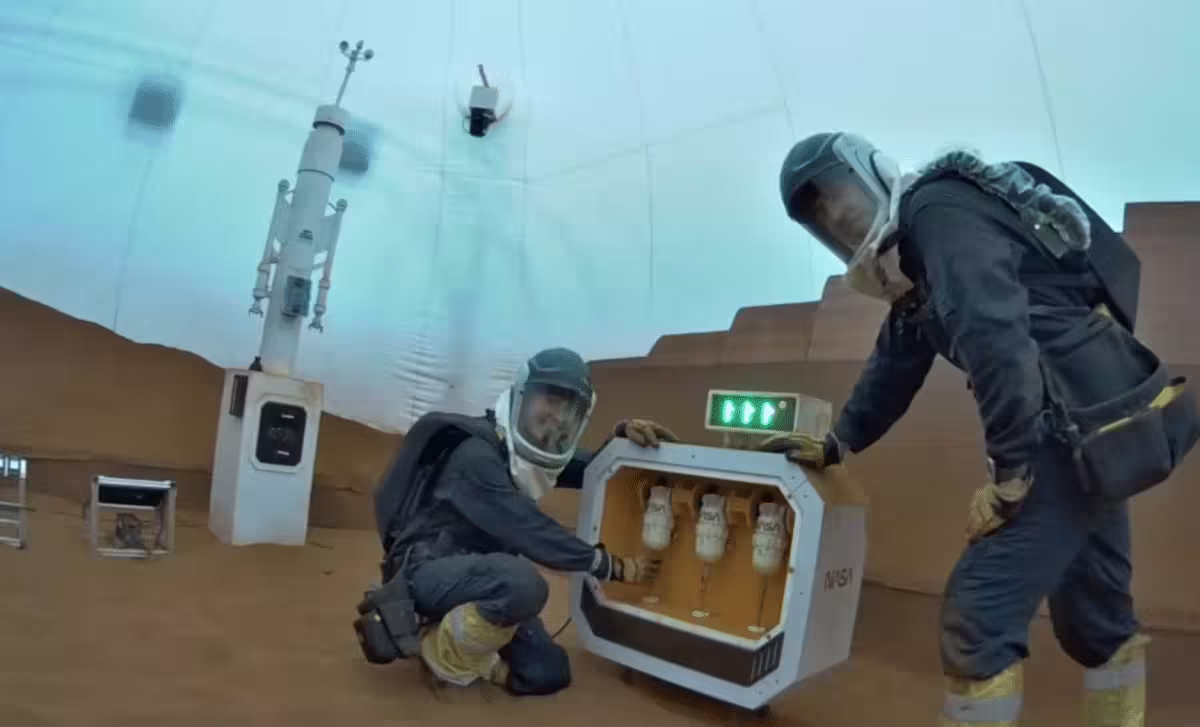
CHAPEA Mission 2 crew member Ellen Ellis (left) and Ross Elder (right) conduct a maintenance task during a simulated extravehicular activity, also known as a spacewalk.Credit: NASA
Simulating the Demands of the Red Planet
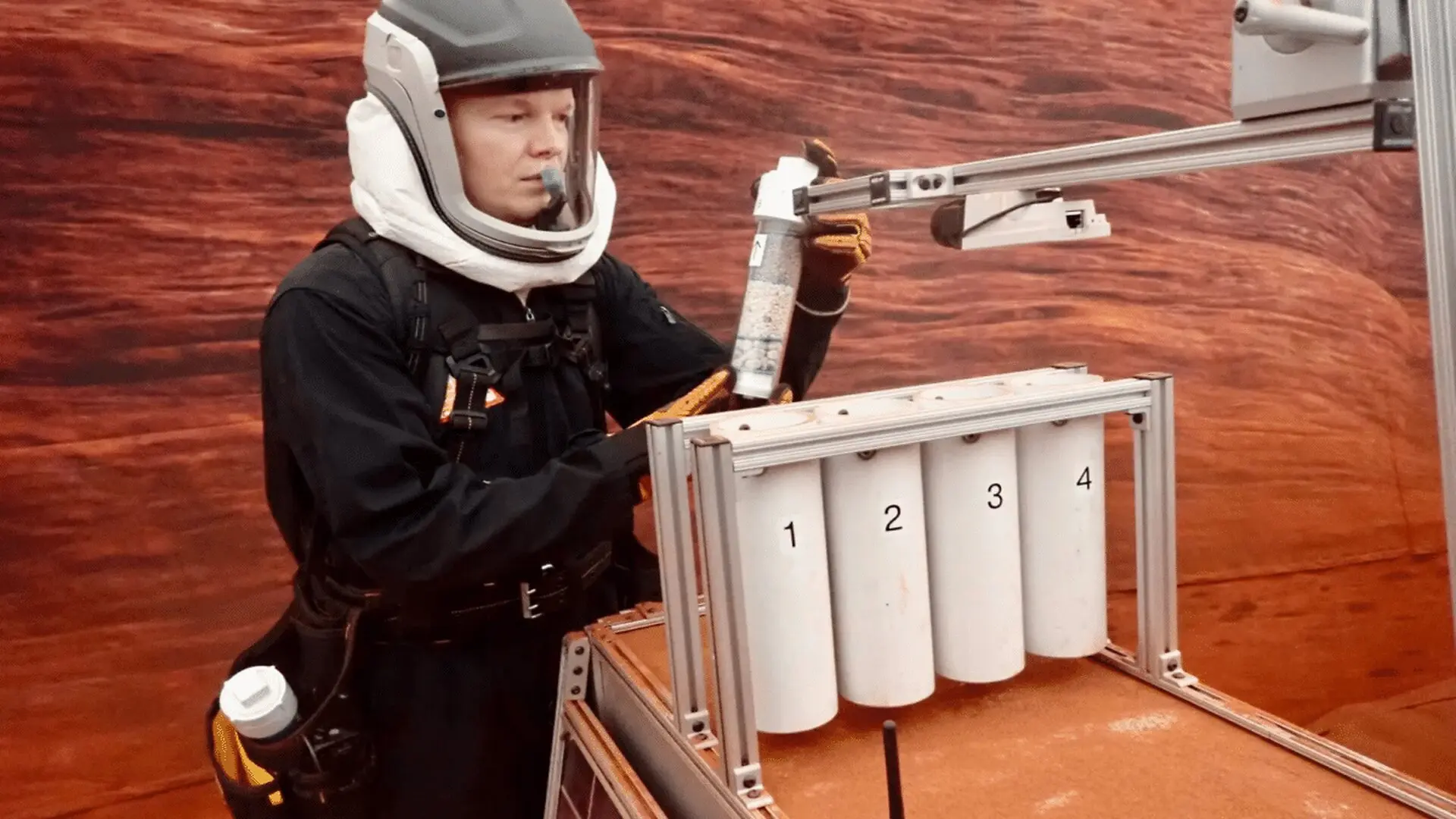
The CHAPEA program serves as a vital proving ground for future human exploration of the Red Planet. According to NASA, the goal is to evaluate the physical and psychological toll of long-duration missions. Inside the habitat, the crew was tasked with duties that mirror the realities of deep-space survival, such as performing simulated spacewalks, maintaining complex life-support systems, and cultivating crops to supplement their diet.
By engaging in these daily responsibilities, the researchers could observe how a small team handles the pressure of limited supplies and the necessity of independent maintenance. While the habitat could not simulate Martian gravity or the hazardous radiation environment, it effectively created a closed-loop system where every logistical decision held weight.
One year. One habitat. One giant step toward Mars.
NASA’s CHAPEA crew concluded their simulated Mars mission on Oct. 31, providing valuable insights that will help NASA design its future Moon Base and plan for missions on Mars. https://t.co/73YmVUatqM
One of the most profound obstacles to Mars exploration is the immense distance between Earth and the target planet. Radio signals can take anywhere from 4 to 24 minutes to travel one way. This delay renders real-time support from ground control impossible, requiring astronauts to solve problems with a high degree of autonomy.
Throughout the CHAPEA mission, the crew operated with these same communication constraints. The data collected will allow NASA to better understand how crews handle decision-making, workload management, and interpersonal cohesion when they are entirely on their own to address equipment failures or unexpected emergencies.
Reflecting on a Year of Voluntary Captivity
Beyond the technical logs and scientific metrics, the mission was a test of human resilience. During the exit ceremony, Ellen Ellis characterized the experience as a taxing but necessary journey, referring to herself and her colleagues as “analog astronauts living in captivity of our own free will.”
The sentiment was echoed by Matthew Montgomery and James Spicer, who expressed gratitude for the support systems that kept them grounded throughout their 378 days in isolation. As NASA looks toward future missions, these human-centric insights—the ability to maintain morale and function as a team while physically removed from the rest of humanity—will be just as critical as the hardware used to get there.
Fact Checked
This article has been fact checked for accuracy, with information verified against reputable sources. Learn more about us and our editorial process.
Das, Karan. “NASA Crew Emerges After Spending Over A Year Locked Inside A Simulated Mars Habitat.” BioScience. BioScience ISSN 2521-5760, 02 November 2026. <https://www.bioscience.com.pk/en/subject/space-science/after-378-days-cut-off-from-the-world-nasas-mars-crew-finally-steps-outside>.
Das, K. (2026, November 02). “NASA Crew Emerges After Spending Over A Year Locked Inside A Simulated Mars Habitat.” BioScience. ISSN 2521-5760. Retrieved November 02, 2026 from https://www.bioscience.com.pk/en/subject/space-science/after-378-days-cut-off-from-the-world-nasas-mars-crew-finally-steps-outside
Das, Karan. “NASA Crew Emerges After Spending Over A Year Locked Inside A Simulated Mars Habitat.” BioScience. ISSN 2521-5760. https://www.bioscience.com.pk/en/subject/space-science/after-378-days-cut-off-from-the-world-nasas-mars-crew-finally-steps-outside (accessed November 02, 2026).