Astronauts Complete Final ISS Solar Array Upgrade in 6‑Hour Spacewalk, Power Up 30%
NASA astronauts finish pivotal spacewalk to ready the ISS for upgraded solar power systems, boosting station energy capacity.
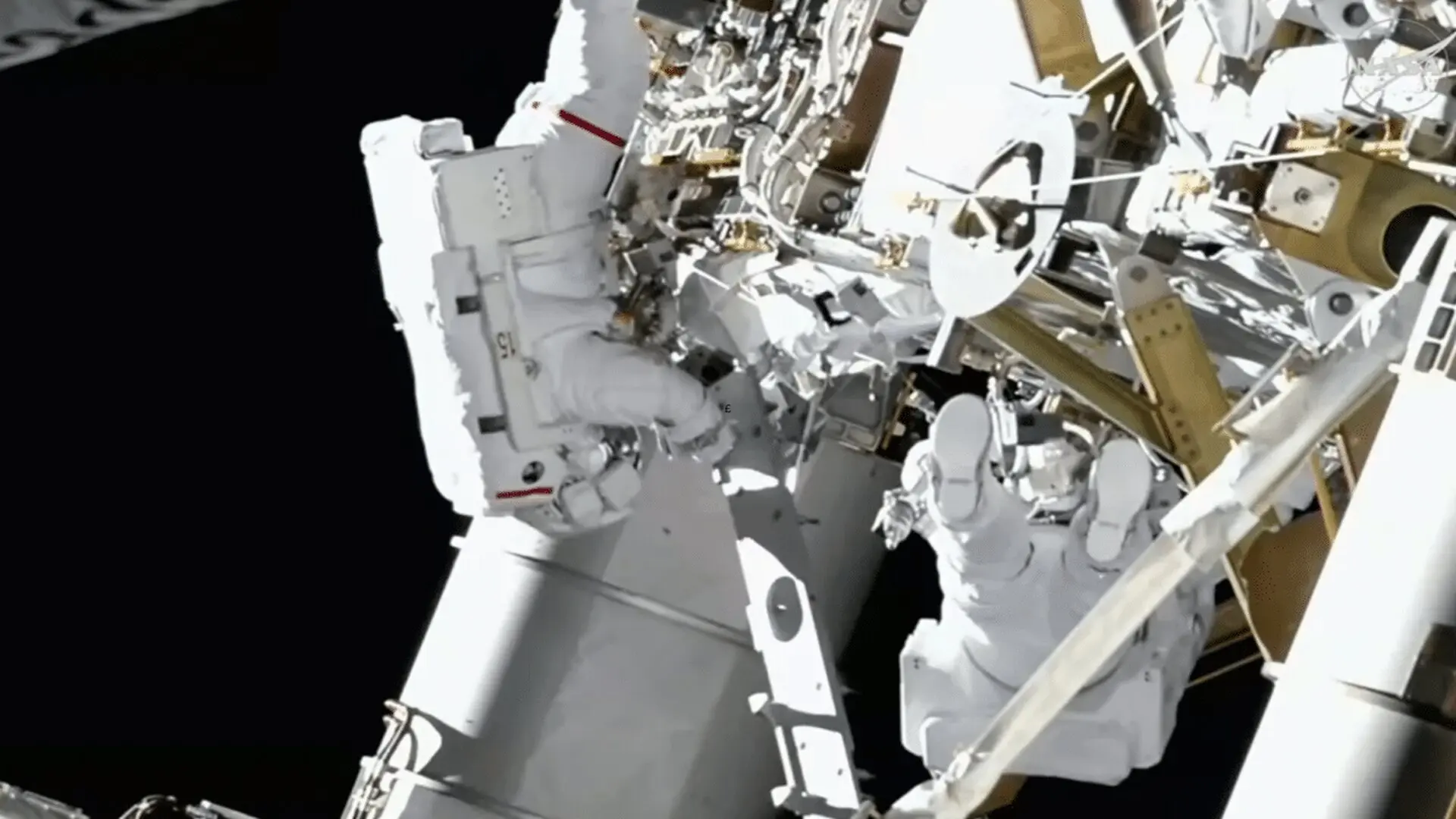
On 6 August, NASA astronauts Jessica Meir and Anil Menon completed a 6‑hour‑plus extravehicular activity that placed the last set of mounting brackets needed for the International Space Station’s next‑generation solar panels. The work clears the way for a power boost that will keep the orbiting laboratory running strong as it supports research and prepares for deeper‑space missions.
Last Brackets Fixed for the iROSA Power Upgrade
During the EVA, the crew installed the seventh and final set of mounting hardware on the starboard‑side S6 truss segment. The brackets, shaped like triangles, were secured to the existing structure, creating the foundation for the upcoming roll‑out solar wing on the station’s 3B power channel.
To stay stable while working, Menon employed an articulating portable foot restraint (APFR) attached to a worksite interface, allowing him to maneuver and fasten components with both hands.
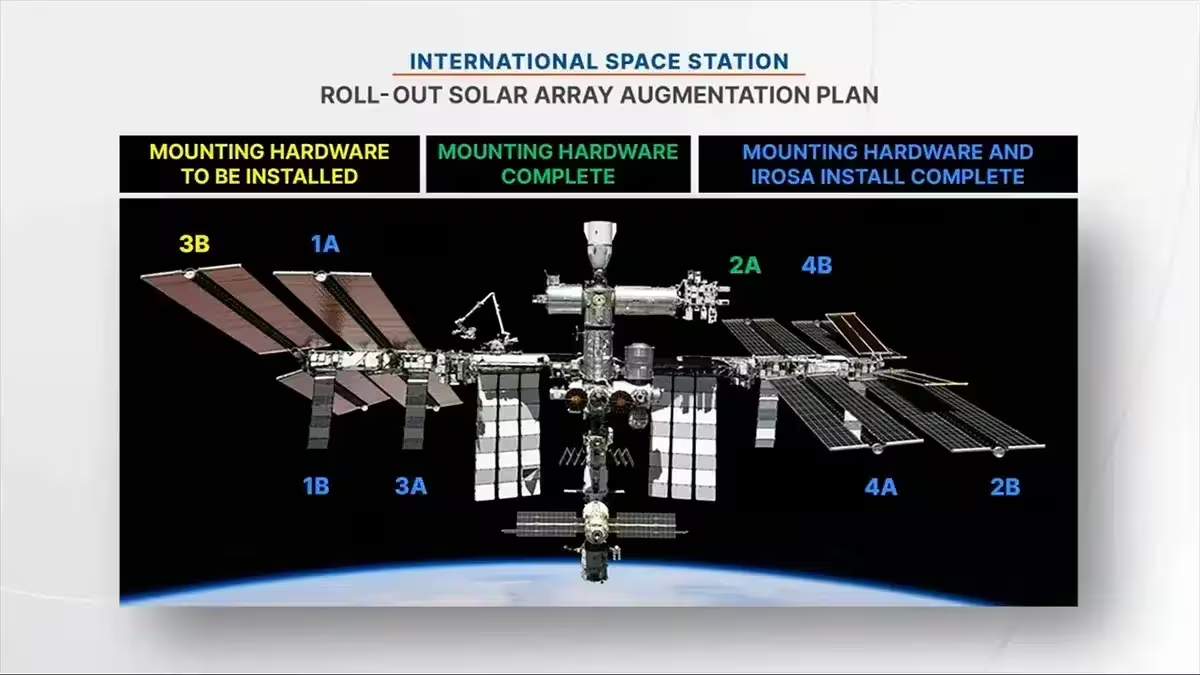
With the brackets in place, the astronauts ran power‑transfer cables from the future solar array to the 3B channel and wrapped the assembly in multi‑layer insulation to guard against micrometeoroid damage.
NASA explains that the new iROSA panels will operate alongside the original wings rather than replace them, compensating for the aging arrays that have already exceeded their 15‑year design life. Once all six new wings are installed, the station’s electrical capacity is projected to rise by roughly 20 % to 30 %, extending its operational envelope in low‑Earth orbit.
A Quick Look at the Moon During the EVA
Halfway through the spacewalk, Meir paused to point out the Moon rising over the horizon, prompting a brief exchange that underscored the station’s role as a stepping stone for NASA’s Artemis program.
“Anil, you can see the moon to the — well, I am not sure what way you’re facing, but…,” said Meir, taking a short break during the spacewalk to notice NASA’s next destination for astronauts under its Artemis program.
“To my right. Yeah, I see it — thanks for the heads‑up,” said Menon. “I can see a future moon base there.”
Also ReadCuriosity Rover Finds Striking Pinstriped Rocks in Gale Crater, Revealing Mars’ Hidden History“I can see it, too!” Meir replied.
The pair’s conversation highlighted how the ISS serves as a testbed for technologies that will later be needed for lunar and Martian expeditions.
Meir later reflected on a milestone that links past and future exploration, recalling the 2012 touchdown of the Curiosity rover on Mars.
“On this day in 2012, NASA’s robotic rover Curiosity successfully landed on the surface of Mars with the goal of understanding if the planet could have fostered life. Curiosity achieved that goal within a year,” she said. “One day, humans will visit Curiosity, propelled by the groundbreaking science, technology demonstrations and operations conducted here on the International Space Station for almost 26 years now.”
Expedition 75 EVA Milestones and Statistics
The Aug. 6 EVA marked the first spacewalk for the Expedition 75 crew. It was Menon’s inaugural extravehicular activity, while Meir logged her sixth EVA.
The operation began at 8:33 a.m. EDT, when the crew switched their suits to internal battery power, and concluded at 3:00 p.m. EDT after re‑entering the Quest airlock. In total, the walk lasted 6 hours 27 minutes, representing the 96th U.S. EVA and the 281st EVA overall dedicated to ISS construction, upkeep, and upgrades.
With the final mounting hardware installed, only two iROSA units remain to be delivered and attached. Six panels have already been deployed since 2021, and the remaining installations will complete the station’s power‑modernization program.
NASA is scheduling additional EVAs later in August to replace aging components, connect new power and data lines, and keep the station’s systems running smoothly as it transitions to its next mission phase.
Looking Ahead: Power Upgrades and Future Missions
The recent walk illustrates how the ISS continues to evolve after nearly three decades in orbit, adapting its infrastructure to meet new scientific and exploration demands. The upgraded solar array network will sustain research activities while supporting NASA’s broader goal of sending humans farther into space.
“Today, we made one more step toward expanding the ISS power system, further sustaining our human presence in low Earth orbit, as we prepare to take those next steps,” said Meir.
As the station readies for its final power‑upgrade phases, it remains a pivotal platform linking current orbital research with the next generation of deep‑space exploration.
This article has been fact checked for accuracy, with information verified against reputable sources. Learn more about us and our editorial process.
Last reviewed on .
Article history
- Latest version
Cite this page:
- Posted by Karan Das