Roman Telescope Set to Uncover Thousands of Hidden Black Holes Through Stellar Deaths
NASA’s Roman Space Telescope may spot distant black holes
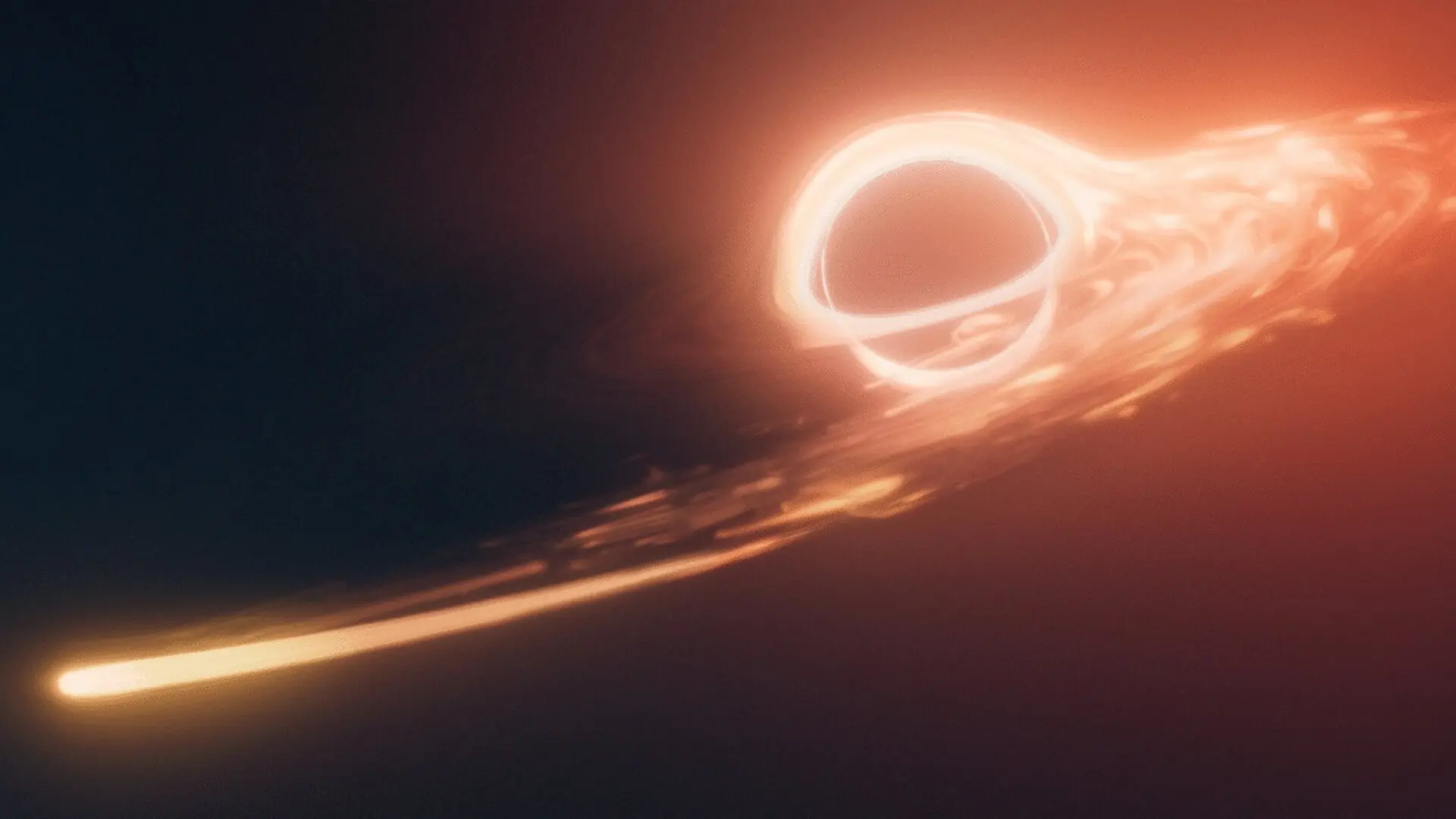
The Nancy Grace Roman Space Telescope is poised to revolutionize the hunt for distant black holes by capturing thousands of transient stellar disruptions across the cosmos. A study released Tuesday in The Astrophysical Journal predicts that Roman’s wide‑field, high‑sensitivity imaging will reveal a previously unseen class of tidal disruption events (TDEs), shedding light on the birth and growth of smaller supermassive black holes throughout cosmic time.
How Tidal Disruption Events Reveal Hidden Black Holes
When a star strays too close to a black hole, the extreme gravitational forces can rip the star apart in a tidal disruption event, producing a bright flare that flags the otherwise invisible black hole. By tracking these fleeting explosions, astronomers can infer the mass, environment, and location of black holes that elude conventional detection methods.
Lead investigator Mitchell Karmen, a graduate researcher and NSF Graduate Research Fellow at Johns Hopkins University, modeled Roman’s ability to spot TDEs at distances far beyond the reach of existing surveys. The analysis focused on black holes with masses of millions of solar masses—objects that are notoriously difficult to identify with traditional techniques.
“The Roman Space Telescope is going to be transformative for transient science,” Karmen said. “Thanks to Roman’s high sensitivity, we can find multiple tidal disruption events out to greater distances and earlier cosmic times than ever before.”
Mapping Black Hole Growth Over Billions of Years
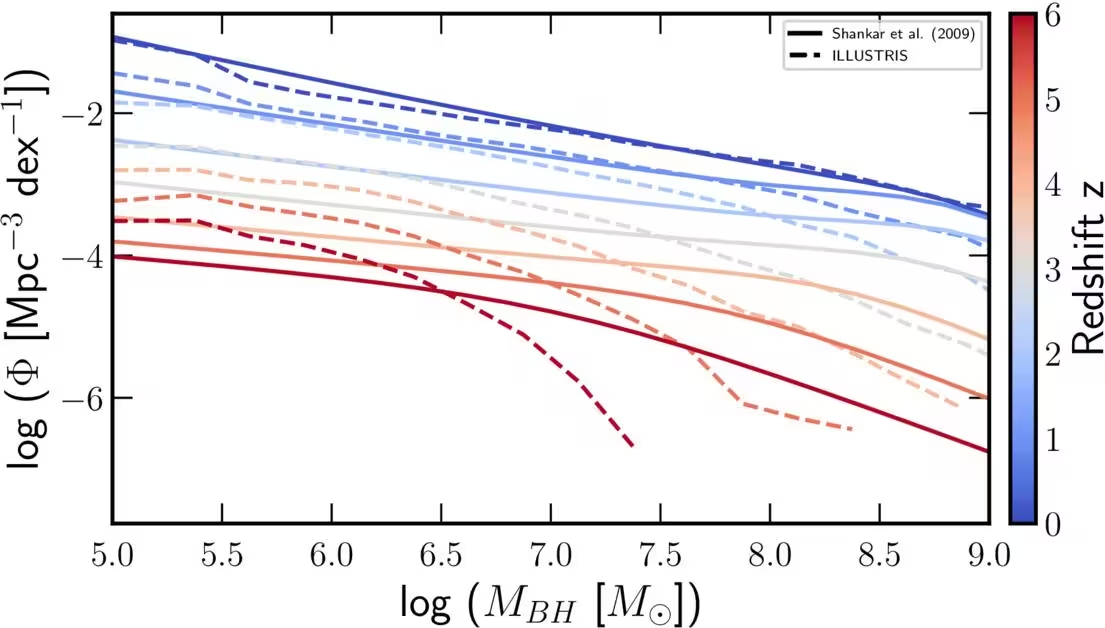
By counting TDEs as a function of redshift, researchers can place quantitative limits on the prevalence of million‑solar‑mass black holes throughout the universe’s history. Co‑author Suvi Gezari, an associate professor of astronomy at the University of Maryland, emphasized that Roman will extend TDE detection to far greater distances, enabling a statistical study of how disruption rates evolve over time.
“Just by counting the number of TDEs as a function of redshift, you can put meaningful constraints on the population of million‑solar‑mass black holes,” Gezari explained. “Roman will be transformative in that it can probe tidal disruption events out to greater distances, so you can look at how the rate of TDEs evolves over time.”
These measurements could address lingering questions about the origins of supermassive black holes, such as whether they grew from smaller seed black holes or emerged via alternative pathways in the early universe. Understanding their distribution across epochs will also illuminate how black holes and their host galaxies co‑evolve.
Roman’s Role in the Next Generation of Transient Surveys
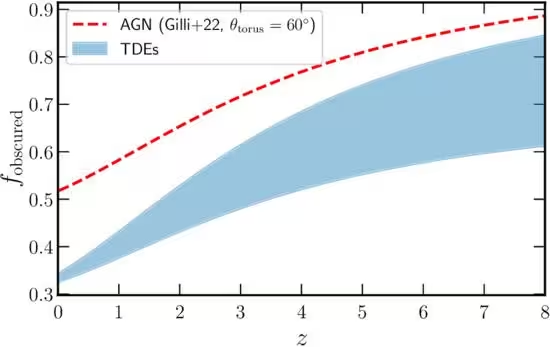
Existing ground‑based and space‑based programs have catalogued only a modest sample of TDEs, predominantly from nearby galaxies. Roman’s planned wide‑area surveys will complement missions such as the James Webb Space Telescope, which focuses on deep observations of distant galaxies, by capturing the rapid, luminous flares that signal black‑hole activity.
“Tidal disruption events help us probe the population of light supermassive black holes, which can help us discriminate between these models,” Karmen added.
With its unprecedented combination of field of view and sensitivity, Roman is set to open a new window on high‑redshift transient phenomena, potentially unveiling black holes from the universe’s formative eras and refining our picture of how these enigmatic objects have shaped galaxy evolution.
This article has been fact checked for accuracy, with information verified against reputable sources. Learn more about us and our editorial process.
Last reviewed on .
Article history
- Latest version
Reference(s)
- Karmen, Mitchell., et al. “Tidal Disruption Event Rates across Cosmic Time: Forecasts for LSST, Roman, and JWST and Their Constraints on the Supermassive Black Hole Mass Function.” The Astrophysical Journal, vol. 1006, no. 1, July 14, 2026, pp. 20 American Astronomical Society, doi: 10.3847/1538-4357/ae7a49. <https://iopscience.iop.org/article/10.3847/1538-4357/ae7a49>.
Cite this page:
- Posted by Karan Das