Teen Discovers 1,
A teen’s hike leads to a rare, well‑preserved ancient ring, proving some relics evade traditional digs.

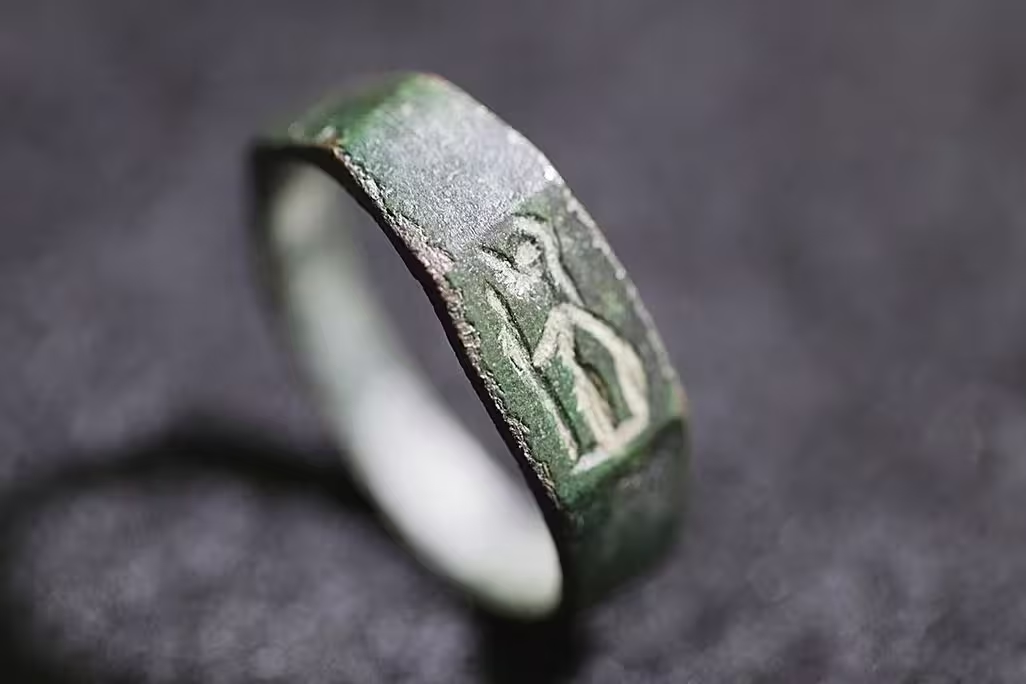
While scouring the slopes of Mount Carmel for fossils, 13‑year‑old Yair Whiteson uncovered a bronze ring that dates back roughly 1,800 years, bearing an image of the Roman goddess Minerva.
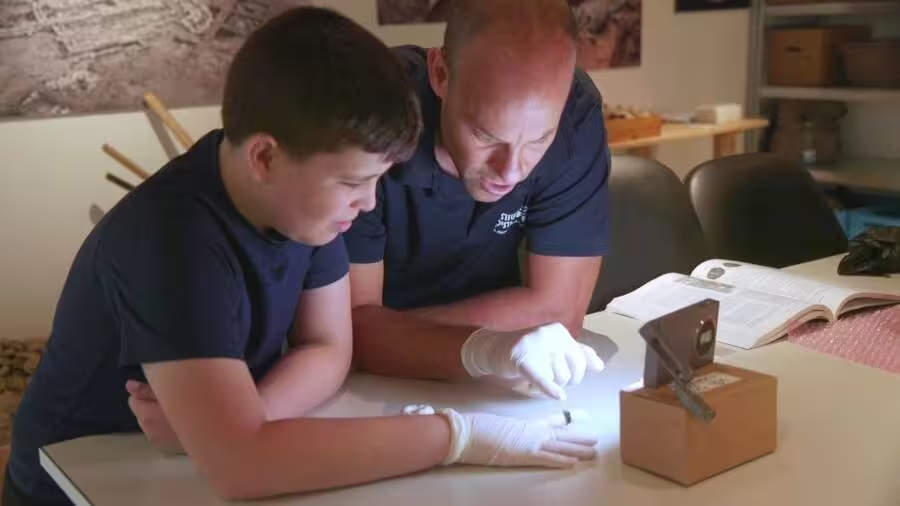
The teenager was exploring a historic quarry with his father when a small, green‑tinged object caught his eye. Initially assuming it was a rusted bolt, he brought the piece home for closer inspection and soon realized it might be far more significant.
From a Corroded Find to a Roman‑Era Treasure
“I am curious about fossils and rocks and love to collect them,” he said in a press release issued by the Israel Antiquities Authority. “While hiking, I noticed a small green item and picked it up. It was corroded, and at first, I thought it was just a rusty bolt. I thought about heating it, but then, fortunately, I understood it was a ring.”
The Israel Antiquities Authority (IAA) subsequently sent the piece to its National Treasures Department. Laboratory analysis confirmed the artifact’s origin in the Late Roman Period and identified the engraved figure as Minerva, the Roman deity of war, strategy and wisdom, known as Athena in Greek mythology.
Engraved Warrior Identified as Minerva
Detailed examination revealed a helmeted, nude figure brandishing a shield and a spear. Researchers Nir Distelfeld and Dr. Eitan Klein from the IAA described the carving as “a helmeted naked figure” and noted that Yair’s initial impression of a warrior was remarkably accurate.
“Yair’s identification of the figure as a warrior is very close to reality. The figure is — apparently, the goddess Minerva from Roman mythology, known also as Athena in Greek mythology,” the experts said.
Possible Origins and Ownership
The bronze ring likely belonged to a woman living in the second or third century CE. Its discovery near an ancient quarry, close to a Roman‑era farmstead and two burial caves, leaves several scenarios open. It could have been a personal adornment of a local resident, a lost item from a quarry worker, or a funerary offering placed in the nearby graves.
“The ring may have belonged to a woman who lived on this farm,” Distelfeld and Klein said. “Or, it might have fallen from a quarry worker, or it may have been a burial offering from these nearby graves. There are many possibilities.”
In recognition of his responsible reporting, the Israel Antiquities Authority awarded Yair a commendation for good citizenship, highlighting the importance of public cooperation in preserving cultural heritage.
This article has been fact checked for accuracy, with information verified against reputable sources. Learn more about us and our editorial process.
Last reviewed on .
Article history
- Latest version
Reference(s)
- “%D7%98%D7%91%D7%A2%D7%AA %D7%91%D7%AA %D7%9B 1800 %D7%A9%D7%A0%D7%94 %D7%A9%D7%A2%D7%9C%D7%99%D7%94 %D7%97%D7%A8%D7%99%D7%AA%D7%94 %D7%A9%D7%9C %D7%90%D7%9C%D7%AA %D7%94%D7%9E%D7%9C%D7%97%D7%9E%D7%94 %D7%94%D7%AA%D7%92%D7%9C%D7%AA%D7%94 %D7%9E%D7%99 %D7%A0%D7%A2%D7%A8 %D7%91%D7%9B%D7%A8%D7%9E%D7%9C.” <https://www.iaa.org.il/page_news/page/%D7%98%D7%91%D7%A2%D7%AA-%D7%91%D7%AA-%D7%9B-1800-%D7%A9%D7%A0%D7%94-%D7%A9%D7%A2%D7%9C%D7%99%D7%94-%D7%97%D7%A8%D7%99%D7%AA%D7%94-%D7%A9%D7%9C-%D7%90%D7%9C%D7%AA-%D7%94%D7%9E%D7%9C%D7%97%D7%9E%D7%94-%D7%94%D7%AA%D7%92%D7%9C%D7%AA%D7%94-%D7%9E%D7%99-%D7%A0%D7%A2%D7%A8-%D7%91%D7%9B%D7%A8%D7%9E%D7%9C>.
- <https://www.researchgate.net/scientific-contributions/Nir-Distelfeld-2241232924>.
- <https://antiquities.academia.edu/EitanKlein>.
Cite this page:
- Posted by Vikram Desai