Scientists Capture First Direct Birth of New Ocean Crust at Southeast Indian Ridge
Scientists filmed a sudden rift on the seafloor between Australia and Antarctica as magma surged upward, capturing the violent event in real time.
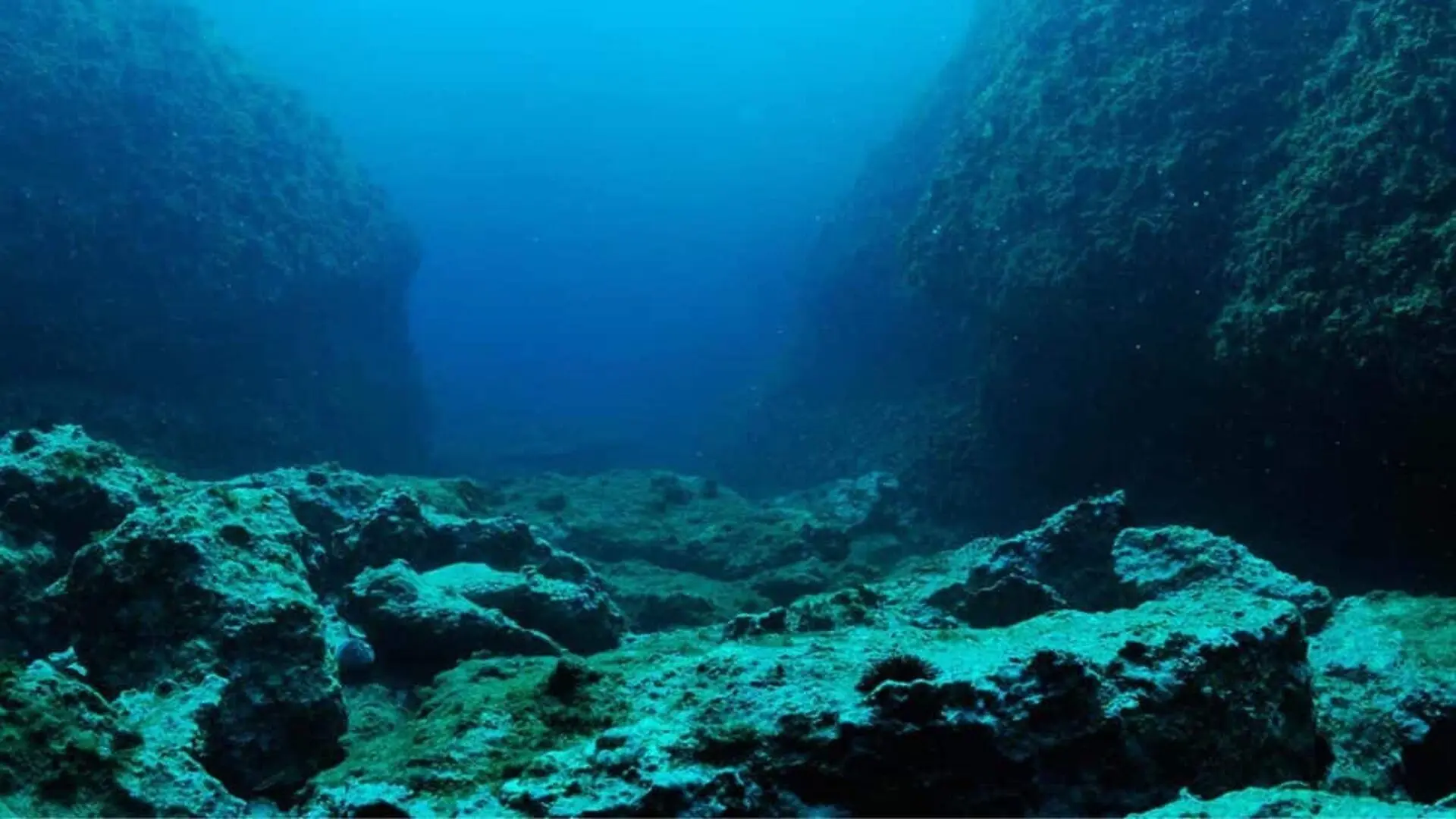
In April 2024 a fissure opened on the seafloor between Australia and Antarctica, and for the first time scientists captured the whole process in real time. The breakthrough, documented in Nature, occurred along the Southeast Indian Ridge, a segment of the underwater mountain chain where fresh oceanic crust is constantly generated. Marine geophysicist Jean‑Yves Royer of the French National Center for Scientific Research had deployed a dedicated observatory there only two months earlier, specifically to record an event of this rarity.
More than two‑thirds of the planet’s surface is formed by such ocean‑floor fractures, where rising magma solidifies into new crust. Because these plate boundaries lie miles beneath the waves, direct observations have been scarce, and researchers have traditionally relied on after‑the‑fact signals. This deployment, however, placed a purpose‑built network of sensors in the path of the ridge’s rupture, documenting everything from the initial tremors to the final lava outpour.
Underground Sensor Array Captured the Ridge’s Sudden Opening
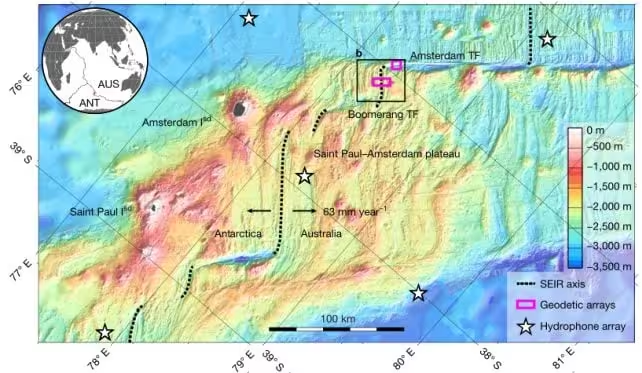
Mid‑ocean ridges compose a connected system extending roughly 65,000 km across the ocean floor. The majority of this system is hidden beneath deep water, making direct study a challenge. Royer’s group targeted the Saint Paul‑Amsterdam volcanic plateau in the Southern Indian Ocean, where the ridge is actively splitting. After years of engineering, they installed a suite of instruments designed to seize a spreading episode as it unfolded.
In late February 2024 the team launched the Observatory with Hydro‑Acoustics and Geodesy near Amsterdam Island, dubbed OHA‑GEODAMS, across a ridge segment near 37° S. The system integrated five autonomous hydrophones for seismic monitoring, 15 acoustic transponders mounted on seafloor tripods to track horizontal displacement, and a bottom‑pressure recorder to sense vertical movements of the valley floor.
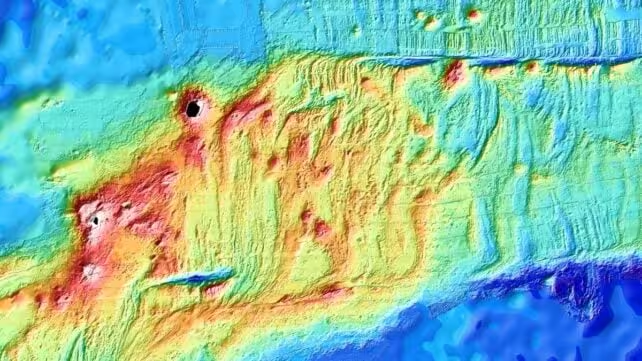
Spreading along the seafloor does not proceed as a slow, continuous creep. Instead, years of stress accumulate before releasing suddenly in what geologists term a quantum event, a combination of earthquakes and magma intrusion. Royer told ScienceAlert that the team had anticipated only modest, steady‑state stretching between such bursts, not a full‑scale rupture so soon after the instruments were activated.
That expectation was upended within weeks. On 26 April 2024, just two months after deployment, a swarm of micro‑earthquakes began marching along the ridge axis, heralding a spreading episode far larger than the team had predicted, with the sensor suite positioned to capture virtually the entire sequence.
Magma Forced Its Way Through the Crust in Less Than Two Hours
The seismic swarm signaled the onset of a rapid subsurface chain reaction. Built‑up pressure found an outlet through sheet‑like magma intrusions known as dikes, which ripped through the crust in under two hours, according to Royer. The rupture propagated first toward the southeast, then reversed direction and advanced roughly nine kilometres northwest—a behavior typical of dikes breaching a ridge axis.
As the dikes moved, they generated earthquakes, re‑activated dormant faults, and drained the magma chamber beneath the segment. The authors estimate the event injected about 150–160 million m³ of magma into the crust and onto the seafloor, a volume comparable to other mid‑ocean‑ridge eruptions.
When the reservoir emptied, the valley floor subsided by 4.2 m over six days, with 83 % of the drop occurring in the first 16 hours. Rising water‑temperature readings from the pressure sensor indicate that lava reached the seafloor within hours of the initial earthquakes, flowing up through the newly formed dikes.
The eruption gradually waned over the following days and finally tapered off. Hydroacoustic signatures associated with lava‑water interaction persisted until early May, suggesting the main eruptive phase lasted roughly 16 days, followed by a smaller burst in mid‑June.
Two Weeks Captured Decades of Plate Motion
The rate of displacement was extraordinary. At its peak the ridge opened at about 5 cm min⁻¹—nearly half a million times faster than its long‑term average of 6.3 cm yr⁻¹. Sensors recorded total horizontal shifts of roughly 2–4 m.
Royer likened this to 30–60 years of continuous spreading at the ridge’s usual speed. Some baselines elongated by more than a metre, while opposite‑side baselines contracted by a similar amount, reflecting simultaneous extension on one flank and fault slip on the other.
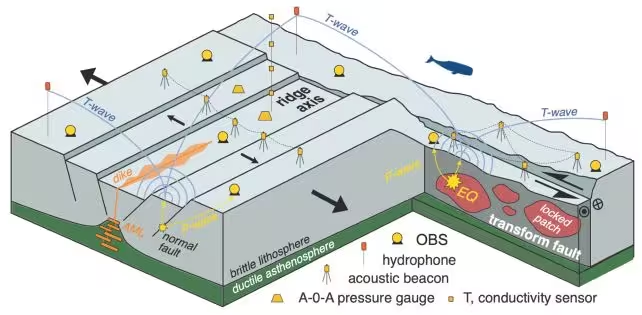
Repeated seafloor mapping documented the physical imprint: fresh lava flows exceeding 90 m in thickness in places, spread across several patches that trace the dikes’ bidirectional paths. Minutes after the dike ceased advancing, nearby transform faults generated their own earthquakes, including a magnitude 5.9 event, confirming that the dike intrusion triggered rupture on adjacent faults.
New Data Clarify the Mystery of “Missing” Plate Motion
The observations answer a longstanding question in geophysics. While the overall plate‑separation rate at ridges like this one is well known, the sum of recorded seismic slip has historically fallen short of the total motion inferred from plate tectonics. In other words, the plates seemed to move farther than seismic data alone could explain.
Royer’s team identified where the “missing” motion occurred. A substantial portion unfolded aseismically, meaning the faults slipped silently without generating strong seismic waves. Modeling suggests that only about a quarter of the total displacement during the 2024 event produced detectable earthquakes, leaving the majority as silent slip—far more aseismic activity than traditional catalogs would indicate.
This imbalance helps explain why mid‑ocean ridges emit relatively little seismic energy despite undergoing rapid deformation over geological time. The researchers propose their dataset as a ground‑truth benchmark for testing seismic records from other ridges, and Royer noted that with adequate preparation, direct measurement of seafloor spreading is now within reach.
This article has been fact checked for accuracy, with information verified against reputable sources. Learn more about us and our editorial process.
Last reviewed on .
Article history
- Latest version
Reference(s)
- Royer, Jean-Yves., et al. “Anatomy of a seafloor spreading event captured by in situ seismogeodesy.” Nature, July 8, 2026 Springer Science and Business Media LLC, doi: 10.1038/s41586-026-10785-0. <https://doi.org/10.1038/s41586-026-10785-0>.
Cite this page:
- Posted by Vikram Desai