Ancient Egyptian Stone Disk Looks Like a Hubcap but Archaeologists Say It Was a Ritual Offering
A 5,000‑year‑old tomb’s stone disk, whose modern‑looking shape baffles archaeologists, sparks ongoing debate over its original purpose.
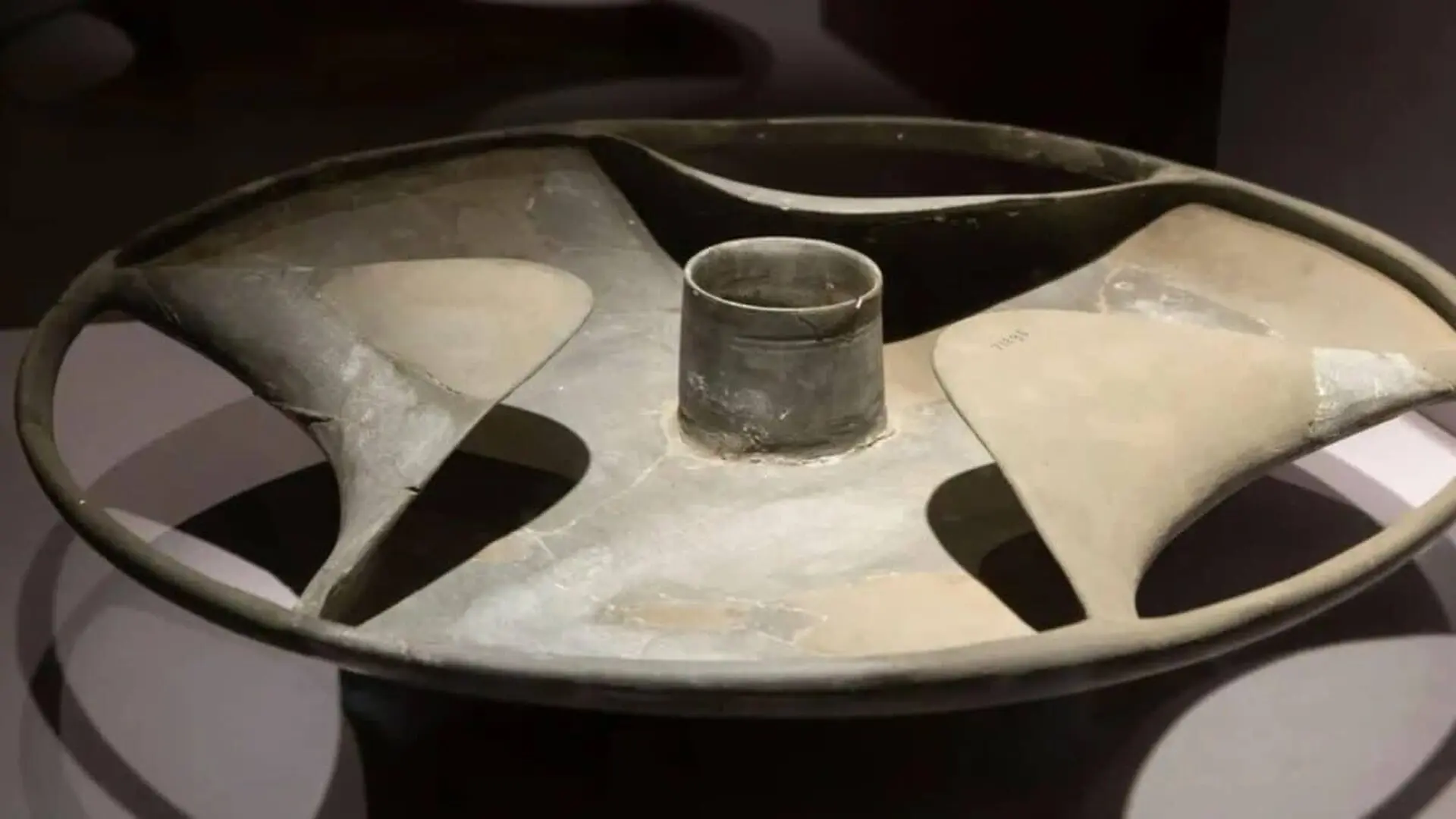
Unearthed nearly a hundred years ago in a First Dynasty burial, the stone object known as the Sabu Disk continues to intrigue scholars with its unconventional silhouette. While its form has sparked imaginative hypotheses, most experts now favor a straightforward functional explanation.
The artifact was recovered in 1936 from the tomb of Sabu, an official interred at the Saqqara necropolis around 3100–2900 B.C.. Broken into several shards, the pieces were painstakingly reassembled and are now displayed in the Egyptian Museum in Cairo.
Seen from above, the stone’s three sweeping lobes resemble a modern hubcap, propeller, or steering wheel—an uncanny likeness that has kept the piece in the public eye for decades.
A High‑Status Grave Unearthed
British Egyptologist Walter Emery led the excavation that revealed Sabu’s burial chamber, which, according to a paper in Archaeological Discovery, had already been robbed of its jewelry and precious metals.
Despite the looting, the tomb still contained a rich assemblage: Sabu’s remains lay within a wooden coffin, accompanied by numerous stone and pottery vessels, flint and copper tools, the skeletons of two oxen, and the now‑famous stone disk.
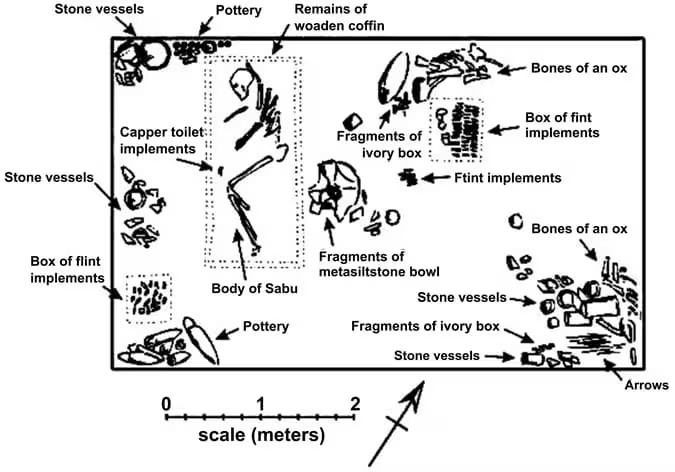
The disk survived only as a collection of fragments, which archaeologists later joined to permit a detailed examination of its atypical geometry.
An Unusual Stone Vessel
Measuring about 24 inches (61 cm) in diameter and standing 3.9 inches (10 cm) tall, the piece was carved from metasiltstone, a mildly metamorphosed sedimentary rock.
Egyptian archaeologist Ali El‑Khouli notes that broad, shallow stone bowls were a common feature of First‑ through Third‑Dynasty tombs. What sets this example apart are the three slender, curved extensions that rise from the rim toward a central aperture.
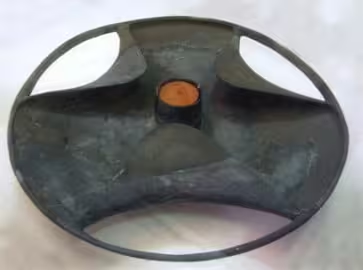
Its sleek, almost contemporary silhouette explains why the object has remained a focal point of public fascination since its discovery.
Speculative Theories and Everyday Uses
Because of its distinctive shape, the disk has been linked to a range of speculative functions. Live Science has reported suggestions that it might have acted as a water turbine, while other fringe ideas propose connections to alien technology. A more grounded proposal sees the vessel serving as a mash tun for brewing beer.
Nevertheless, the consensus among Egyptologists is that the Sabu Disk performed the same routine role as other large stone bowls of the era—holding foodstuffs or oil—rather than functioning as a mechanical device.
The choice of metasiltstone, its delicate carving, and the fragility of the finished object suggest it was never meant for daily handling. Instead, it was likely intended as a funerary offering, placed alongside the other grave goods to accompany Sabu into the afterlife.
This article has been fact checked for accuracy, with information verified against reputable sources. Learn more about us and our editorial process.
Last reviewed on .
Article history
- Latest version
Reference(s)
- “Walter Bryan Emery | Artefacts of Excavation.” <https://egyptartefacts.griffith.ox.ac.uk/people/walter-bryan-emery/>.
- Kato, Akio. “The Tri-Lobed Disc in the Tomb of Sabu and the Basins at the Sun Temple Were for Beer.”, vol. 10, no. 1, January 5, 2022, pp. 35-59. Scientific Research Publishing, doi: 10.4236/ad.2022.101002. <https://www.scirp.org/journal/paperinformation?paperid=114435>.
- “Ali Abdel-Rahman Hassanain el-Khouli | Artefacts of Excavation.” <https://egyptartefacts.griffith.ox.ac.uk/people/ali-abdel-rahman-hassanain-el-khouli/>.
- Killgrove, Kristina. “Sabu Disk: A mysterious 5,000-year-old Egyptian stone sculpture that looks like a hubcap.”, August 11, 2025 Live Science <https://www.livescience.com/archaeology/ancient-egyptians/sabu-disk-a-mysterious-5-000-year-old-egyptian-stone-sculpture-that-looks-like-a-hubcap>.
Cite this page:
- Posted by Vikram Desai