Dusty Trail Reveals Runaway Supermassive Black Holes Kicked From Their Galaxies
A faint cosmic signal could unlock the hunt for fast‑moving supermassive black holes traveling across the universe for millions of years.
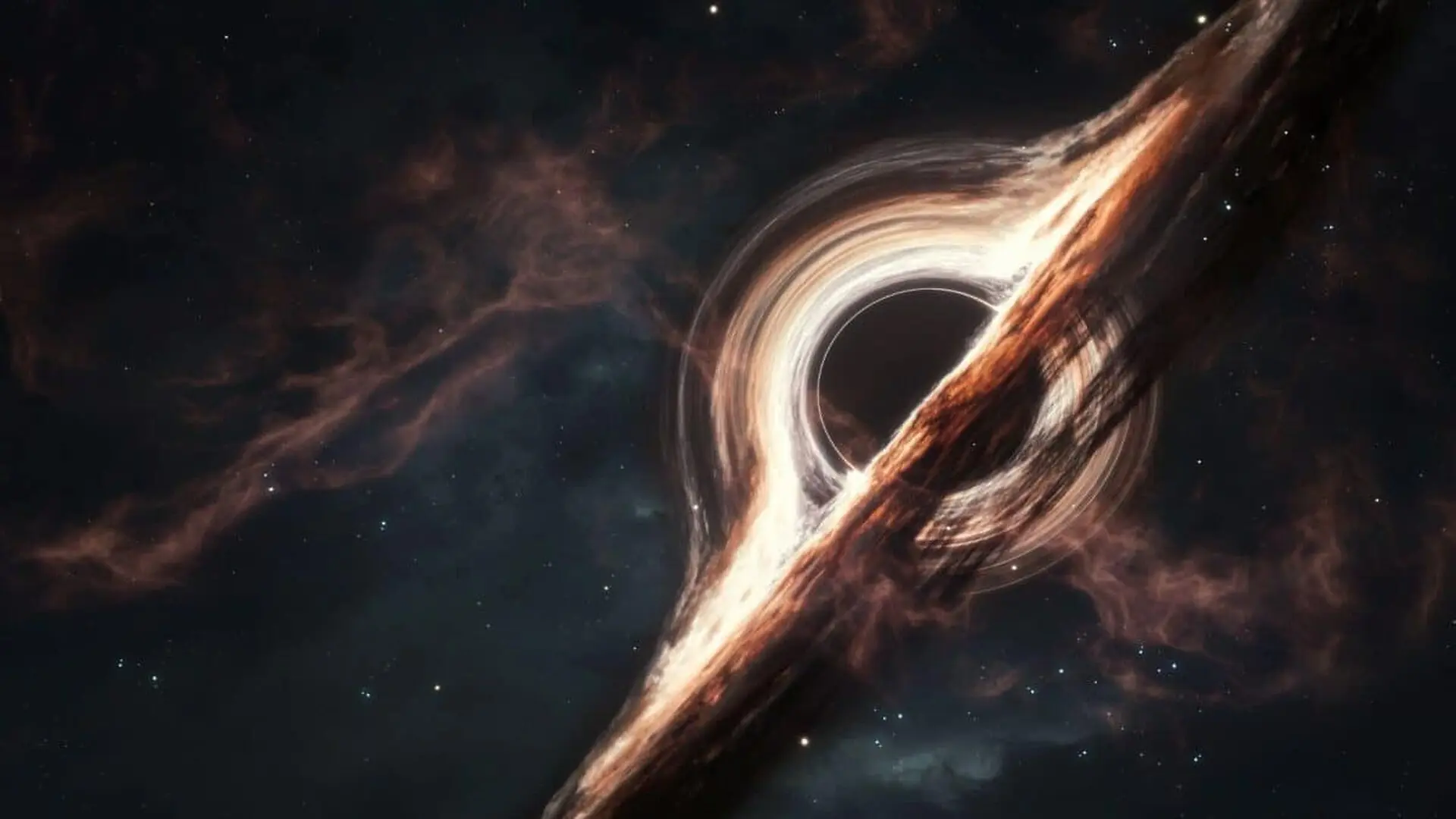
A fresh analysis suggests that the dusty shroud surrounding quasars could serve as a beacon for identifying runaway supermassive black holes, the massive remnants that may be expelled from their host galaxies after a merger.
Gravitational‑Wave Kicks Can Launch Merged Black Holes at Extreme Speeds
When two galaxies collide, their central supermassive black holes spiral inward and eventually coalesce. According to Einstein’s general relativity, the merger releases gravitational waves that can carry momentum unevenly if the black holes differ in mass or spin orientation. This imbalance imparts a powerful recoil, capable of propelling the newly formed black hole at velocities of hundreds to thousands of kilometers per second.
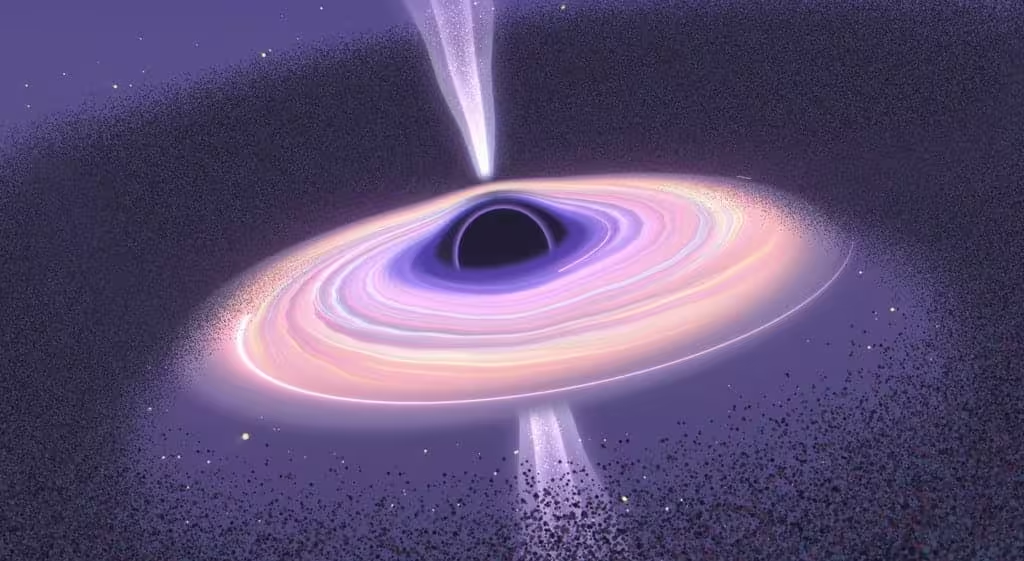
Although the theoretical framework for such “recoiling” black holes has existed for years, direct observational evidence remains scarce because clear signatures are difficult to isolate.
Dust Envelopes May Hold the Missing Evidence
The recent arXiv paper investigates the material that stays gravitationally bound to a black hole after it receives a kick. The authors argue that the innermost portion of the accretion disk, associated with the Broad Line Region, should travel with the displaced black hole, carrying dust that can be measured through infrared emission.
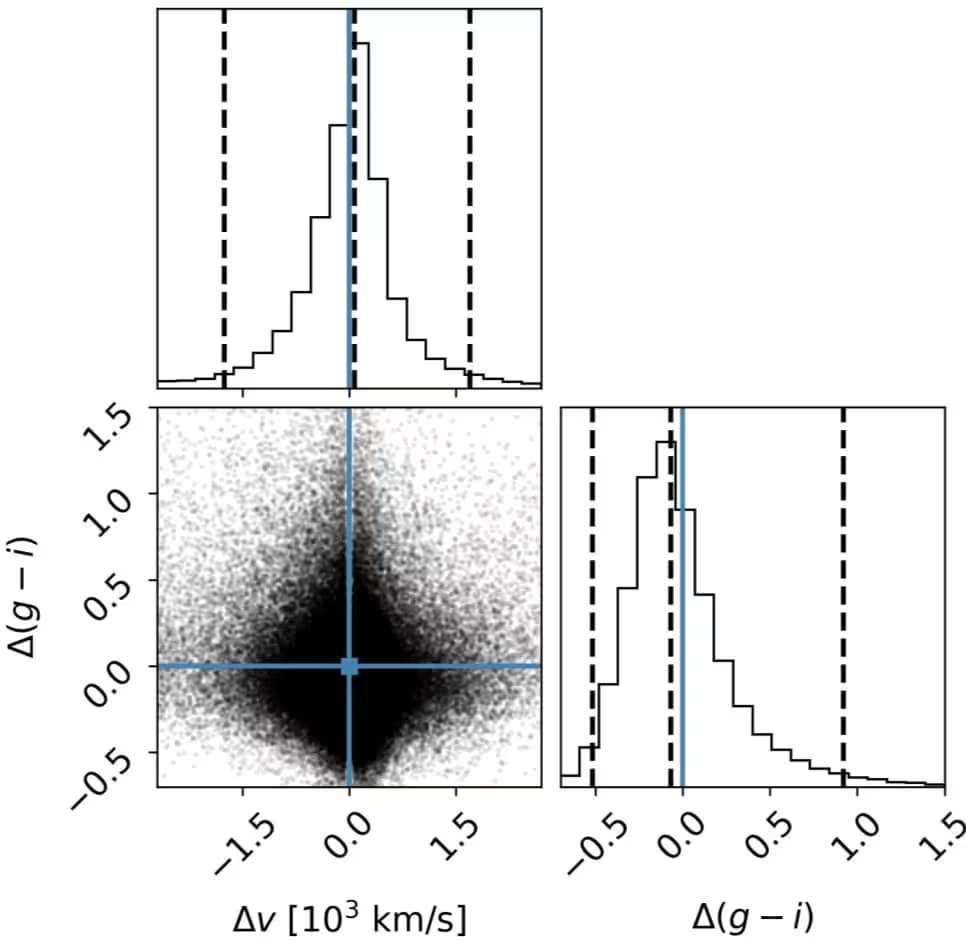
By comparing quasar velocity offsets with the amount of surrounding dust, the team uncovered a modest yet statistically significant positive correlation. To test whether this link might arise by chance, they repeated the analysis using only the Narrow Line Regions, which are expected to remain stationary after a recoil. In that subset the correlation vanished, reinforcing the idea that dust tied to the Broad Line Region traces the black hole’s motion.
Unexpected Dust Distribution Challenges Simple Models
Contrary to the straightforward recoil expectation, the study found that quasars with blue‑shifted velocity offsets—indicating motion toward Earth—tended to exhibit higher dust content than those receding from us. The authors suggest that this reversal could stem from biases in spectral‑line fitting or from additional physical mechanisms influencing the dust environment, though no definitive explanation emerged.
Implications for Quasar Demographics and Future Searches
The researchers emphasize that their findings describe a statistical relationship rather than a direct cause‑and‑effect link. Nonetheless, they estimate that up to 50 % of known quasars may have originated from relatively recent supermassive black hole mergers. If so, the dust signature highlighted in this work could become a valuable tool for pinpointing recoiling black holes in upcoming surveys.
This article has been fact checked for accuracy, with information verified against reputable sources. Learn more about us and our editorial process.
Last reviewed on .
Article history
- Latest version
Reference(s)
- Bécsy, Bence. “Statistical evidence for massive black hole recoils in active galactic nuclei.” arXiv.org <https://arxiv.org/abs/2605.04781>.
- <https://www.open.edu/openlearn/science-maths-technology/introduction-active-galaxies/content-section-5.3.1>.
- <https://www.open.edu/openlearn/science-maths-technology/introduction-active-galaxies/content-section-5.3.2>.
Cite this page:
- Posted by Aisha Ahmed