Euclid’s One-Day Mosaic of 60 Million Stars Sets Baseline for Future Exoplanet Microlensing
ESA’s Euclid telescope captures the largest high‑resolution visible‑light image of the Milky Way’s core, mapping 60 million stars to aid exoplanet research.
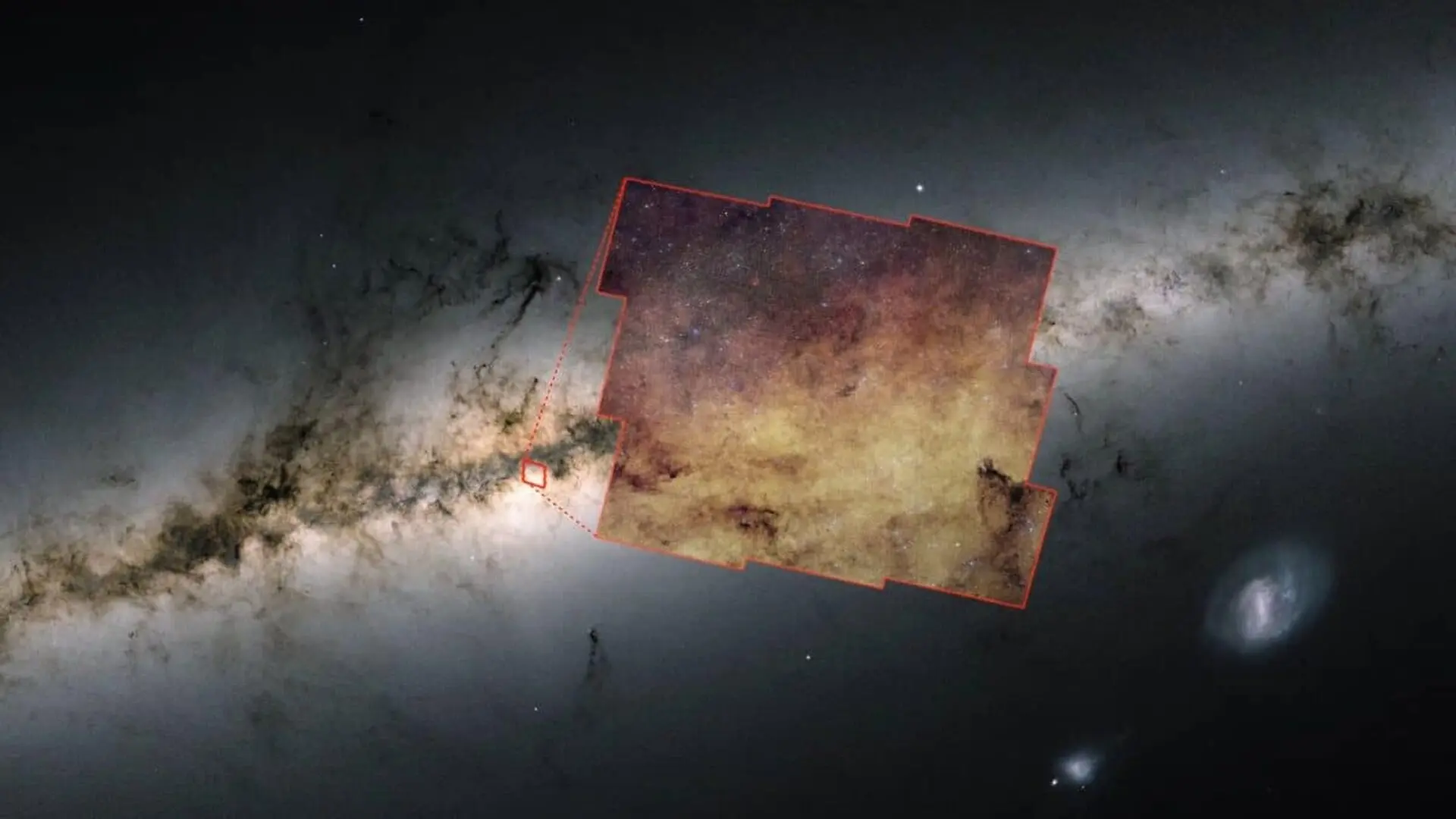
While the European Space Agency’s Euclid telescope was primarily built to chart the cosmos for dark matter and dark energy, a single‑night campaign turned its gaze toward the crowded heart of our own galaxy. The resulting map supplies astronomers with a long‑term benchmark that can be used to verify exoplanet detections and weigh their masses when later observations capture gravitational microlensing events.
The bulge scan took place on 23 March 2025 and lasted roughly 26 hours. Instead of hunting for fresh worlds during that interval, Euclid recorded millions of stellar sources, establishing a comprehensive pre‑event snapshot for future microlensing studies.
One‑Day Survey Yields Unprecedented Galactic Bulge Mosaic
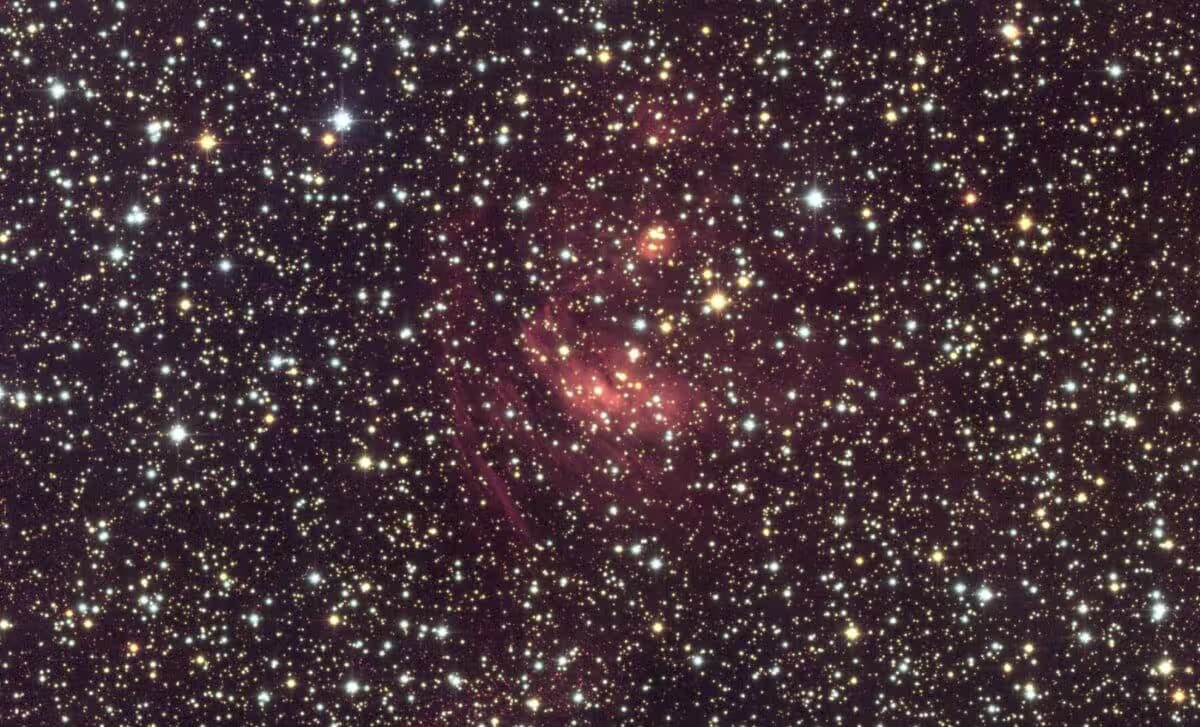
ESA reports that the telescope stitched together nine separate pointings—each covering an area larger than the full Moon—into a single mosaic that features more than 60 million stars, along with clusters and nebulae spread across the dense central bulge. The visible‑light camera on Euclid delivers sharpness and sensitivity comparable to Hubble’s wide‑field instrument, yet each exposure spans a region roughly 270 times wider than Hubble’s field of view. By contrast, reproducing the same coverage from the ground with the Keck Observatory would require around 2 000 hours of observing time.
The assembled image also encompasses the entire zone that NASA’s upcoming Nancy Grace Roman Space Telescope will monitor in its quest for distant exoplanets.
Jean‑Philippe Beaulieu, a researcher at the Institut d’Astrophysique de Paris and the University of Tasmania, originally championed the bulge survey and co‑led the Euclid Consortium’s exoplanet working group.
The densely packed stellar backdrop of the bulge makes it an ideal arena for gravitational microlensing, a phenomenon that depends on the fortuitous alignment of two stars. When a nearer star passes in front of a more distant one, its gravity bends and brightens the background light; a planet orbiting the foreground star adds a smaller, tell‑tale fluctuation that can betray its presence.
“To capture microlensing you must observe sky regions teeming with stars, such as those near the centre of our galaxy,” Beaulieu explained. He noted that ground‑based surveys have uncovered roughly 300 exoplanets via microlensing over the past two decades, all aimed toward the galactic centre. The new Euclid mosaic already includes 51 previously identified planetary systems and will help researchers probe many more.
Baseline Image Set to Aid Future Exoplanet Mass Determinations
A typical microlensing episode unfolds over more than 20 days, meaning Euclid’s one‑day snapshot cannot itself reveal new planets. Its true value lies in providing a reference frame of the stars before any alignment occurs. Natalia Rektsini of the Institut d’Astrophysique de Paris coordinated the public release of the bulge dataset and emphasized that Euclid has already captured the stars that will later participate in microlensing events targeted by the Roman telescope.
“In a 24‑hour window Euclid has documented the stars involved in all forthcoming microlensing events that Roman will detect, but before the stars and planets line up,” Rektsini said.
Astronomers can now compare this historic image with subsequent observations, tracking stellar motions and isolating the subtle brightening signatures that indicate planetary companions. The approach also enables mass estimates for the planets once their lensing effects are measured.
Beyond exoplanets, the same dataset is poised to support investigations of brown dwarfs, binary star systems, stellar kinematics and the distribution of interstellar dust throughout the Milky Way.
Among the cataloged objects are the host stars of two cold exoplanets of particular interest, notably OGLE‑2013‑BLG‑341Lb—a binary star with a single planet. By merging earlier Keck and Hubble measurements with Euclid’s fresh view, scientists anticipate separating the stellar components more cleanly and pinning down the planet’s mass.
Although the bulge survey spanned only about a day, ESA asserts that the resulting archive will serve future missions for years to come. As stars gradually drift apart, researchers can juxtapose Euclid’s baseline with both earlier and later datasets, sharpening studies of exoplanets and a broad array of galactic phenomena.
This article has been fact checked for accuracy, with information verified against reputable sources. Learn more about us and our editorial process.
Last reviewed on .
Article history
- Latest version
Reference(s)
- “Jean-Philippe Beaulieu.” <https://www.iap.fr/useriap/beaulieu/Pages/cv_jp.htm>.
- <https://www.researchgate.net/profile/Natalia-Rektsini>.
Cite this page:
- Posted by Aisha Ahmed