GWTC‑5 Catalog Shows 390 Black Hole Mergers, Including Record‑Precise Localization
Scientists release a massive new catalog of cosmic events, marking a decade since the first gravitational wave detection.
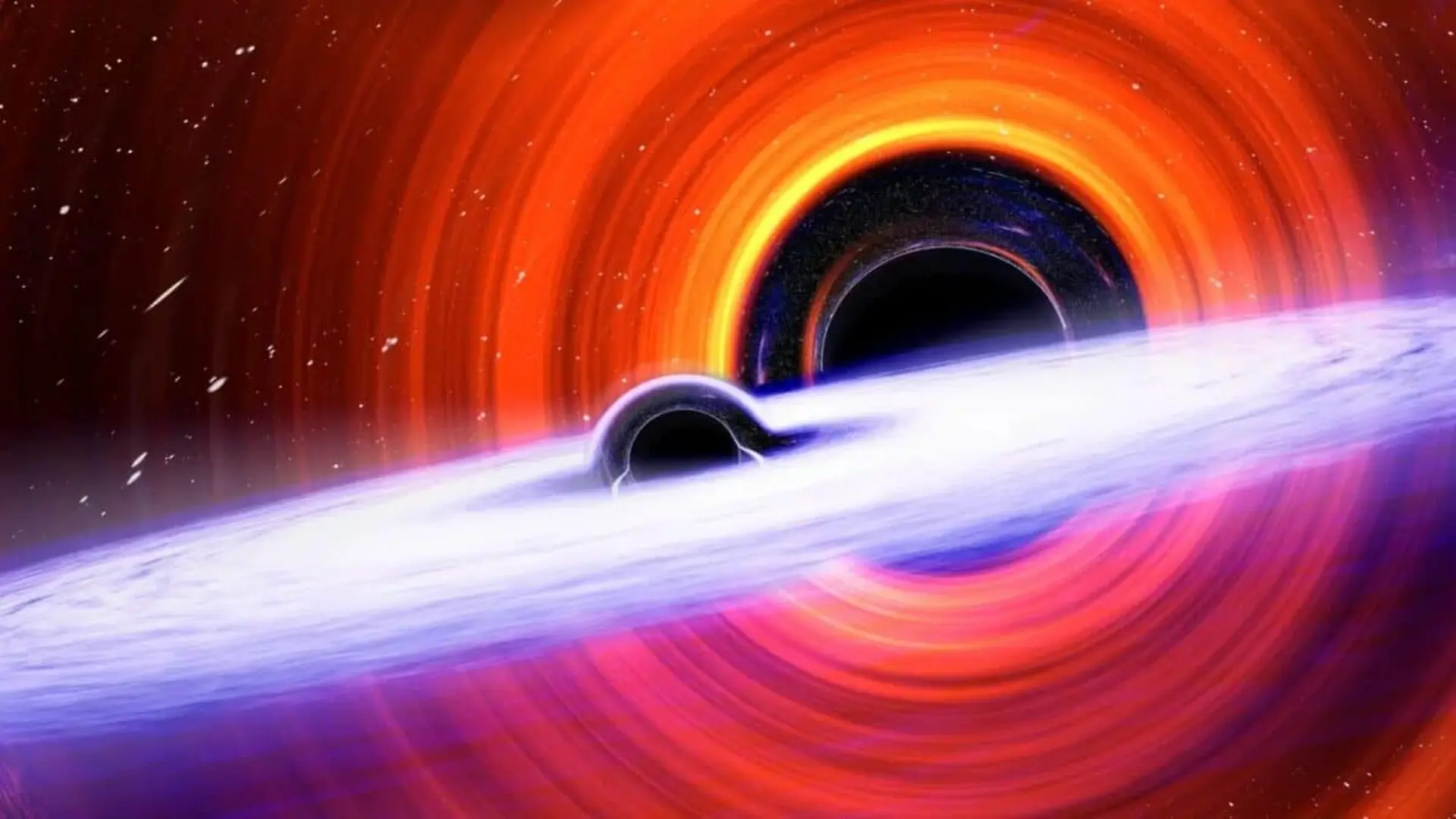
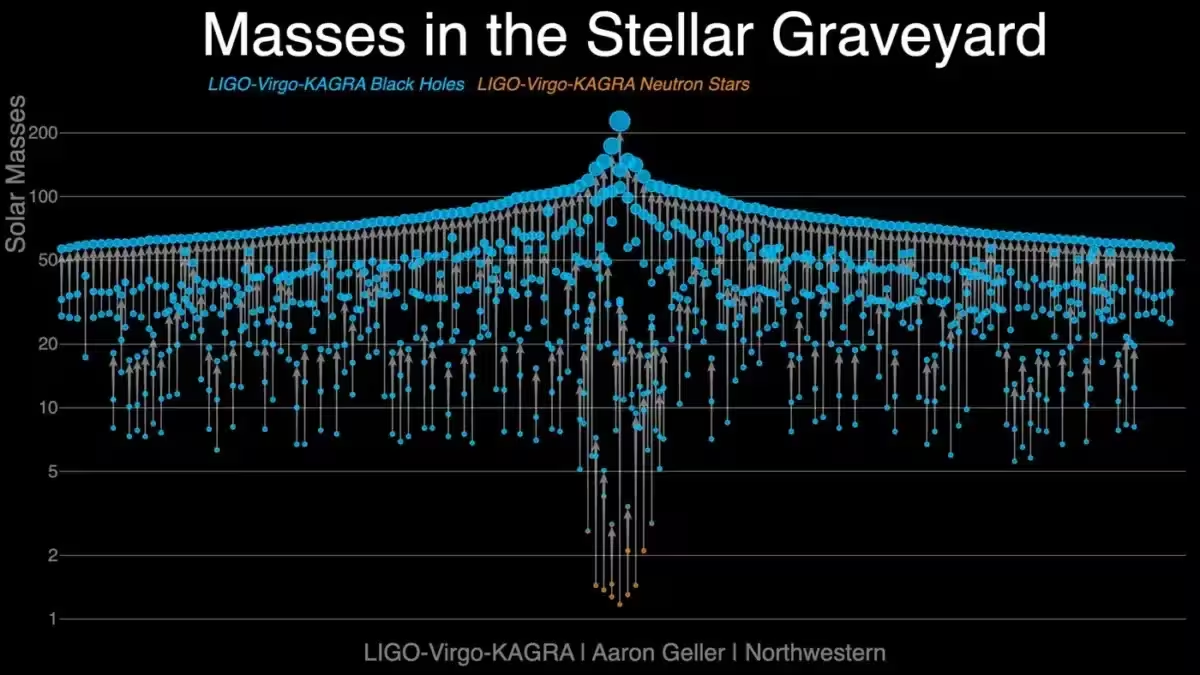
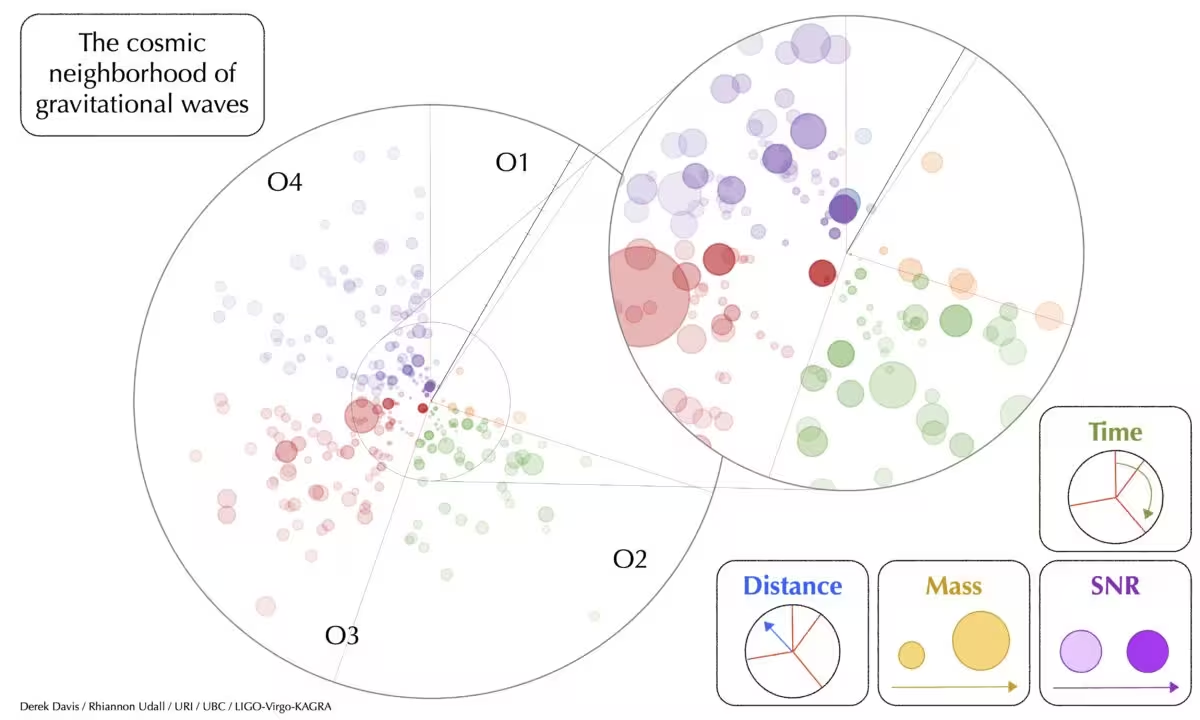
A fresh release from the LIGO‑Virgo‑KAGRA partnership expands the roster of confirmed gravitational‑wave events to 390, adding 161 new black‑hole mergers. The dataset, compiled from observations between April 2024 and January 2025, supplies unprecedented detail on black‑hole formation, spin dynamics and cosmological distance measurements.
The international LVK collaboration—combining the United States‑based LIGO detectors, Italy’s Virgo interferometer and Japan’s KAGRA observatory—has now amassed a catalog that spans a decade of detections, moving the field from a handful of isolated signals to a robust statistical sample.
GWTC‑5 Boosts Event Count and Delivers Novel Measurements
According to the University of Glasgow, the new Gravitational Wave Transient Catalogue‑5 (GWTC‑5) contributes 161 previously unreported signals, raising the total of verified mergers to 390. Beyond sheer numbers, the release supplies the first evidence for second‑generation black holes, the most precise sky‑localization achieved for a gravitational‑wave source, and the inaugural detection of three distinct quasi‑normal modes ringing a black hole after coalescence.
Glasgow researchers have been integral to gravitational‑wave science since the 1970s, notably contributing ultra‑sensitive mirror suspension technology that underpins NSF LIGO’s ability to detect minuscule space‑time ripples. Their ongoing work improves detector sensitivity and refines data‑analysis pipelines.
Dr. Daniel Williams, research fellow at the Institute for Gravitational Research and co‑chair of the LSC’s Compact Binary Science Working Group, highlighted the collaborative effort that made the expanded catalog possible.
“Just ten years ago we made the first detection of gravitational waves from one of these events, and it’s a real testament to the work of hundreds of scientists around the world that we’re now detecting and analyzing hundreds of them.”
Record‑Setting Mergers Reveal New Astrophysical Detail
Among the newcomers, the event designated GW240615 achieved the tightest localization to date. Recorded on June 15, 2024 by the twin LIGO sites and Virgo, the merger involved black holes of roughly 26 and 30 solar masses and was traced to a sky region no larger than six square degrees, despite originating more than three billion light‑years away.
Another standout, GW250114, delivered the strongest signal ever captured, with a signal‑to‑noise ratio of 76.9. This burst arose from a pair of 32‑ and 34‑solar‑mass black holes colliding over a billion light‑years from Earth.

The exceptional fidelity of GW250114 enabled the most stringent test of general relativity to date and provided the first observational confirmation of Stephen Hawking’s black‑hole area theorem. Dr. John Veitch noted that the measured increase in the combined event‑horizon area matched Hawking’s prediction.
Statistical Analyses Uncover Diverse Black‑Hole Origins
A companion paper to GWTC‑5 examined 267 gravitational‑wave sources—including 104 fresh detections—to explore correlations among mass, spin and distance. The study, which linked to a broader investigation of black‑hole populations, found that objects in different mass brackets exhibit distinct spin characteristics, suggesting multiple formation channels.
Two late‑2024 mergers, GW241011 and GW241110, displayed spin signatures consistent with the larger component having arisen from a prior black‑hole merger rather than a direct stellar collapse.
The expanded event set also strengthens gravitational‑wave cosmology. Alex Papadopoulos explained that the Hubble constant—describing the universe’s expansion rate—can be derived from gravitational‑wave distances, either directly from the signal or by identifying the host galaxy.
“The rate of this expansion is described by a value called the Hubble constant. Gravitational waves allow us to measure this by estimating how far away merging objects are, either directly from the signal itself or by identifying the galaxy where the merger took place.”
Improvements in Virgo’s sensitivity have sharpened sky‑localization, while software contributions from the University of Glasgow accelerated analysis by more than a thousandfold, enabling rapid testing of diverse astrophysical scenarios.
This article has been fact checked for accuracy, with information verified against reputable sources. Learn more about us and our editorial process.
Last reviewed on .
Article history
- Latest version
Reference(s)
- “Astrophysicists strike black gold with treasure trove of gravitational wave detections.” <https://www.gla.ac.uk/news/headline_1267010_en.html>.
- “University of Glasgow - Schools - School of Physics & Astronomy - Our staff - Dr Daniel Williams.” <https://www.gla.ac.uk/schools/physics/staff/danielwilliams/>.
- “University of Glasgow - Schools - School of Physics & Astronomy - Our staff - Dr John Veitch.” <https://www.gla.ac.uk/schools/physics/staff/johnveitch/>.
- “Alex Papadopoulos.” UCL Faculty of Social & Historical Sciences <https://www.ucl.ac.uk/social-historical-sciences/geography/research/research-centres/extreme-citizen-science-excites/people/alex-papadopoulos>.
Cite this page:
- Posted by Aisha Ahmed