Astronomers Discover Star With Record Breaking Orbit Around Milky Way Black Hole
Astronomers have discovered S301, a star orbiting Sagittarius A* at 8.5% the speed of light, offering a unique new way to measure the black hole’s spin.
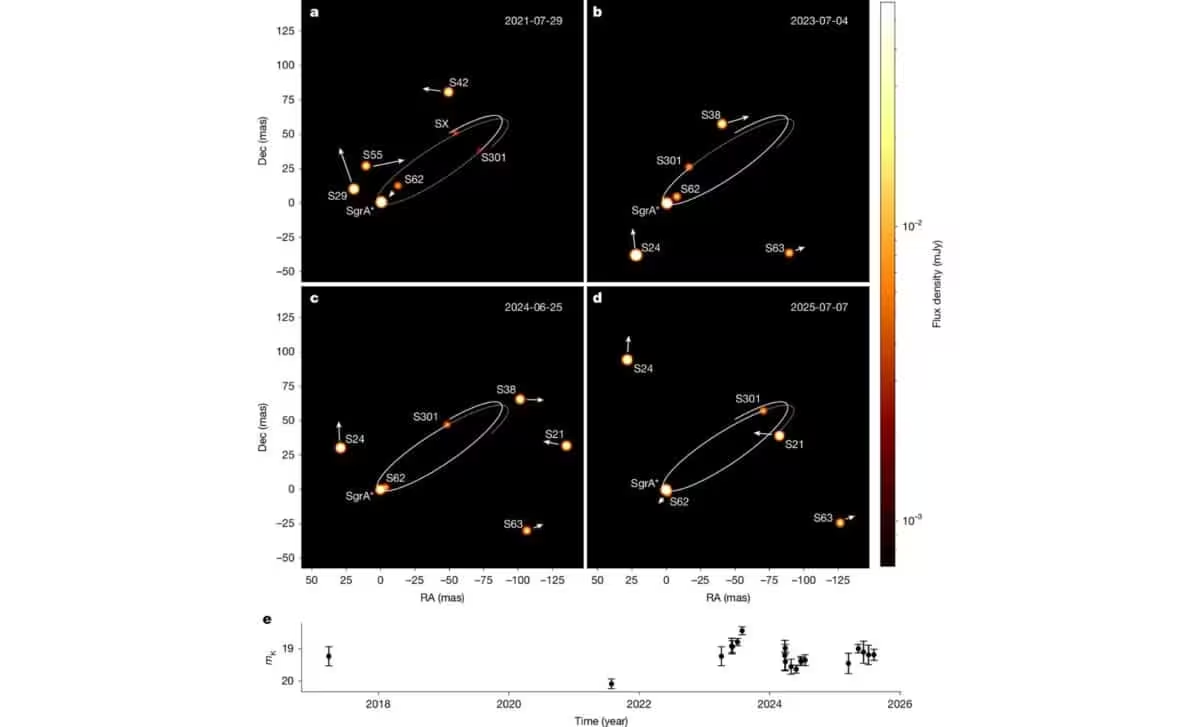
Astronomers have identified a new stellar resident in the immediate vicinity of the Milky Way’s central black hole that is set to rewrite our understanding of gravity in the galactic core. Known as S301, this faint main-sequence star currently holds the record for the fastest and tightest orbit around Sagittarius A*, completing a full circuit in just 8.7 years. This discovery provides a rare, high-precision laboratory for testing the laws of physics under the influence of an object with 4.3 million times the mass of the Sun.
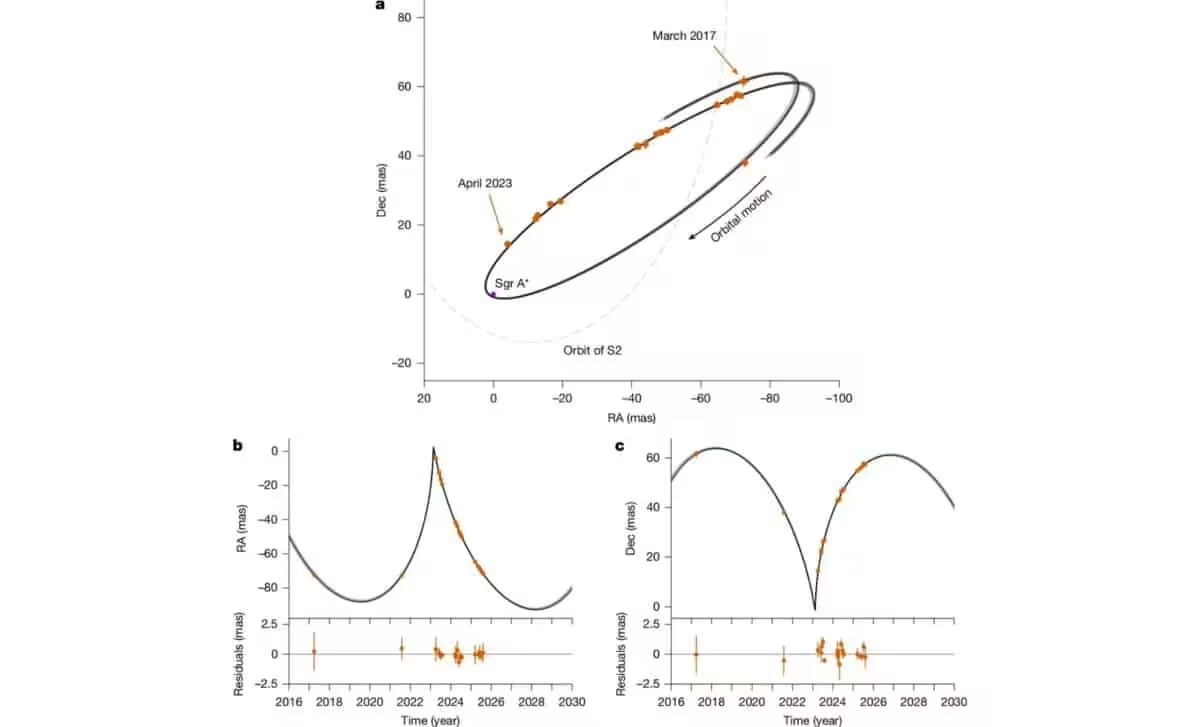
The study, published in Nature, details how researchers used the GRAVITY instrument at the European Southern Observatory’s Very Large Telescope Interferometer to track the star’s movement. By piecing together astrometric data collected between 2017 and 2023, the team confirmed that S301 follows an exceptionally eccentric path, swinging within 136 to 142 Schwarzschild radii of the black hole’s event horizon.
A New Benchmark for General Relativity
While the star S2 has long been the primary benchmark for studying relativistic effects near the galactic center, S301 surpasses it in both speed and proximity. At its closest point, known as pericenter, S301 reaches velocities of roughly 25,000 to 25,600 kilometers per second. This extreme environment triggers significant relativistic precession, with the star’s orbit shifting by approximately 2 degrees each time it completes a loop.
The research team suggests that S301’s extreme proximity to the black hole offers a unique opportunity to measure “frame dragging,” or Lense-Thirring precession. This phenomenon occurs when a massive, rotating object twists the very fabric of spacetime around it. While previous measurements of S2 were insufficient to isolate the spin of Sagittarius A*, S301’s tighter orbit makes this effect much more pronounced. Projections indicate that continued monitoring through 2035, utilizing upcoming upgrades like GRAVITY+ and the Extremely Large Telescope, could allow astronomers to finally pin down the spin rate and orientation of our galaxy’s central black hole.
Uncovering the Origins of Galactic Travelers
Beyond its utility as a gravity probe, the star’s current trajectory hints at its violent history. The extreme eccentricity of its orbit is a hallmark of the Hills mechanism, a theoretical process where a binary star system is disrupted by the immense tidal forces of a massive black hole. In this scenario, the black hole captures one star into a tight, highly elliptical orbit while violently ejecting its companion as a high-velocity wanderer.
Researchers estimate the original binary system was likely separated by a mere 0.1 astronomical units. As observations continue, the team expects to refine these models, potentially confirming how such stars end up trapped in the high-stakes dance of the galactic core. For now, S301 serves as the most sensitive instrument available to investigate the invisible, spinning heart of the Milky Way.
This article has been fact checked for accuracy, with information verified against reputable sources. Learn more about us and our editorial process.
Last reviewed on .
Article history
- Latest version
Reference(s)
- Abd El Dayem, K.. “Discovery of a star sensitive to the spin of Sagittarius A* - Nature.”, August 19, 2026, pp. 1-5. Nature, doi: 10.1038/s41586-026-10894-w. <https://www.nature.com/articles/s41586-026-10894-w>.
Cite this page:
- Posted by Aisha Ahmed