JWST Reveals Neptune’s Small Moons Are Actually Debris From A Lost Ancient Satellite System
Astronomers have discovered hidden clues in the faint light of Neptune’s moons that may explain why its satellite system is unlike any other in the solar system.
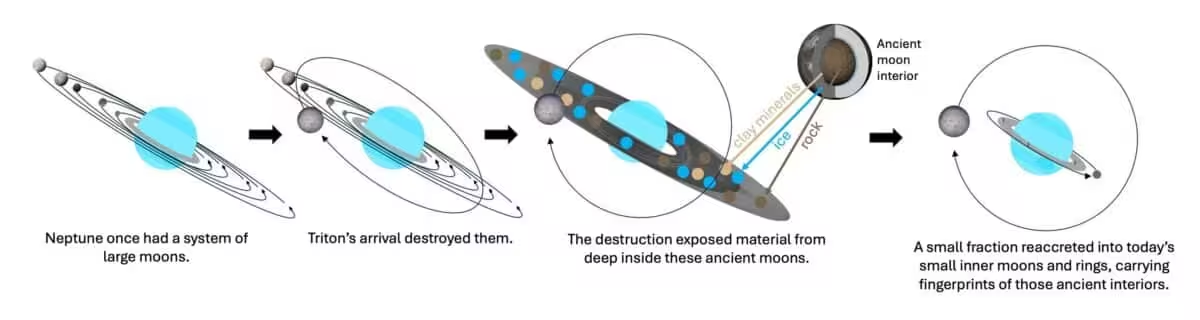
New evidence from the James Webb Space Telescope (JWST) indicates that the rings and minor moons of Neptune may be composed of debris from a shattered, ancient satellite system. This revelation suggests that the orbital neighborhood of the ice giant was once home to a more conventional family of moons, which were systematically dismantled following the arrival of the massive, wandering moon Triton.
Neptune’s current satellite configuration is an anomaly in the outer solar system. While gas giants like Jupiter and Saturn boast stable collections of major moons, Neptune is dominated by Triton, which accounts for more than 99% of the total mass within the planet’s orbital environment. Because Triton moves in a retrograde orbit—traveling in the direction opposite to Neptune’s rotation—astronomers have long suspected that it was not born in situ but was captured from the distant Kuiper Belt.
A study recently published in Science Advances provides a closer look at this history. By utilizing the JWST’s Near-Infrared Spectrograph (NIRSpec), researchers analyzed the chemical composition of Neptune’s rings and smaller inner moons, uncovering signatures that point to a violent, ancient reorganization of the system.
Evidence of Ancient Geological Activity
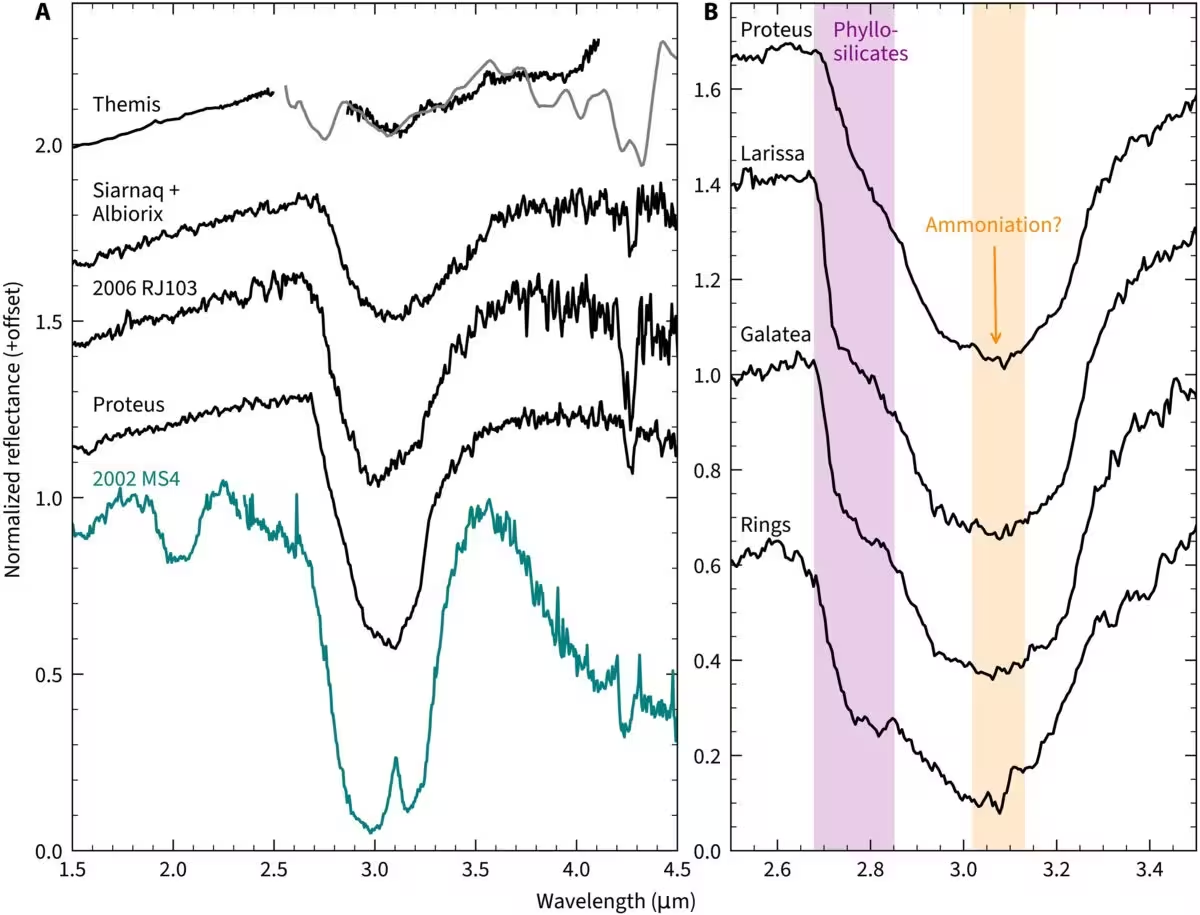
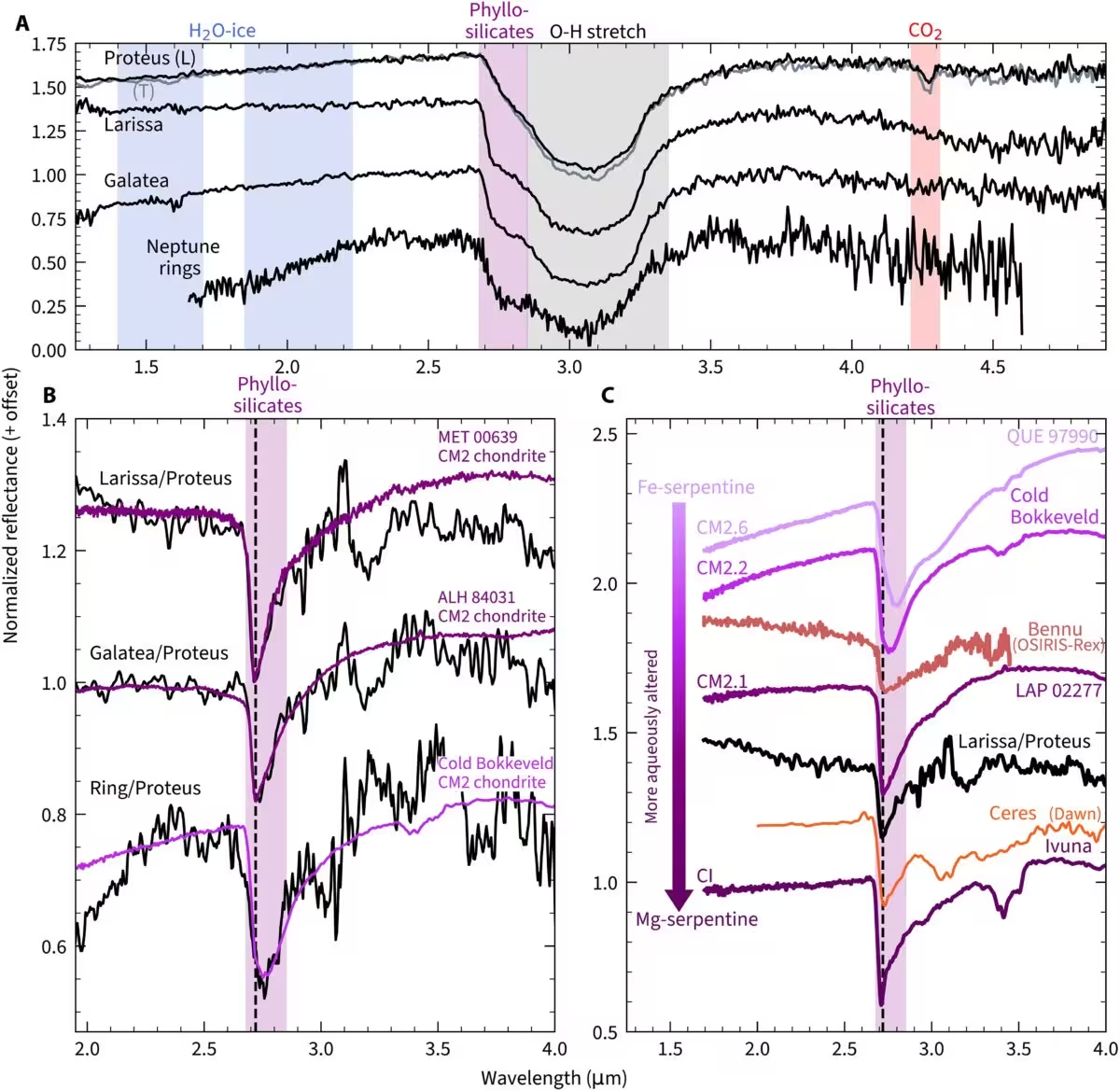
The JWST observations identified magnesium-rich phyllosilicates on the surfaces of the moons Larissa and Galatea, as well as within the planet’s ring system. These minerals are typically produced through the interaction of liquid water and rock. This discovery presents a paradox: these small, frozen moons are far too cold to sustain liquid water, and the absence of associated water ice suggests the minerals originated elsewhere before being deposited on their current hosts.
The research team proposes that these minerals were synthesized within the warm, differentiated interiors of much larger primordial moons. Similar to the materials found on Ceres and various main-belt asteroids, these silicates offer a glimpse into the internal makeup of now-destroyed satellites that were large enough to support internal geothermal activity.
The Catastrophic Impact of Triton
The most compelling narrative supported by the data is that the gravitational capture of Triton acted as a cataclysmic event. As the massive Kuiper Belt object moved into its current orbit, it would have exerted immense tidal forces on the original satellite system, likely colliding with or breaking apart the existing moons. The current inner moons and ring material are, in this view, the recycled remains of those vanished worlds.
This theory effectively explains why Neptune’s system appears so distinct from those of its gas giant counterparts. Before the arrival of Triton, Neptune likely maintained a stable, traditional arrangement of satellites. The arrival of the rogue moon effectively cleared the slate, leaving only fragments behind.
Nereid as a Witness to History
While some researchers considered whether an unrelated object from the Kuiper Belt might have crashed into the system to account for this material, the evidence suggests otherwise. The team’s observations of Nereid, Neptune’s third-largest moon, provide a critical data point. Unlike the minerals found on the inner moons, Nereid’s spectral signature is dominated by crystalline water ice, which does not align with the composition of known Kuiper Belt objects or irregular satellites.
“Companion JWST observations of Nereid—Neptune’s third-largest moon, historically classified as an irregular satellite—provide independent evidence that a primordial regular satellite system existed around Neptune before Triton’s capture. Nereid’s near-infrared spectrum is dominated by crystalline water ice and is inconsistent with the spectrum of any observed KBO or irregular satellite,” the team explained.
By analyzing these small, scattered worlds, astronomers are effectively performing an autopsy on a lost generation of satellites. These fragments represent the only accessible remnants of a vanished system, offering a unique opportunity to study the interiors of ancient icy bodies that existed before Triton reshaped the Neptune system forever.
This article has been fact checked for accuracy, with information verified against reputable sources. Learn more about us and our editorial process.
Last reviewed on .
Article history
- Latest version
Reference(s)
- Cermak, Alicia. “Larissa - NASA Science.”, November 21, 2017 NASA <https://science.nasa.gov/neptune/moons/larissa/>.
- Cermak, Alicia. “Galatea - NASA Science.”, November 21, 2017 NASA <https://science.nasa.gov/neptune/moons/galatea/>.
- Cermak, Alicia. “Nereid - NASA Science.”, December 6, 2017 NASA <https://science.nasa.gov/neptune/moons/nereid/>.
Cite this page:
- Posted by Aisha Ahmed