Physicists Bridge Metal Deformation and Magnetic Noise
A new mathematical mapping shows how testing machine feedback turns jerky plastic flow into statistical avalanches.

When certain metal alloys are stretched under specific temperatures and deformation rates, their plastic flow breaks down into jerky, intermittent instabilities known as deformation bands. Researchers have now linked these macroscopic material surges to statistical physics models traditionally used to study magnetic noise, revealing how testing machine feedback shapes metal deformation.
The study, published in arXiv by physicists Tero Mäkinen and Mikko J. Alava from Aalto University, bridges two long-standing theoretical frameworks. On one side are constitutive models of dynamic strain aging, which describe how mobile atomic defects catch on barriers and temporarily halt dislocation glide. On the other side is the Alessandro-Beatrice-Bertotti-Montorsi (ABBM) mean-field model, a statistical framework originally designed to explain Barkhausen noise when magnetic domain walls move through a disordered landscape.
How Metal Deformation Imitates Magnetic Noise
When type-A deformation bands travel across a metal specimen, their motion is far from smooth. High-speed imaging reveals that the instantaneous velocity of these bands undergoes massive fluctuations organized into distinct avalanches. The authors derived a coarse-grained mathematical connection showing that the global elastic feedback from a tensile testing machine naturally generates the increasing drive and restoring terms required by the ABBM description.
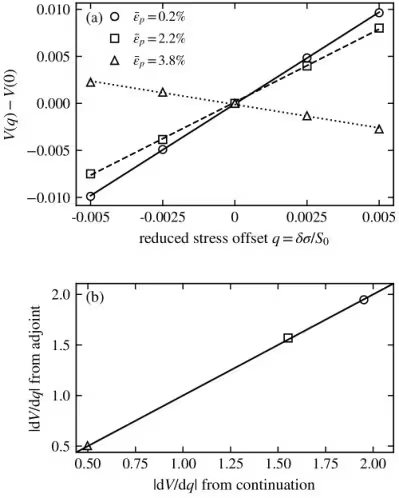
To evaluate how band speed responds to stress, the team employed a finite-time discrete adjoint method. This allowed them to calculate the phase mobility of the propagating band from a single unperturbed simulation trajectory rather than running multiple costly trial tests. Their numerical results indicate that the phase mobility scales approximately proportionally to the hardening parameter, while the band speed itself scales approximately with its square root.
What Happens When Strain Leaves Behind Persistent Disorder
The research also addresses how random pinning forces emerge in an otherwise homogeneous crystal lattice. When a deformation band passes through a section of material, it leaves behind a localized plastic strain increment that varies slightly across the specimen. The global elastic response of the testing machine integrates these microscopic variations along the gauge length, converting short-range spatial heterogeneity into an effective Brownian force.
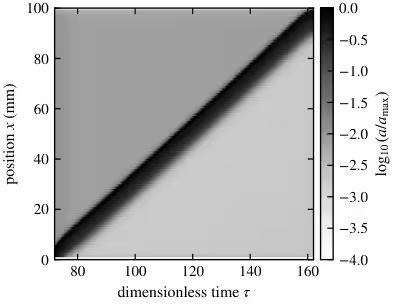
By introducing a weak persistent barrier disorder into their simulations, the authors demonstrated that the resulting effective disorder strength grows linearly with spatial separation and follows a quadratic dependence on the microscopic disorder amplitude. This mechanism explains why simplified statistical models can successfully capture complex avalanche statistics even when underlying metallurgical models are required to predict stress-strain curves.
Why These Findings Matter for Advanced Alloy Design
Understanding these dynamics is increasingly important as modern engineering moves beyond traditional aluminum alloys toward complex material systems. Serration patterns and intermittent band propagation frequently appear in high-entropy alloys, austenitic stainless steels, and advanced superalloys utilized in extreme environments. By mapping microscopic dislocation mechanics onto collective coordinate descriptions, materials scientists gain a quantitative tool to evaluate how alloy chemistry, temperature, and machine stiffness influence mechanical stability and formability before catastrophic necking or failure occurs.
The study was posted to the arXiv preprint server on November 18, 2026.
This article has been fact checked for accuracy, with information verified against reputable sources. Learn more about us and our editorial process.
Last reviewed on .
Article history
- Latest version
Reference(s)
- Mäkinen, Tero. “From dynamic strain aging to Alessandro--Beatrice--Bertotti--Montorsi dynamics of propagating Portevin--Le Chatelier bands.” arXiv.org <http://arxiv.org/abs/2611.24141v1>.
Cite this page:
- Posted by Anjali Singh