Centimeter-Scale Crystal Growth Unlocks Thermoelectric Potential of Zintl Phases
New flux growth techniques yield large-size KCd4As3 and RbCd4As3 single crystals with enhanced electrical and thermoelectric properties.
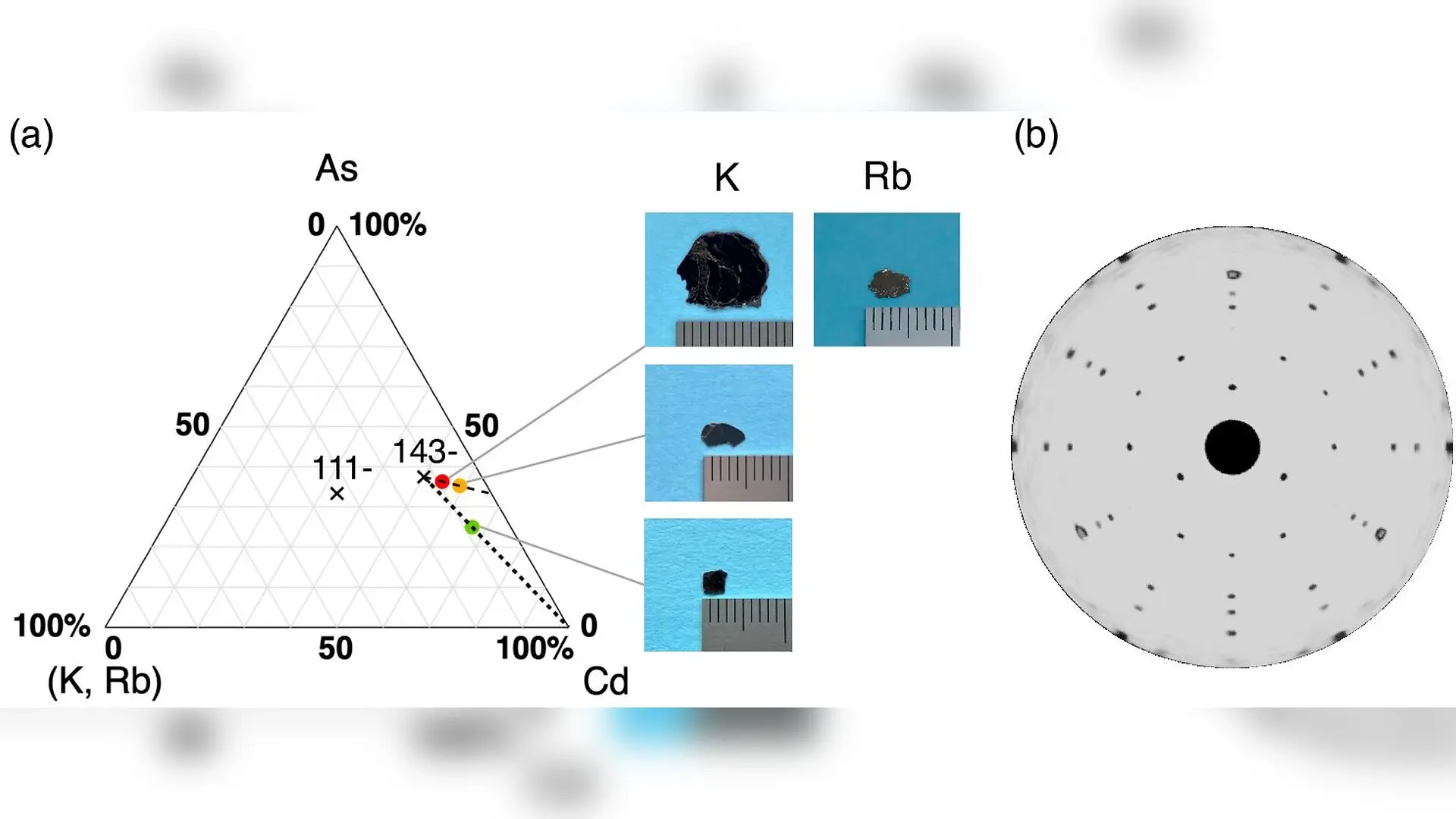
Centimeter-scale single crystals of complex thermoelectric materials called KCd$_4$As$_3$ and RbCd$_4$As$_3$ have been grown using a specialized flux method that overcomes previous size limitations. Researchers developed this synthesis strategy to examine the fundamental electronic and transport behavior of these compounds in greater detail than previously possible.
Overcoming Growth Hurdles With a Novel Flux Solution
Materials scientists have increasingly focused on a family of compounds known as 143-Zintl phases, which contain alkali metals, transition metals, and pnictogens, because they combine low electrical resistance with low thermal conductivity. Generating large, high-quality samples of these materials is notoriously difficult because unwanted secondary phases tend to precipitate during standard crystal growth. Keigo Ono and colleagues at the National Institute of Advanced Industrial Science and Technology (AIST) in Japan utilized a Cd$_2$As flux to suppress these interfering phases. As detailed in a study published in the Journal of the Physical Society of Japan, this adjustment enabled the team to expand the dimensions of KCd$_4$As$_3$ crystals up to one centimeter in length.
To synthesize these materials, the authors prepared precursors including potassium arsenide, rubidium arsenide, and cadmium arsenide by sealing raw elements in stainless steel containers filled with argon gas and heating them in furnaces. By adjusting the starting compositions closer to exact stoichiometry alongside the Cd$_2$As flux, the researchers prevented the formation of unwanted KCdas impurities. X-ray diffraction and energy-dispersive X-ray spectroscopy confirmed that the resulting crystals matched the target atomic ratios and possessed the expected rhombohedral crystal structures.
Electrical Transport Properties and Performance Metrics
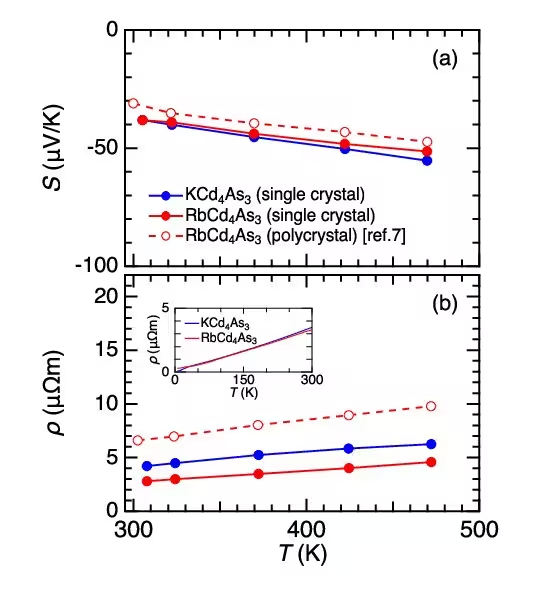
Measurements of the electrical resistivity and Seebeck coefficients, which quantify how efficiently a material converts temperature gradients into electricity, revealed that both KCd$_4$As$_3$ and RbCd$_4$As$_3$ operate as n-type conductors. Their electrical resistivities increased linearly with temperature in a manner characteristic of metals. The authors observed that the single-crystal RbCd$_4$As$_3$ samples displayed lower electrical resistivity than earlier polycrystalline versions of the same material, which stems from reduced scattering at grain boundaries and anisotropic conduction paths.
Calculations of the power factor, a primary indicator of thermoelectric efficiency, showed that RbCd$_4$As$_3$ reached a maximum value of 0.58 milliwatts per meter kelvin squared at 472 kelvins. This performance level is approximately three times higher than that of polycrystalline samples. The data suggest that effective mass increases as the mass of the constituent alkali metal atom decreases, pointing to new avenues for tuning thermoelectric performance in Zintl phases.
The study was posted to the arXiv preprint server on November 18, 2026.
This article has been fact checked for accuracy, with information verified against reputable sources. Learn more about us and our editorial process.
Last reviewed on .
Article history
- Latest version
Reference(s)
- Ono, Keigo., et al. “Large Single Crystal Growth and Transport Properties of KCd 4 As 3 and RbCd 4 As 3.” Journal of the Physical Society of Japan, vol. 95, no. 11, November 15, 2026 Physical Society of Japan, doi: 10.7566/JPSJ.95.115001. <https://doi.org/10.7566/JPSJ.95.115001>.
Cite this page:
- Posted by Anjali Singh