AI Model Unlocks Rapid Simulation of Earth’s Invisible Atmospheric Chemistry
Researchers fine-tune an atmospheric foundation model to link weather and trace gas chemistry, cutting global simulation times from days to minutes.

An advanced artificial intelligence model has successfully bridged the gap between atmospheric chemistry and weather forecasting, solving a computational bottleneck that has frustrated climate scientists for decades. Researchers fine-tuned a massive atmospheric foundation model to simulate both weather dynamics and trace gas chemistry simultaneously, running global predictions in a fraction of the time required by traditional climate simulators.
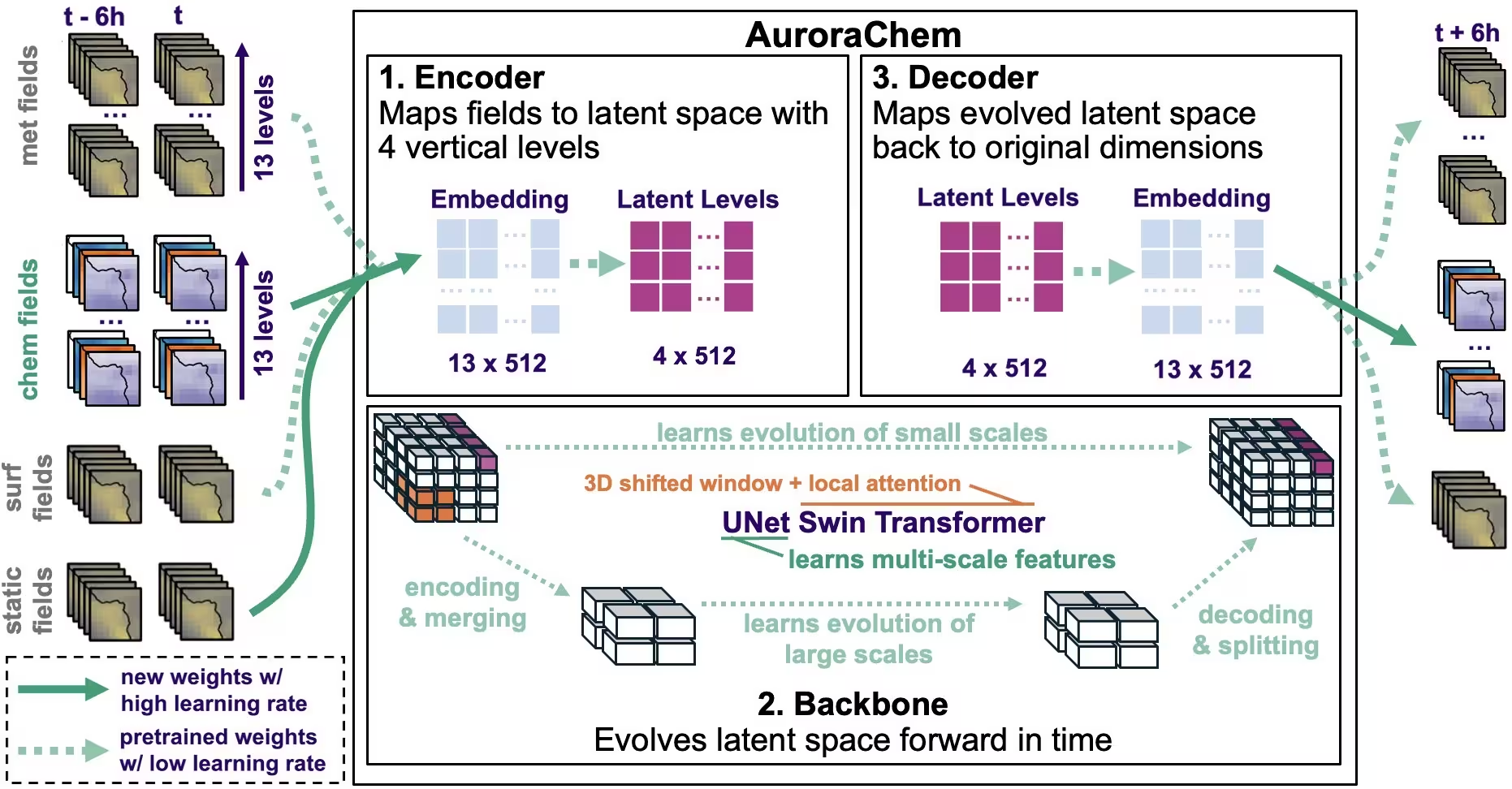
The hydroxyl radical, often called the atmospheric detergent because it breaks down pollutants and accounts for roughly 88 percent of the natural methane sink, remains notoriously difficult to track. Traditional chemistry-climate models are computationally prohibitive when attempting joint data assimilation, which combines observations with computer models to constrain invisible chemical trends. To overcome this hurdle, Eliot J. Kim and colleagues developed a fine-tuned version of the Aurora atmospheric foundation model named AuroraChem, available on the arXiv preprint server, which links chemistry and meteorology in a single unified state.
How Artificial Intelligence Tracks the Invisible Atmosphere
The research team fine-tuned the base model using chemical fields from a global chemical transport model spanning 2018 alongside meteorological reanalysis data. While traditional numerical simulations require roughly 4,000 minutes of heavy computing power to model one year of atmospheric chemistry, AuroraChem completes a full one-year rollout in just 12 minutes on a single graphics processing unit. The model ingests seven key chemical fields, including the hydroxyl radical, ozone, carbon monoxide, and nitrogen dioxide, alongside five standard meteorological variables across 13 vertical pressure levels.
To evaluate stability, the authors ran free-running simulations for an entire year without feeding in any observational updates. After three days of simulated time, the model maintained high spatial pattern correlations for temperature and chemical species, with correlation coefficients ranging between 0.91 and 0.97. Over a six-month period, temperature and hydroxyl radical concentrations remained physically realistic, though longer-lived trace gases began to drift in the tropics due to the absence of transient emission events like wildfires in the training data.
What Happens When Weather Observations Update Chemical States
The team tested whether inserting observational data for one set of variables could successfully update the other through an idealized data assimilation technique known as direct insertion. Surprisingly, inserting only meteorological fields effectively constrained the distribution and seasonal cycle of the hydroxyl radical, achieving a spatial correlation of 0.93 compared to 0.94 when inserting the chemical fields directly. Conversely, inserting only chemical data successfully recovered large-scale circulation patterns, including the moisture loading and the position of the low-level southwesterly Somali jet associated with the Indian summer monsoon.
Further tests simulated sparse, satellite-based observations by incorporating nitrogen dioxide column retrievals representative of the TROPOspheric Monitoring Instrument aboard the Sentinel-5P satellite. Daily sparse satellite data constrained the hydroxyl radical nearly as well as complete three-dimensional chemical fields, demonstrating that localized atmospheric measurements can effectively update global chemical models.
What Are the Limitations of Learned Atmospheric Correlations?
The authors note that the model does not explicitly learn the underlying chemical and physical equations governing the atmosphere. Instead, AuroraChem learns the statistical correlation structure between chemistry and meteorology that is imprinted on the training data via transport, solar radiation, and seasonal cycles. Much like a human driver who relies on visual cues to navigate a familiar road without calculating the physics of tire friction, the machine learning emulator uses learned covariances to let an observation of one variable update another.
While this statistical approach works exceptionally well for data assimilation, it means the model is unsuited for perturbation experiments designed to attribute future chemical changes directly to shifting emissions. Future improvements aim to incorporate multi-year training data, higher spatial resolution, and explicit methane chemistry to better constrain global greenhouse gas budgets independently of traditional proxy measurements.
The study was posted to the arXiv preprint server on November 18, 2026.
This article has been fact checked for accuracy, with information verified against reputable sources. Learn more about us and our editorial process.
Last reviewed on .
Article history
- Latest version
Reference(s)
- Kim, Eliot. “Enabling joint chemical and meteorological data assimilation with an atmospheric foundation model.” arXiv.org <http://arxiv.org/abs/2611.24020v1>.
Cite this page:
- Posted by Vikram Desai