Hidden Trait Variations Reveal Why Average Ecosystem Models Fail
Mathematical modeling shows that species with identical average abilities can face completely different survival outcomes based on trait distribution shapes.

Microbial communities and other ecological populations often harbor immense diversity among organisms that appear remarkably similar on the surface, a phenomenon that has long puzzled scientists trying to reconcile how competing species manage to coexist on limited resources. A new mathematical framework published in arXiv suggests that traditional ecological models miss a crucial piece of the puzzle by ignoring the shape of individual variations within a group. The study demonstrates that two species can share the exact same average competitive ability and variance, yet still experience vastly different evolutionary fates and population abundances simply because of how those abilities are distributed across individual organisms.
Why Average Traits Fail to Predict Species Survival
For decades, researchers studying community ecology have relied on simplified averages to understand how populations interact and compete for dominance. Classical models frequently assume that all members of a species behave similarly or that variations average out in a predictable manner over time. However, biological populations ranging from natural yeast strains to marine phytoplankton exhibit profound phenotypic heterogeneity, meaning individual cells display wide performance differences in growth, stress resistance, and resource acquisition even when they are genetically identical. By expanding on Hubbell’s well-known neutral theory of biodiversity, researchers Julie Rowlett and Leo Tingqvist sought to determine how this internal variation alters larger population dynamics.
The authors developed a finite-population Markov model in which a focal species competes against a shared aggregate of all other species in a local community. Instead of assigning a single static score to an entire species, the model evaluates pairwise competitive encounters by independently sampling individual abilities from competing distribution shapes. These individual-level wins, losses, and ties are then translated into stochastic differential equations that govern population movement, drift, and eventual fixation or extinction.
The Hidden Impact of Distribution Shape on Competition
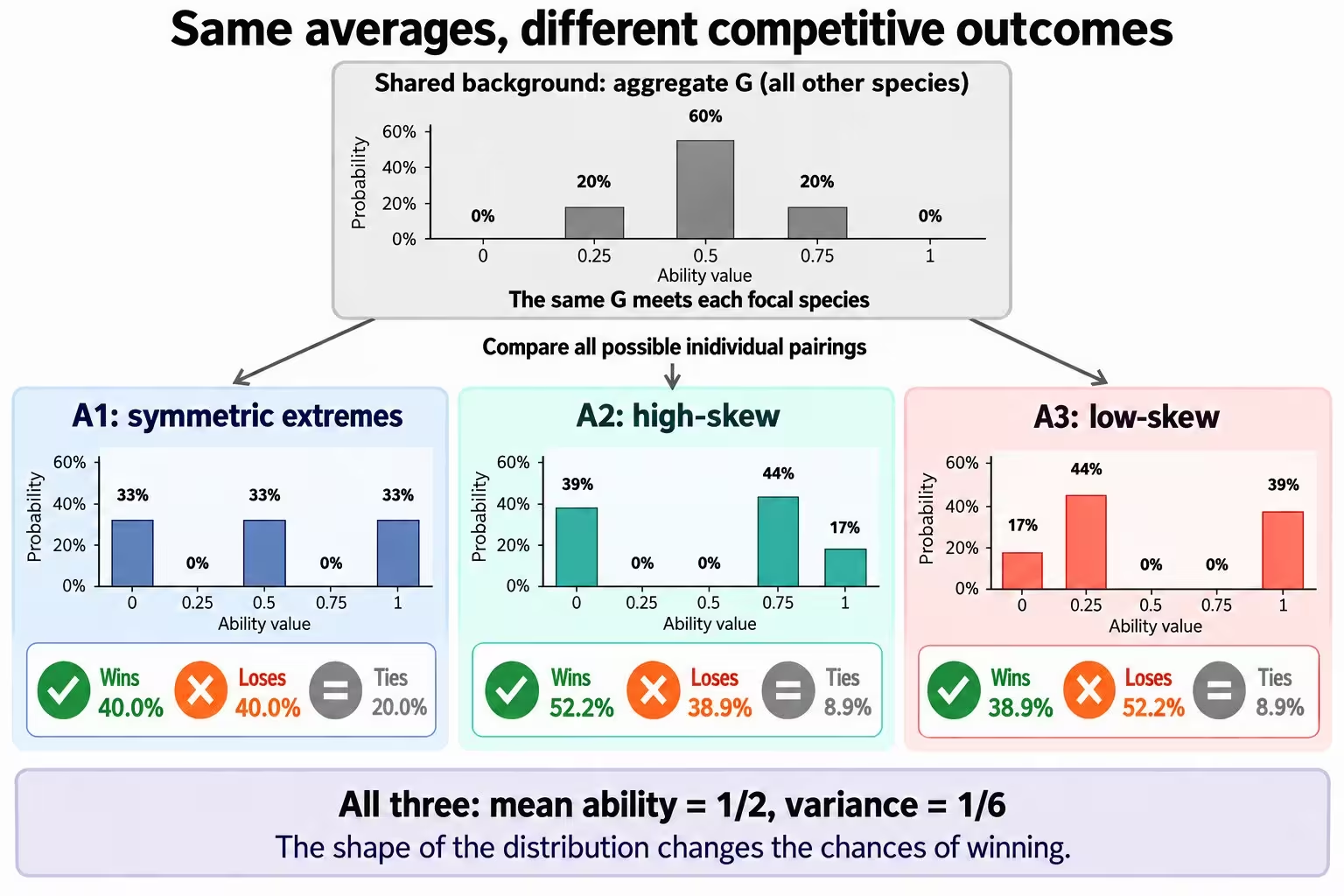
The mathematical analysis reveals that two populations with identical mean traits and identical variances can produce completely opposite competitive outcomes against the same background community. For instance, testing three different focal species with a mean competitive ability of one-half and a variance of one-sixth against a shared aggregate competitor showed that distribution skewness drastically alters winning probabilities. One species achieved a distinct competitive advantage, another performed neutrally, and the third suffered a clear competitive disadvantage.
This occurs because competitive encounters depend heavily on the entire spread of individual capabilities rather than a central benchmark. When these dynamics are scaled up to closed local communities and analyzed through diffusion approximations, the resulting fixation probabilities mirror population-genetics frameworks established by Motoo Kimura. Communities with higher directional competitive advantage relative to demographic randomness show significantly altered survival odds, proving that community size and distribution shape jointly dictate whether a species persists or disappears.
How Immigration Rescues Struggling Populations
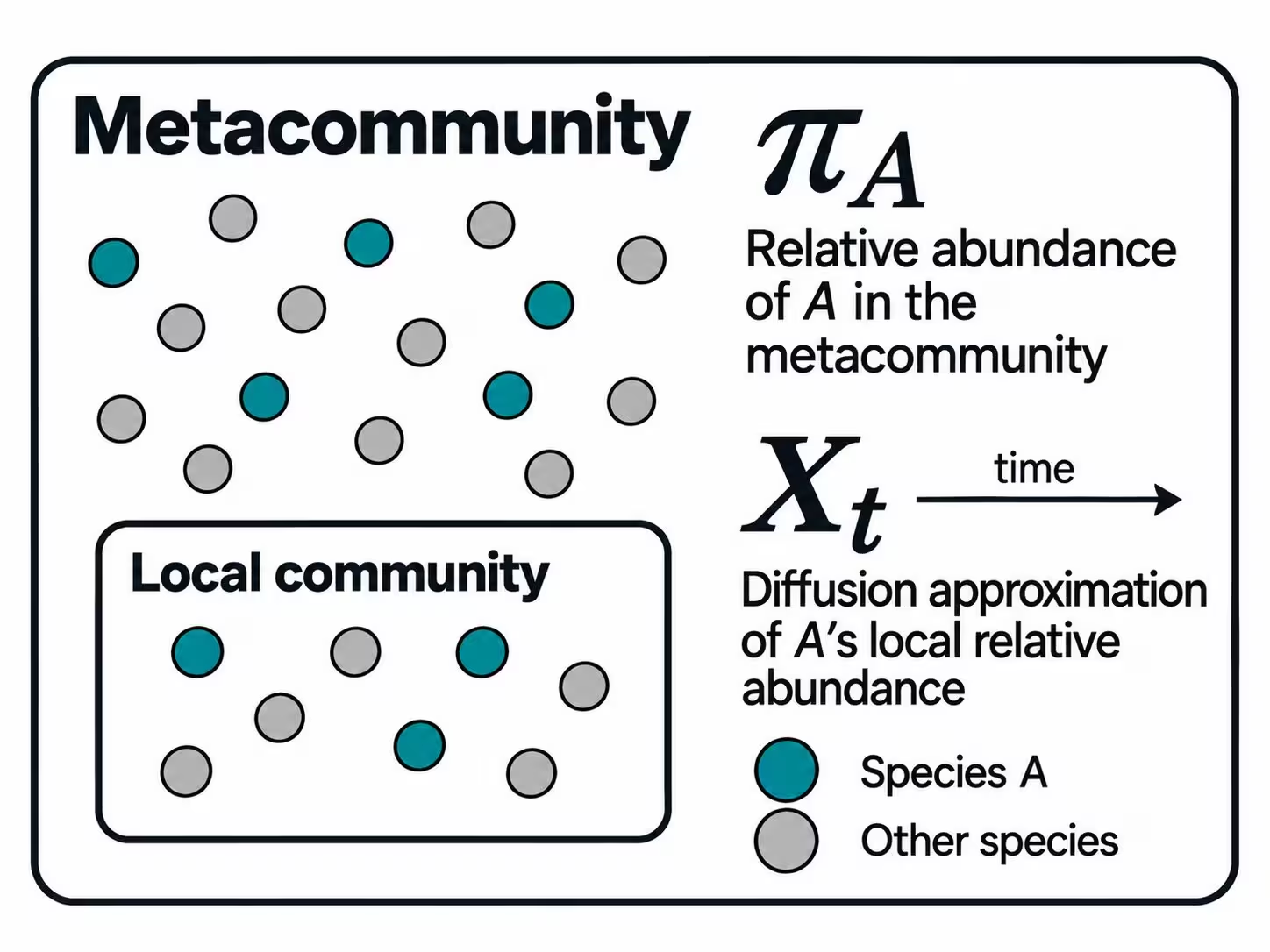
To make the model reflect real-world ecosystems more accurately, the researchers also incorporated immigration from a larger regional metacommunity. In closed environments without immigration, populations facing unfavorable distribution shapes eventually trend toward local extinction or complete fixation. However, continuous regional input acts as a powerful stabilizing force that can rescue species from local disappearance even if their local competitive encounters are unfavorable.
By solving the Fokker-Planck equations for stationary abundance densities, the team mapped out how immigration rates and regional proportions interact with local competition. Their findings indicate that immigration can sustain local occurrence in a manner analogous to source-sink dynamics. Even when a species loses head-to-head battles more frequently than it wins, constant replenishment from a regional pool prevents permanent extinction. Ultimately, the work highlights that capturing the true complexity of biodiversity requires looking beyond species-level averages and accounting for the intricate distribution shapes hidden within every population.
The study was posted to the arXiv preprint server on November 18, 2026.
This article has been fact checked for accuracy, with information verified against reputable sources. Learn more about us and our editorial process.
Last reviewed on .
Article history
- Latest version
Reference(s)
- Rowlett, Julie. “The Shape of Individual Fitness Distributions and the Dynamics of Ecological Communities.” arXiv.org <http://arxiv.org/abs/2611.24047v1>.
Cite this page:
- Posted by Priya Sharma