New Mountain Electronics Board Promises Sharper View of Cosmic Gamma Rays
Engineers developed a compact readout board featuring automated temperature compensation and rapid waveform sampling to upgrade high-altitude gamma-ray telescopes.
A new electronic board built to capture faint flashes of high-energy light high in the mountains could soon help astronomers map cosmic gamma-ray sources with unprecedented precision. The device operates at an altitude of 4,410 meters, where freezing weather and thin air present severe engineering hurdles for sensitive scientific gear.
Researchers working on the Large Array of Imaging Atmospheric Cherenkov Telescope, known as LACT, detailed their hardware design in a study published on the arXiv preprint server. The array will sit inside the existing Large High Altitude Air Shower Observatory site in China, utilizing 32 telescopes with 6-meter mirrors to peer deep into the universe.
Catching Invisible Flashes in the High Mountains
When very high energy gamma rays slam into Earth’s upper atmosphere, they trigger particle showers that emit faint blue flashes of Cherenkov light. Telescopes like LACT use dense arrays of light sensors called silicon photomultipliers to record these fleeting bursts. Each camera contains 1,616 individual sensor pixels, demanding compact electronics capable of managing massive amounts of data without overheating.
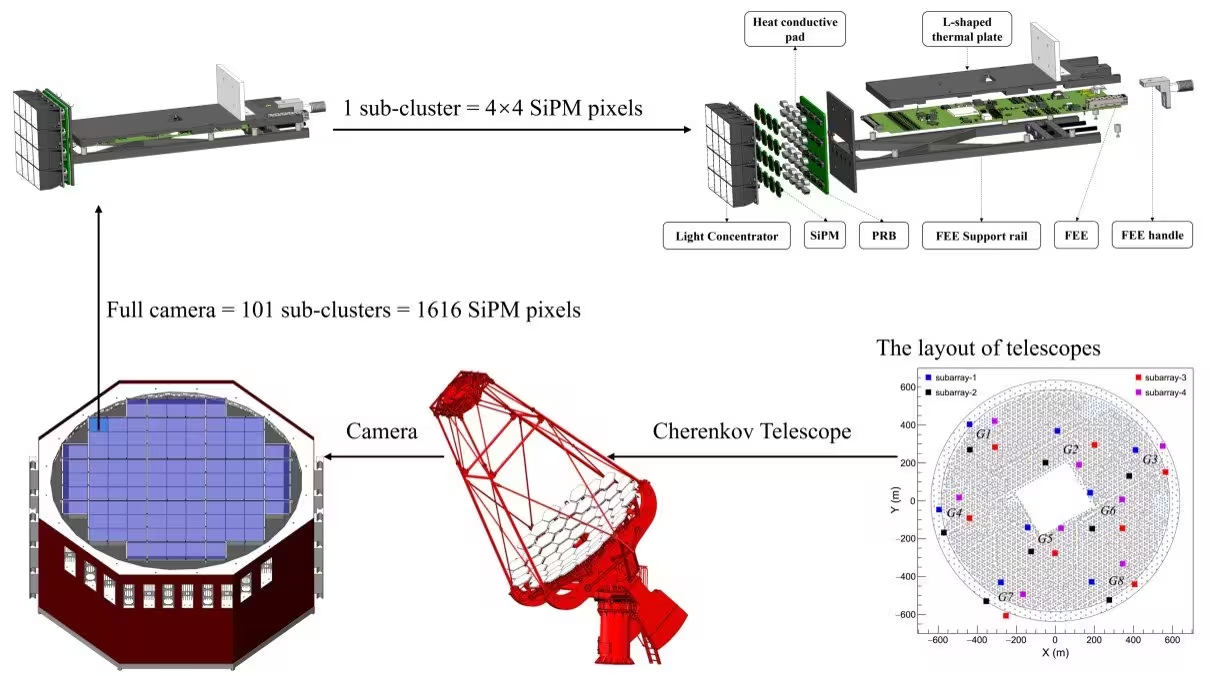
The newly developed front-end readout electronics board packs 16 independent channels into a tight space. Each channel handles gain adjustment, temperature monitoring, and high-speed waveform sampling. Because outdoor temperatures at the high-altitude site swing wildly from -20 °C to 30 °C, the sensors experience severe thermal stress that alters their electrical breakdown voltage. Left unchecked, this shift distorts the measurements of incoming light intensity.
Smart Voltage Control and Rapid Sampling
To conquer thermal drift, the research team integrated an automated compensation circuit that tracks each sensor’s temperature using dedicated sensors mounted directly behind the pixels. The system dynamically adjusts the operating voltage for every single channel independently. Previous tests cited by the authors showed this compensation scheme successfully keeps gain drift below 2% across the entire operational temperature range.
For capturing the fast electrical pulses generated by the sensors, the board employs two multi-channel analog-to-digital converters operating at 250 million samples per second. This high sampling speed provides roughly nine distinct measurement points across the width of a typical pulse waveform. Such high density allows scientists to accurately integrate the signal area while filtering out ambient background glow from the night sky.
Power Constraints and Future Observational Goals
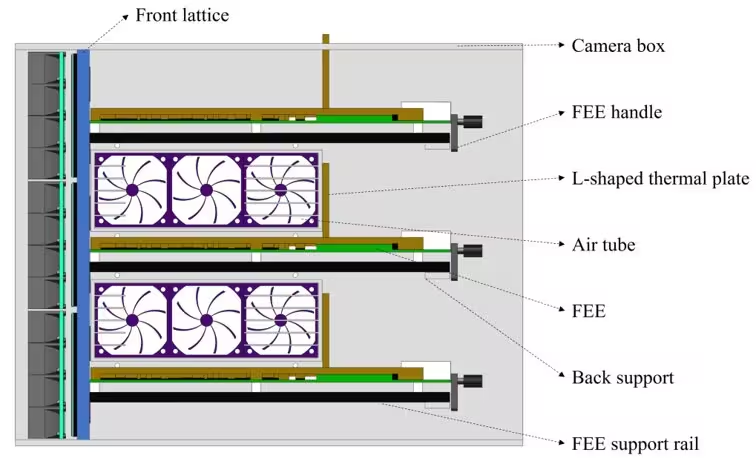
Operating delicate electronics at 4,410 meters requires careful thermal management because thin air reduces the efficiency of natural convective cooling. The board was engineered to consume a total power of 18.86 watts during standalone bench testing, which drops further to 17.81 watts once installed inside the sealed camera housing by disabling unused clock and communication links.
Laboratory tests demonstrated an integral nonlinearity of just 0.0709% for direct current responses, alongside an integral area resolution of 0.2725% using simulated electrical pulses. When tested with actual sensor modules at a light level equivalent to 1,000 photoelectrons, the resolution reached 3.5441%. These performance metrics suggest the new electronics will meet the strict requirements needed to resolve fine spatial structures in cosmic gamma-ray sources.
The study was posted to the arXiv preprint server on November 18, 2026.
This article has been fact checked for accuracy, with information verified against reputable sources. Learn more about us and our editorial process.
Last reviewed on .
Article history
- Latest version
Reference(s)
- Zi, Changge. “Design and performance of the front-end readout electronics for LACT.” arXiv.org <http://arxiv.org/abs/2611.24263v1>.
Cite this page:
- Posted by Nida Rehman