AI Model Tests Milky Way Black Hole Spacetime Using Star S2 Orbits
A differentiable neural network analyzing three decades of stellar telemetry finds no deviation from general relativity.
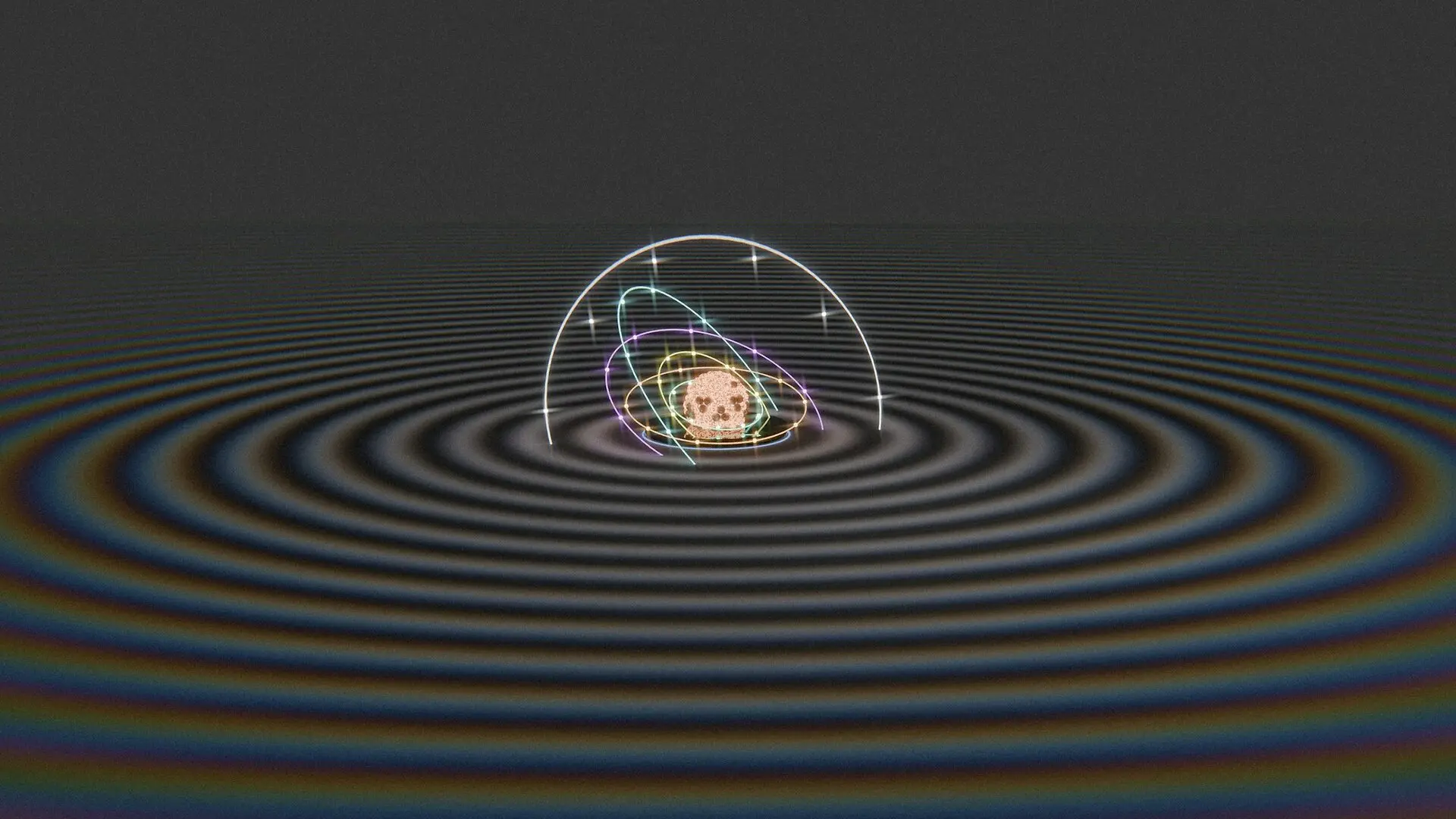
A high-speed machine learning model tracking the swift orbital loop of star S2 around our Galaxy’s central supermassive black hole has revealed no departures from standard general relativity. Researchers deployed an artificial intelligence framework to analyze three decades of astronomical observations probing the extreme gravity regime at the heart of the Milky Way.
The study, published on the arXiv preprint server in November 2026, was conducted by astrophysicists Prajwal Hassan Puttasiddappa and Dennis Fremstad alongside colleagues at the University of Oslo in Norway and the Federal University of Espírito Santo in Brazil. The team applied their newly constructed physics-informed architecture to test six distinct gravitational spacetimes using archival data collected between 1992 and 2016.
How a Neural Network Maps Relativistic Star Orbits
Star S2 orbits the compact radio source Sagittarius A* in roughly 16 years on a highly elongated path with an eccentricity of approximately 0.88. At its closest approach during its 2018 pericenter passage, the star sweeps past the center at a distance of about 2,800 times the Schwarzschild radius, feeling intense gravitational forces that test fundamental physics. Traditional analyses rely on slow numerical integration methods to evaluate likelihoods across massive parameter spaces.
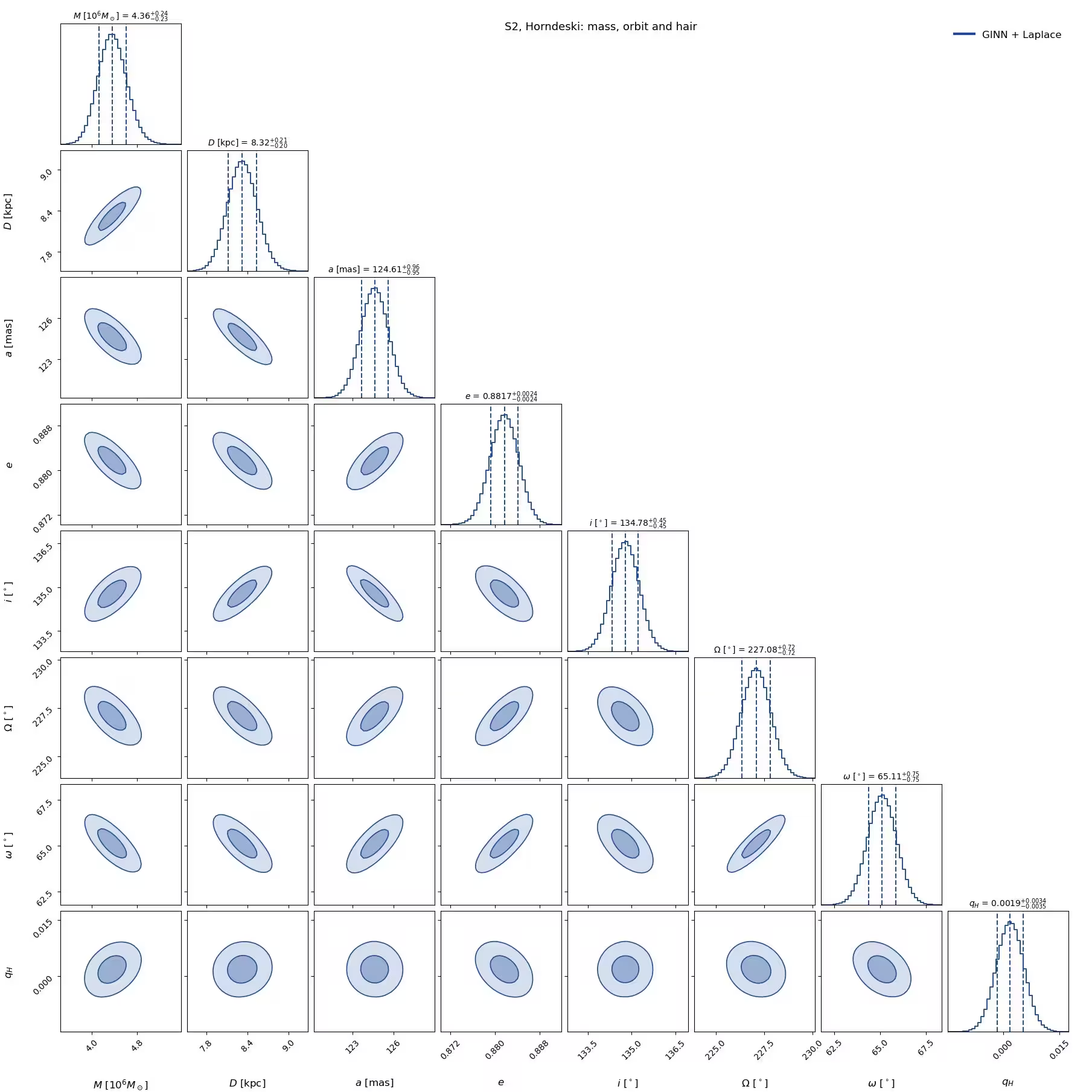
To overcome this computational bottleneck, the authors designed a Geodesic-Informed Neural Network that computes exact conserved quantities, orbital shapes, and gravitational redshifts directly from metric equations. An artificial neural network handles only the time evolution of the radial phase, constrained strictly by physical laws. This hybrid design makes the entire forward model differentiable, allowing researchers to locate parameter values and estimate uncertainties through gradient-based optimization in a single computational run rather than standard stochastic sampling.
What the Galactic Center Data Reveals About Gravity
When applied to 334 individual data points comprising 145 astrometric positions and 44 radial velocity measurements, the model reproduced standard parameters with high precision. For the standard Schwarzschild spacetime, the team inferred a central black hole mass of $M = (4.32 \pm 0.22) \times 10^6$ solar masses and a distance of $D = 8.33 \pm 0.21$ kiloparsecs. None of the alternative theoretical models tested showed statistically significant deviations from standard general relativity.
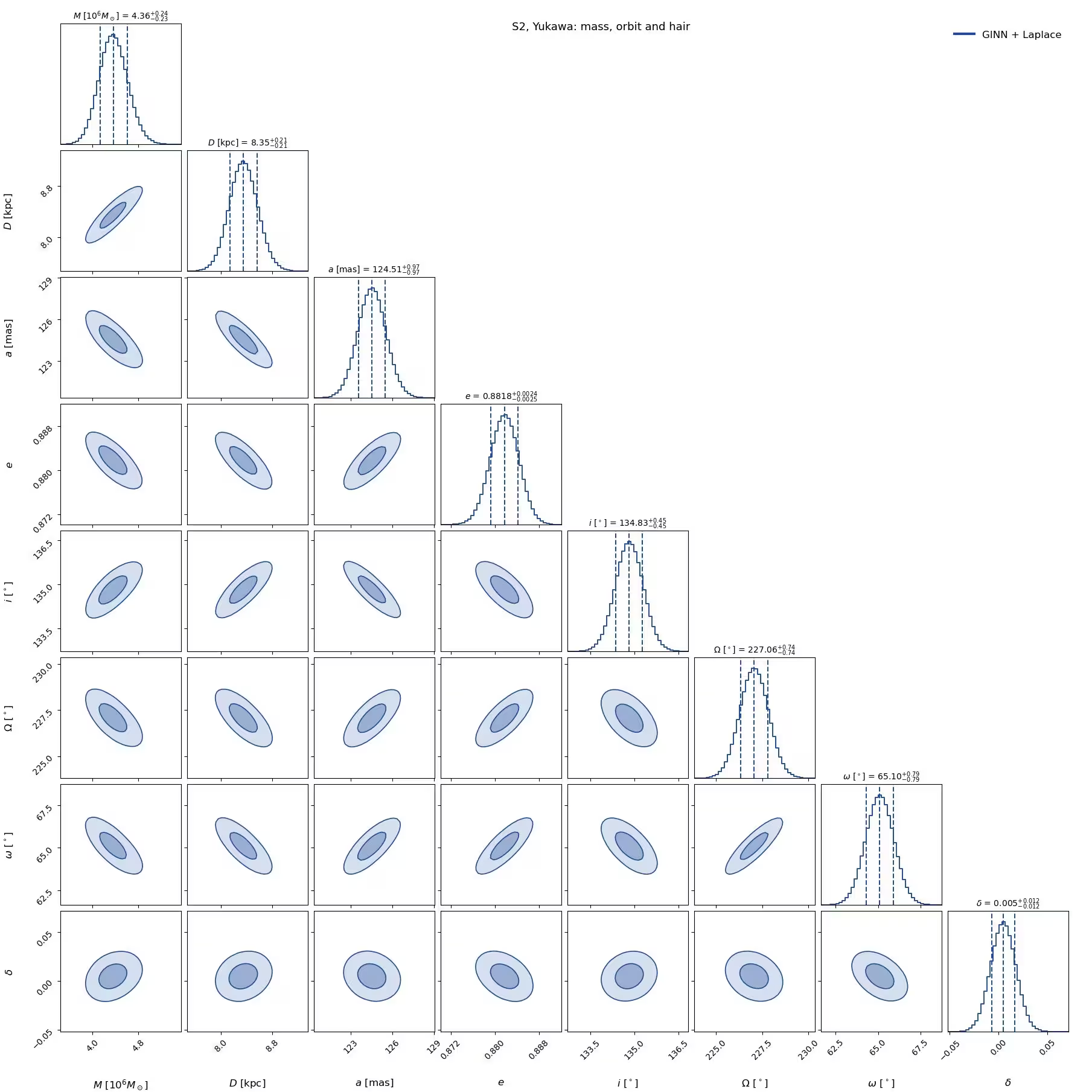
The team evaluated alternative scenarios including Horndeski gravity, Reissner-Nordström electrically charged black holes, Bardeen regular black holes, Janis-Newman-Winicour scalar-tensor spacetimes, and Yukawa-type corrections linked to massive scalar fields. For Yukawa modifications, the analysis constrained the interaction strength to $|\delta| < 0.011$ at a 95 percent confidence level for a scale of approximately 180 astronomical units. Bayesian model comparisons indicated that none of the modified gravity frameworks were preferred over standard general relativity, with Bayes factors penalizing additional parameters via Occam’s razor.
Limitations and Future Prospects for Differentiable Astronomy
While the Gaussian Laplace approximation efficiently mapped uncertainties for most models, the authors noted that parameters entering the metric only through their square, such as electric charge parameters, generated non-Gaussian posteriors requiring higher-order expansions. The model currently assumes a static, spherically symmetric metric and treats the star as a test particle without accounting for black hole spin or astrometric confusion.
Despite these constraints, the differentiable architecture opens new pathways for analyzing stellar dynamics. The framework can be extended to handle multiple stars simultaneously and incorporate advanced interferometric measurements from instruments like the GRAV-ITY interferometer, transforming how astronomers reconstruct the invisible geometry of galactic centers.
The study was posted to the arXiv preprint server on November 18, 2026.
This article has been fact checked for accuracy, with information verified against reputable sources. Learn more about us and our editorial process.
Last reviewed on .
Article history
- Latest version
Reference(s)
- Puttasiddappa, Prajwal. “Geodesic-informed neural networks for testing spacetimes with S2.” arXiv.org <http://arxiv.org/abs/2611.24370v1>.
Cite this page:
- Posted by Nida Rehman