Nearby Galaxy Challenges Leading Theories About Mysterious Red Space Objects
Radio wave analysis of a local analog reveals unexpected clues about how supermassive black holes grow and hide behind gas cocoons.

A rare local galaxy hosting a supermassive black hole is challenging leading theories about mysterious red objects discovered by the James Webb Space Telescope. The galaxy, known as J1047, sits at a redshift of 0.1682, putting it much closer to Earth than the ancient cosmic specimens usually studied.
Astronomers have been intensely debating the nature of Little Red Dots, a population of compact, active galaxies with distinctive V-shaped light profiles and unusually faint X-ray emissions. Several competing ideas have emerged to explain these cosmic oddities, ranging from thick clouds of neutral gas and extreme black hole feeding rates to an ionized gas cocoon that scatters light. To test these hypotheses, researchers led by an international team of scientists available on the arXiv preprint server analyzed radio wave data alongside optical spectroscopy for J1047.
Why Radio Waves Reveal the True Nature of Obscured Black Holes
While X-rays can be easily blocked by surrounding material, radio emissions usually slice straight through dust and neutral gas. This makes radio telescopes powerful tools for peering into active galactic nuclei, which are regions around supermassive black holes powered by infalling matter. If Little Red Dots were simply standard active galaxies hidden behind thick walls of neutral gas, they should shine brightly in radio wavelengths. On the other hand, if their faint X-rays stem from extreme feeding rates or a scattering cocoon, their radio signatures would look very different.
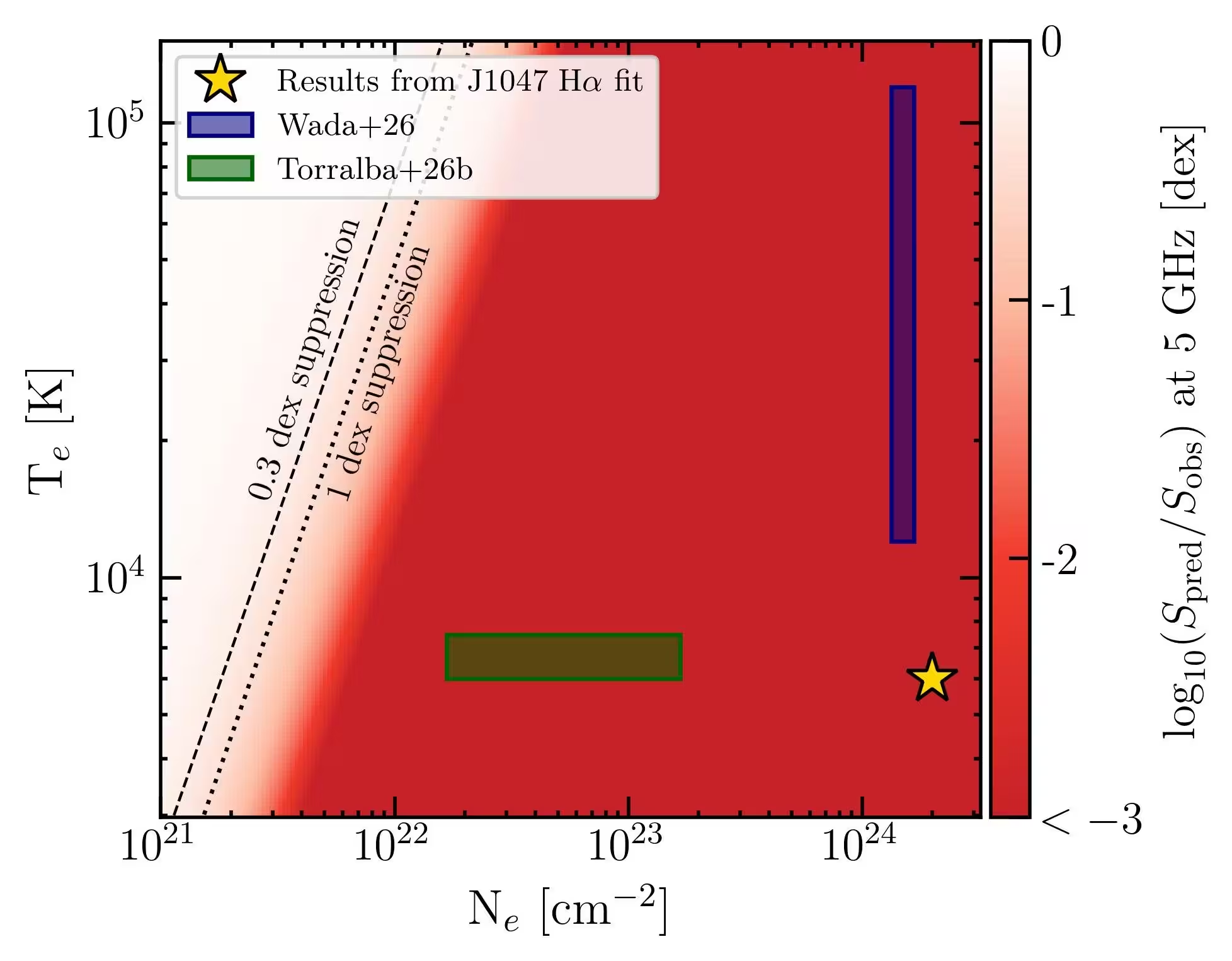
When the authors evaluated the radio data for J1047, they found that its radio brightness matches expectations for a standard radio-quiet active galactic nucleus obscured by dense neutral gas. By contrast, a purely extreme feeding scenario underpredicted the observed radio luminosity by a factor of roughly thirty. However, the researchers note that a hybrid model combining high accretion rates with moderate gas obscuration remains a viable possibility.
The Paradox of the Ionized Cocoon and Electron Scattering
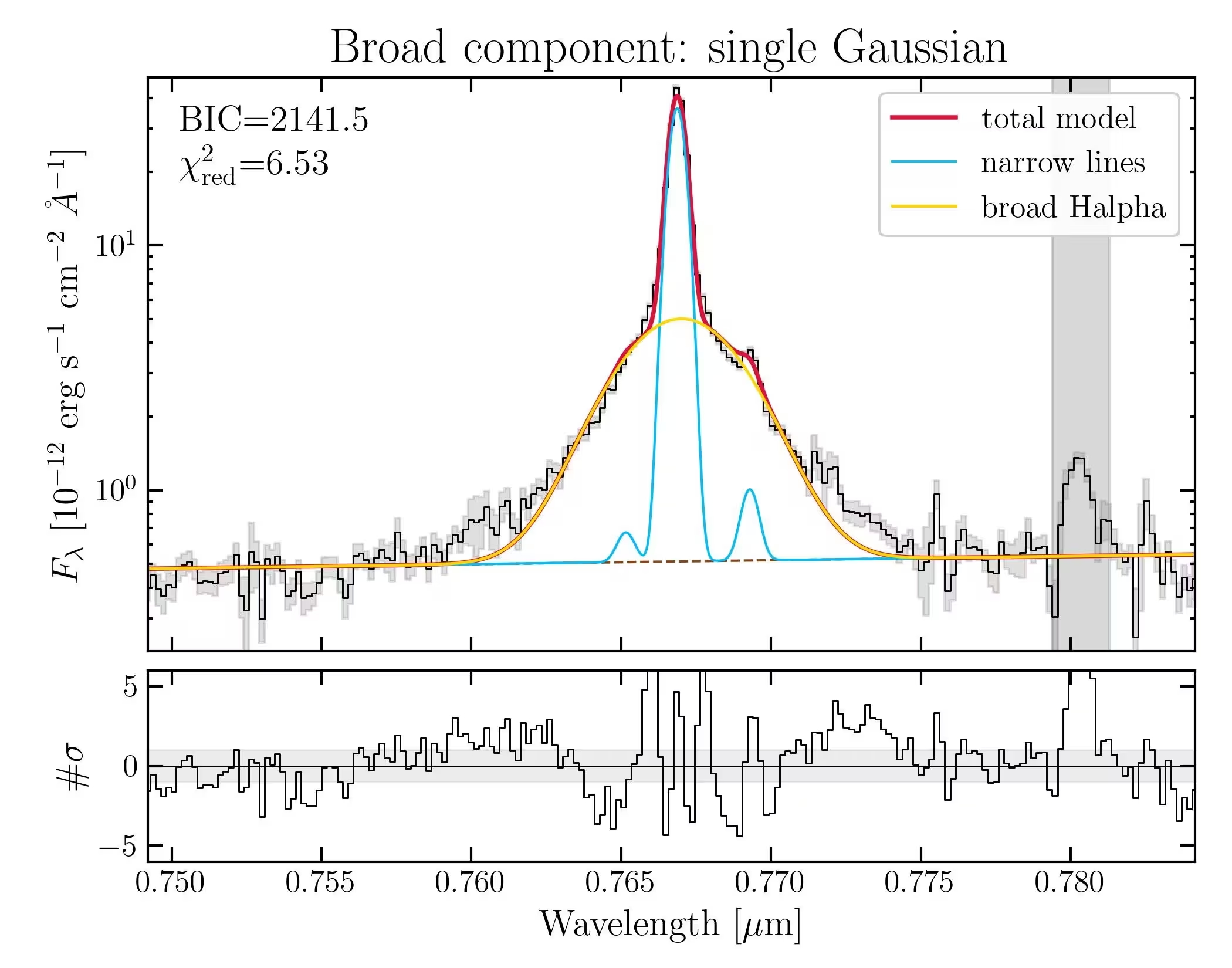
One of the most popular explanations for the unusual spectral shapes of Little Red Dots involves Thomson scattering by free electrons inside an ionized gas layer. When the team fitted the hydrogen-alpha emission line profile of J1047, an exponential model provided a remarkably strong statistical preference over standard Gaussian profiles. This type of profile is frequently interpreted as clear evidence of electron scattering.
If electron scattering is indeed shaping the optical light, it implies an enormous electron column density and a punishingly high degree of free-free absorption. Free-free absorption occurs when free electrons block low-energy electromagnetic radiation, and at the densities implied by the scattering model, this effect would completely wipe out the radio emission detected by the Very Large Array. This severe physical tension suggests that the exponential line profiles in J1047 trace a stratified broad-line region rather than electron scattering.
What This Means for Supermassive Black Hole Mass Estimates
Distinguishing between these physical scenarios carries significant weight for measuring the masses of supermassive black holes across the universe. If electron scattering is responsible for broadening the emission lines, astronomers would have to revise black hole mass estimates downward by a factor of ten or more. However, if the emission lines arise from a stratified region of gas clouds spanning various orbital distances, traditional virial mass calculation methods remain largely intact.
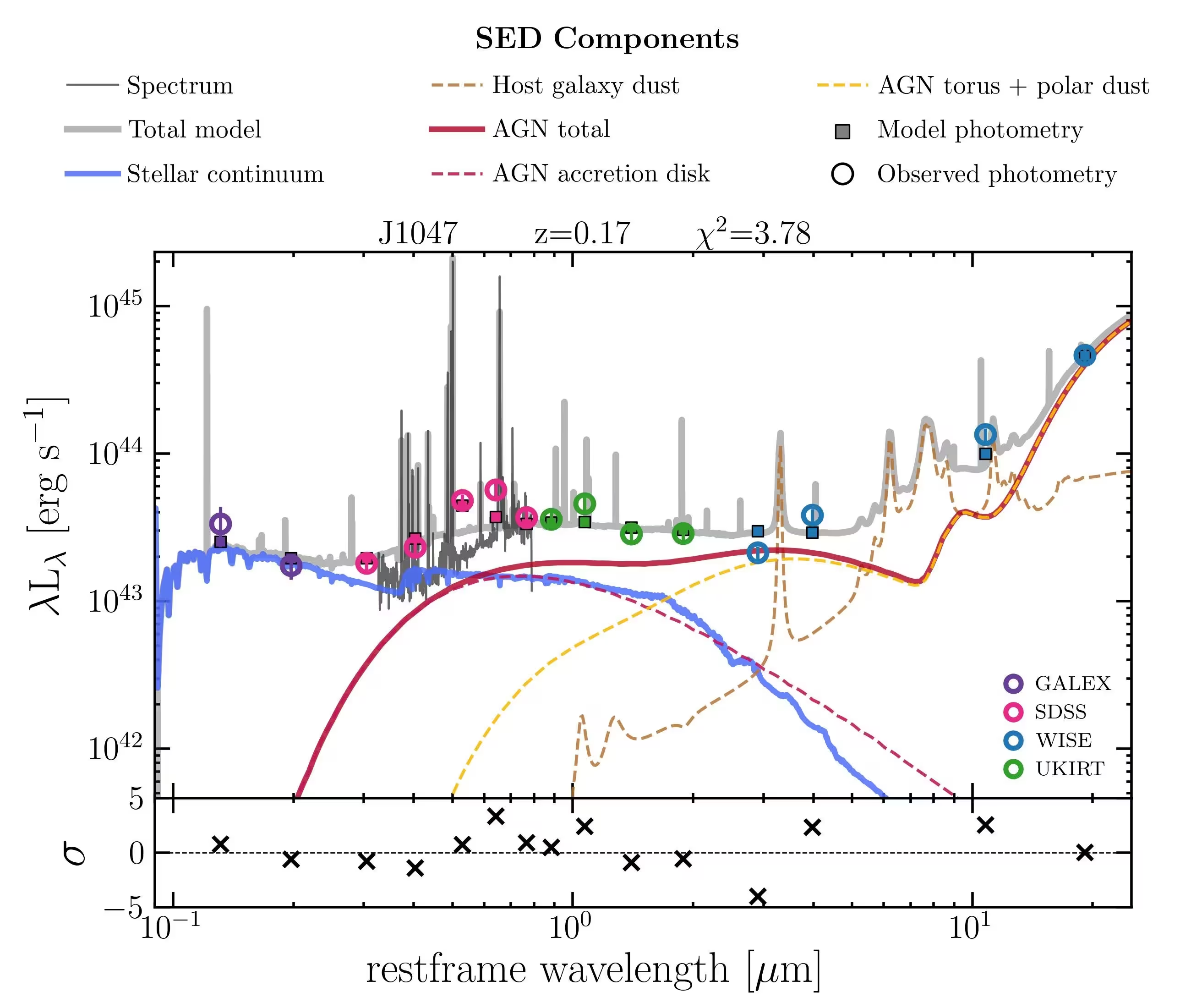
The authors also investigated whether star formation could explain the radio emission, calculating that the host galaxy forms stars at a rate of roughly 1.35 solar masses per year. This star formation rate is far too low to account for the observed radio luminosity, confirming that the radio signals originate directly from the central black hole activity.
Unresolved Questions and Future Cosmic Surveys
Although the radio detection at gigahertz frequencies fits standard obscuration models well, a non-detection at lower frequencies by the LOFAR telescope introduces new puzzles. The team suggests that a low-frequency turnover caused by synchrotron self-absorption or modest intervening absorption could explain the missing low-frequency flux, though future observations will be necessary to confirm this.
The researchers emphasize that gathering larger statistical samples of radio-detected active galaxies will be essential to determine whether J1047 represents the broader population of Little Red Dots. Upcoming ultra-sensitive continuum surveys using the SKA Observatory are expected to finally detect similar radio signatures from high-redshift cosmic specimens, shedding light on the early growth of supermassive black holes.
The study was posted to the arXiv preprint server on November 18, 2026.
This article has been fact checked for accuracy, with information verified against reputable sources. Learn more about us and our editorial process.
Last reviewed on .
Article history
- Latest version
Reference(s)
- Mazzolari, Giovanni. “Radio emission from a local Little Red Dot: a challenge to the ionized cocoon scenario.” arXiv.org <http://arxiv.org/abs/2611.24387v1>.
Cite this page:
- Posted by Karan Das