2.4 Billion-Solar-Mass Black Hole Weighed in Nearby Galaxy
Astronomy

2.4 Billion-Solar-Mass Black Hole Weighed in Nearby Galaxy

High-resolution molecular gas mapping reveals a giant black hole in NGC 3862 that defies standard galactic scaling relations.
By Aisha Ahmed
Published:
Email this Article
2.4 Billion-Solar-Mass Black Hole Weighed in Nearby Galaxy
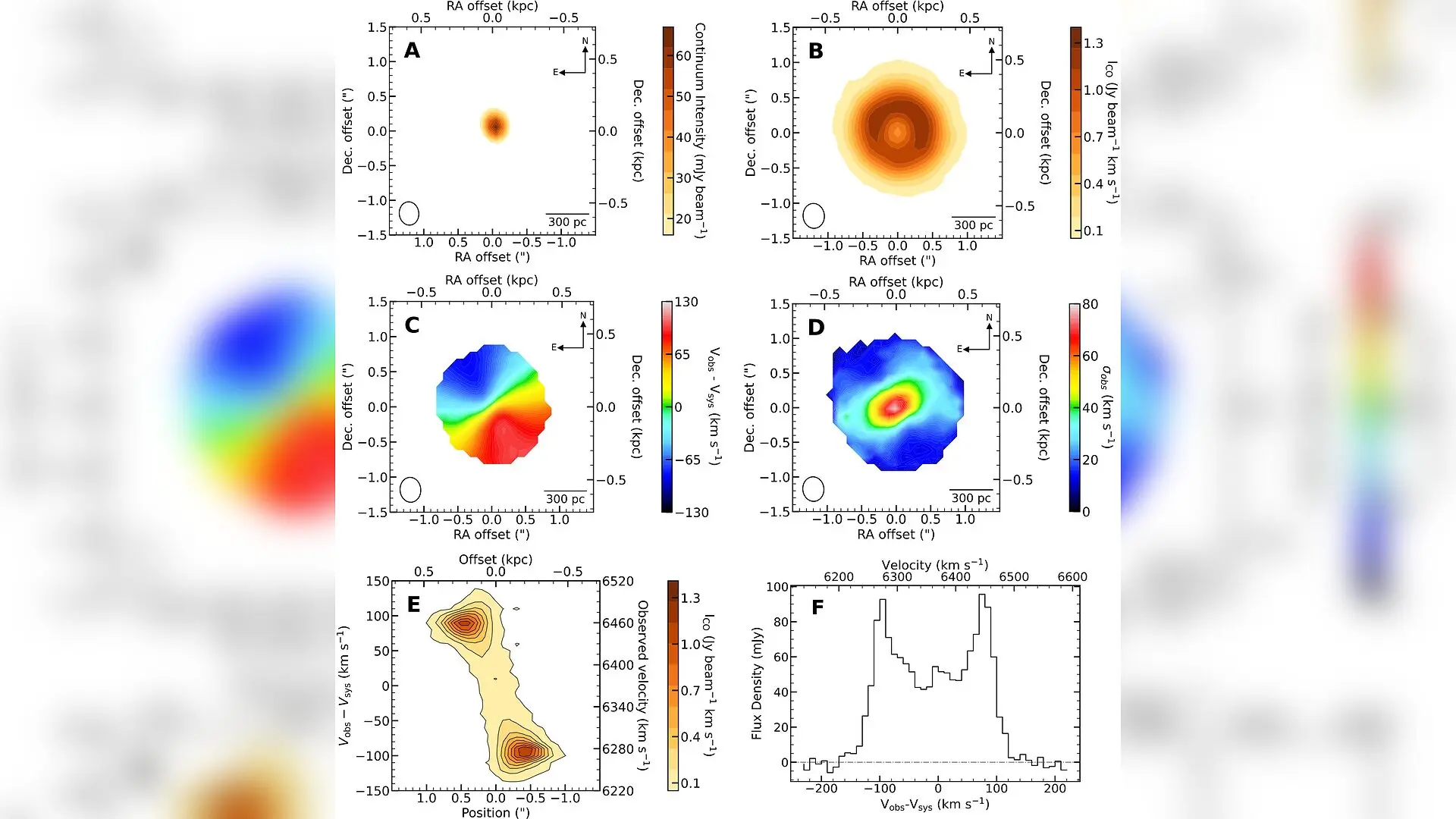
ALMA Band 6 observations of the 12CO(2−-1)-molecular gas in NGC 3862. Panel A: 1.3 mm continuum emission. Contours begin at 110σ\sigma and increase in steps of 35σ\sigma, where 1​σ=0.145​mJy​beam−11\sigma=0.145~\rm{mJy~beam}^{-1}. Panel B: 12CO(2−-1) integrated intensity (moment-0) map. Panel C: Intensity-weighted mean LOS velocity (moment-1) map, referenced to the systemic velocity vsys=6370v_{\rm sys}=6370 km s-1 (see Section II.4). Panel D: Intensity-weighted LOS velocity dispersion (moment-2) map. In Panels A–D, the synthesized beam (θ=0​.′′​348×0​.′′​293\theta=0\farcs 348\times 0\farcs 293, PA = 0∘) is shown as a filled black ellipse in the lower-left corner, and the map center is set to the best-fit kinematic center (R.A., decl.) == (11h​45m​05​.s​00911^{\rm h}45^{\rm m}05\fs 009, +19​°​36​′​22​.′′​741{+}19\arcdeg 36\arcmin 22\farcs 741). Panel E: Major-axis PVD extracted along PA =209​°=209\arcdeg through the kinematic center, with velocities referenced to vsysv_{\rm sys}. Panel Tuan N. Le et al. / arXiv

A colossal black hole weighing 2.4 billion times the mass of our Sun is lurking at the center of the massive elliptical galaxy NGC 3862, located 99.4 million light-years away from Earth. Astronomers used the Atacama Large Millimeter/submillimeter Array (ALMA) to peer through the dust of this giant galaxy and perform the first direct measurement of its central engine’s gravitational pull.

The research findings are available on the arXiv preprint server, providing fresh data on how supermassive black holes grow in the high-mass end of the cosmic web. NGC 3862, also known as the radio galaxy 3C 264, features a prominent one-sided jet of material shooting outward at nearly the speed of light.

Mapping Cold Gas to Uncover Mass

To weigh the invisible monster, the international team of researchers tracked the motion of cold molecular gas swirling in a ring-like disk right around the galactic core. This gas spins in orderly, circular orbits that act as a precision speedometer for the central gravitational potential. By observing the emission of carbon monoxide molecules at a high resolution of about 144 parsecs, the team mapped how fast the gas travels as it gets closer to the center.
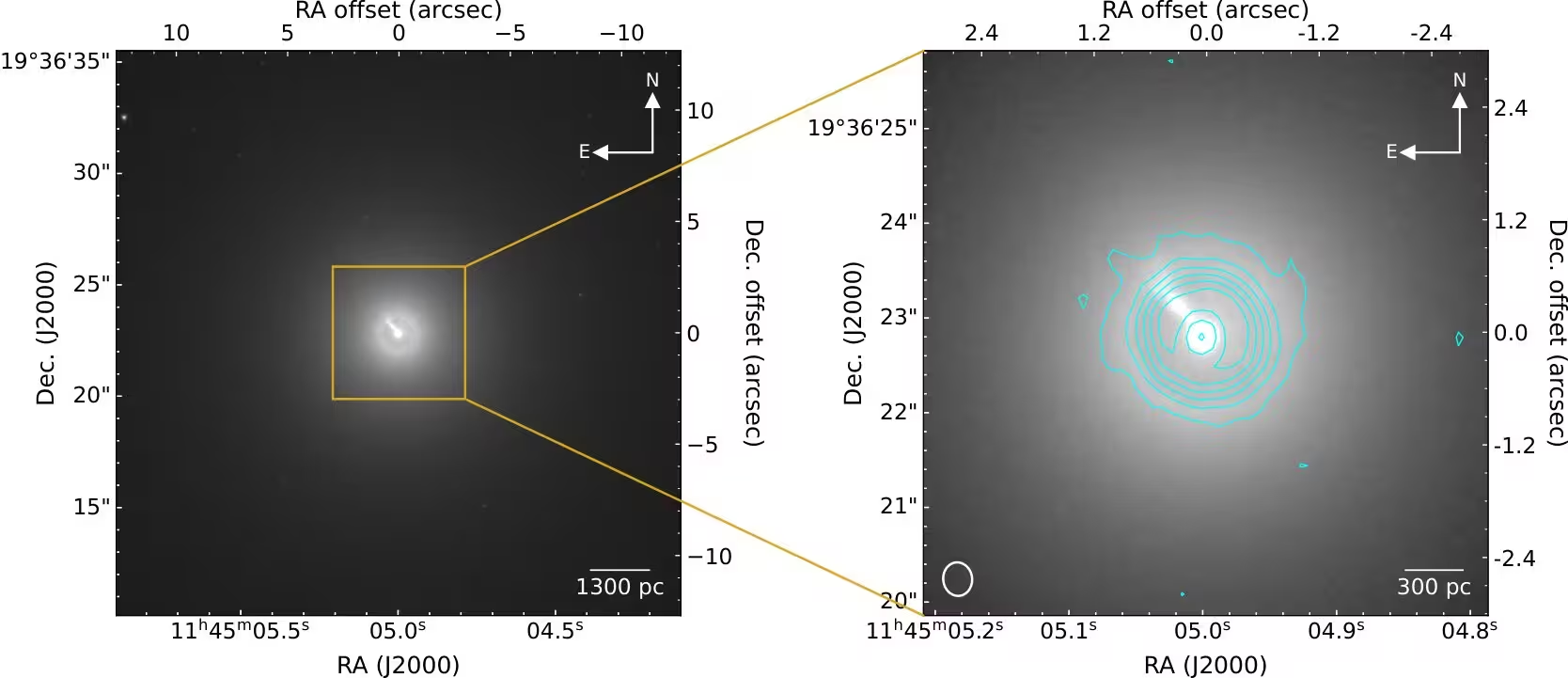
Figure 1: Left: HST/WFC3 F814W image of NGC 3862 centered on the nucleus, displayed over a 25.6​″×25.6​″25.6\arcsec\times 25.6\arcsec (12.34​kpc×12.34​kpc12.34~{\rm kpc}\times 12.34~{\rm kpc}) field of view. The circumnuclear dust disk is clearly visible as a dark absorption feature against the stellar continuum. North is up, and east is to the left. Right: Zoom-in of the central 6.0​″×6.0​″6.0\arcsec\times 6.0\arcsec (2.9​kpc×2.9​kpc2.9~{\rm kpc}\times 2.9~{\rm kpc}) region (yellow box in the left panel), with ALMA 12CO(2−-1) integrated intensity (moment-0) contours overlaid in cyan. Contours begin at 5σ\sigma and increase in steps of 13​σ13\sigma, where 1​σ=16​mJy​beam−1​km​s−11\sigma=16~{\rm mJy~beam}^{-1}~{\rm km~s}^{-1}. The ALMA synthesized beam (0.348​″×0.293​″0.348\arcsec\times 0.293\arcsec, PA =6.1​°=6.1\arcdeg) is shown as a white ellipse in the lower-left corner. The 12CO(2−-1)-molecular gas emission is spatially coincident with the dust disk, consistent with a rotating circumnuclear
Left: HST/WFC3 F814W image of NGC 3862 centered on the nucleus, displayed over a 25.6​″×25.6​″25.6\arcsec\times 25.6\arcsec (12.34​kpc×12.34​kpc12.34~{\rm kpc}\times 12.34~{\rm kpc}) field of view. The circumnuclear dust disk is clearly visible as a dark absorption feature against the stellar continuum. North is up, and east is to the left. Right: Zoom-in of the central 6.0​″×6.0​″6.0\arcsec\times 6.0\arcsec (2.9​kpc×2.9​kpc2.9~{\rm kpc}\times 2.9~{\rm kpc}) region (yellow box in the left panel), with ALMA 12CO(2−-1) integrated intensity (moment-0) contours overlaid in cyan. Contours begin at 5σ\sigma and increase in steps of 13​σ13\sigma, where 1​σ=16​mJy​beam−1​km​s−11\sigma=16~{\rm mJy~beam}^{-1}~{\rm km~s}^{-1}. The ALMA synthesized beam (0.348​″×0.293​″0.348\arcsec\times 0.293\arcsec, PA =6.1​°=6.1\arcdeg) is shown as a white ellipse in the lower-left corner. The 12CO(2−-1)-molecular gas emission is spatially coincident with the dust disk, consistent with a rotating circumnuclear Credit: Tuan N. Le et al. / arXiv

The data revealed a steep central velocity rise where gas speeds jump significantly, signaling the immense gravitational grip of a supermassive black hole. The authors utilized a sophisticated forward-modeling code known as KinMS to simulate the three-dimensional gas distribution and account for blurring effects caused by the telescope beam. Their best-fit model yielded a black hole mass of 2.40 billion solar masses, alongside a stellar mass-to-light ratio that matches an old, metal-rich stellar population older than 10 billion years.

Testing Cosmic Scaling Relations

For decades, astronomers have noticed that supermassive black holes scale predictably with the properties of their host galaxies, such as the random velocities of their stars. However, galaxies at the absolute highest end of the mass scale often defy these standard rules by hosting black holes that appear disproportionately heavy. NGC 3862 fits squarely into this overmassive category, sitting well above standard empirical scaling relations.

The team verified that their observations successfully resolved the gravitational sphere of influence of the black hole, meaning the region where the black hole dominates the stellar dynamics. The radius of this sphere stretches across approximately 198 parsecs, comfortably larger than the telescope beam resolution. This confirmation ensures that the mass measurement is robust against instrumental limitations and foreground interference.
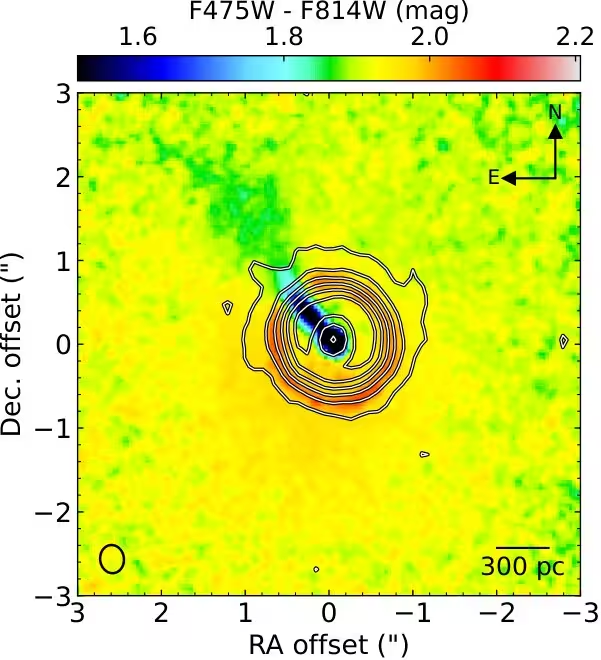
Figure 3: HST/WFC3 F475W−-F814W color map of the nuclear region of NGC 3862, with ALMA 12CO(2−-1) integrated intensity contours overlaid in white; contour levels and synthesized beam as in Figure 1. The stellar color is uniform at ≈\approx1.9–2 mag away from the central blue jet feature (NE–SW) and the dust lane within r≲1​″r\lesssim 1\arcsec, consistent with a single, old (≳\gtrsim10 Gyr) stellar population dominating the nuclear light.
HST/WFC3 F475W−-F814W color map of the nuclear region of NGC 3862, with ALMA 12CO(2−-1) integrated intensity contours overlaid in white; contour levels and synthesized beam as in Figure 1. The stellar color is uniform at ≈\approx1.9–2 mag away from the central blue jet feature (NE–SW) and the dust lane within r≲1​″r\lesssim 1\arcsec, consistent with a single, old (≳\gtrsim10 Gyr) stellar population dominating the nuclear light. Credit: Tuan N. Le et al. / arXiv

Accounting for Uncertainties and Dust

Measuring the mass of a distant black hole carries several technical hurdles, including dust obscuration and contamination from the active galactic nucleus itself. The nuclear region contains bright synchrotron radiation from the high-speed jet, which can easily mimic starlight and skew mass estimates if left uncorrected. The researchers carefully masked jet-affected pixels and applied a dust-extinction correction using high-resolution images from the Hubble Space Telescope.

Additional systematic checks involving thick-disk geometries and varying turbulent gas velocity dispersions confirmed that the mass estimate remains stable within expected statistical margins. While distance uncertainties to the host galaxy introduce a notable scaling factor, the successful direct dynamical measurement adds a vital data point to the census of massive black holes, helping scientists refine models of galaxy and black hole co-evolution across cosmic time.

The study was posted to the arXiv preprint server on November 18, 2026.

Fact Checked

This article has been fact checked for accuracy, with information verified against reputable sources. Learn more about us and our editorial process.

Last reviewed on .

Article history

  • Latest version

Cite this page:

Ahmed, Aisha. “2.4 Billion-Solar-Mass Black Hole Weighed in Nearby Galaxy.” BioScience. BioScience ISSN 2521-5760, 19 November 2026. <https://www.bioscience.com.pk/en/subject/astronomy/unveiling-the-central-black-hole-of-ngc-3862-a-direct-mass-determination-using-almas-high-resolution-molecular-gas-kinematics>. Ahmed, A. (2026, November 19). “2.4 Billion-Solar-Mass Black Hole Weighed in Nearby Galaxy.” BioScience. ISSN 2521-5760. Retrieved November 19, 2026 from https://www.bioscience.com.pk/en/subject/astronomy/unveiling-the-central-black-hole-of-ngc-3862-a-direct-mass-determination-using-almas-high-resolution-molecular-gas-kinematics Ahmed, Aisha. “2.4 Billion-Solar-Mass Black Hole Weighed in Nearby Galaxy.” BioScience. ISSN 2521-5760. https://www.bioscience.com.pk/en/subject/astronomy/unveiling-the-central-black-hole-of-ngc-3862-a-direct-mass-determination-using-almas-high-resolution-molecular-gas-kinematics (accessed November 19, 2026).
End of the article