Massive Galaxy Bar Found Earlier Than Scientists Ever Expected
JWST découvre une barre stellaire massive dans une galaxie jeune bouleversant les théories de formation galactique
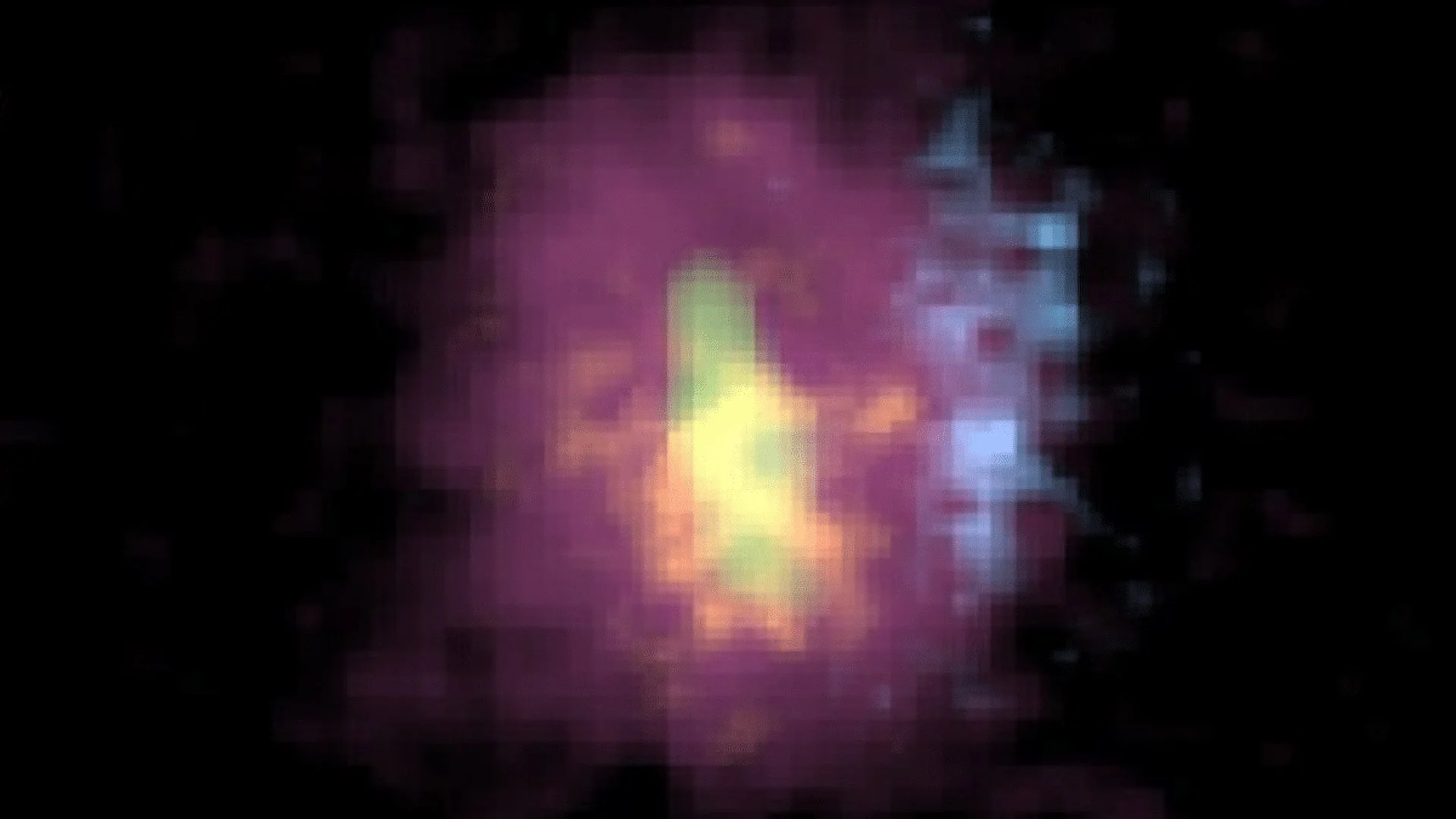
Using the James Webb Space Telescope, astronomers have identified an enormous stellar bar inside the distant, dust‑shrouded galaxy GN20, whose light dates back to just 1.5 billion years after the Big Bang. The finding, reported in a paper posted to arXiv on 14 May 2026, challenges prevailing ideas about how quickly complex structures can appear in the early universe.
How Bars Shape Galaxies
In many nearby spirals, elongated stellar bars stretch across the central regions, rotating as a coherent unit. Their motion channels gas toward the nucleus, often sparking bursts of star formation, feeding central black holes, and building dense bulges. The Milky Way itself hosts such a bar, which helps regulate the flow of material into its inner zones.
JWST Cuts Through the Dust
GN20 is heavily obscured by interstellar dust, a factor that has long limited high‑resolution studies. By combining observations from JWST’s Mid‑Infrared Instrument (MIRI) and Near‑Infrared Camera (NIRCam), researchers penetrated the veil and reconstructed the galaxy’s internal layout. Their analysis revealed a distinct bar‑shaped component, a result confirmed with isophotal fitting that tracks how light intensity varies with radius.
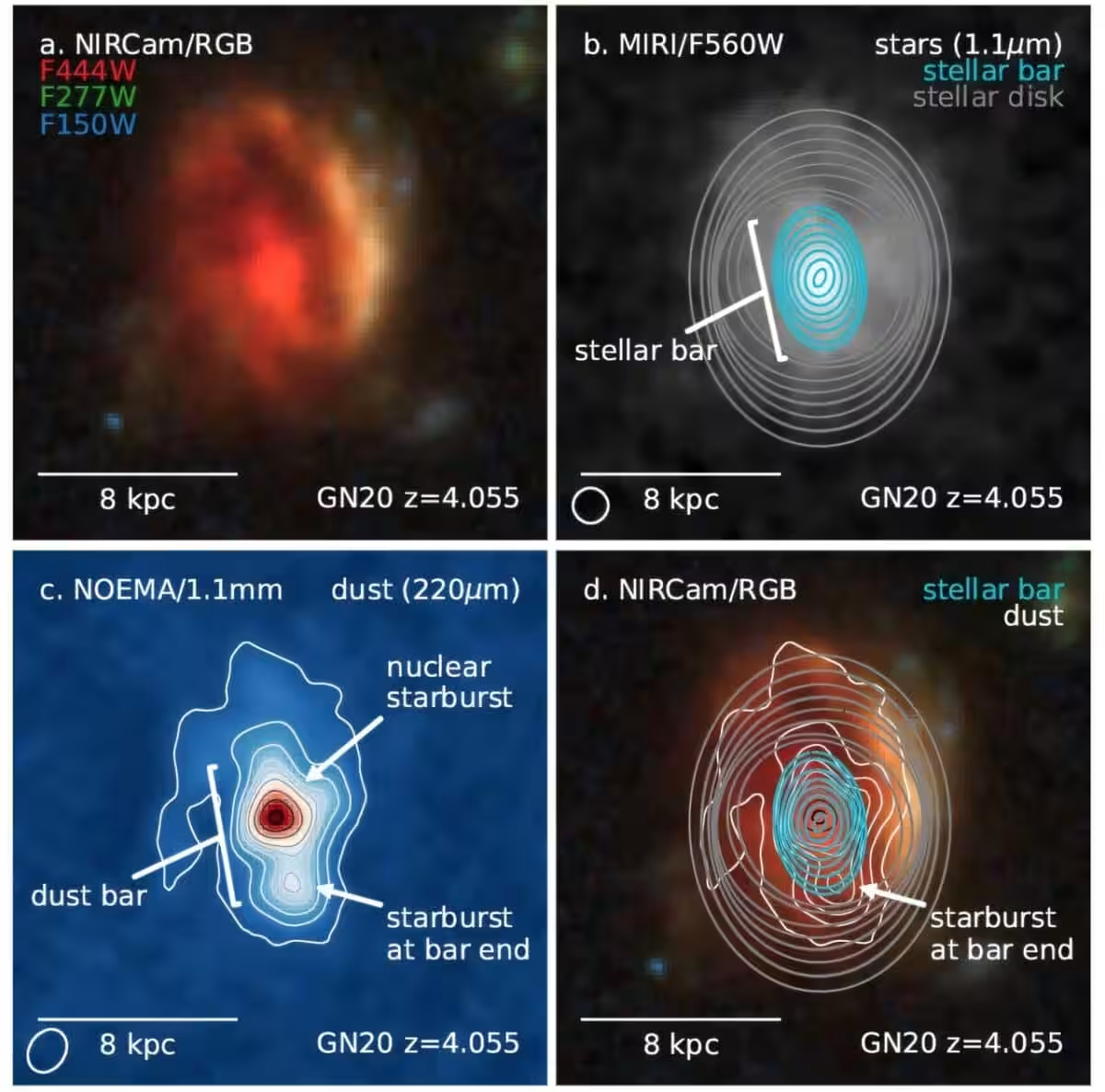
Credit: Leindert A. Boogaard et al (2026). DOI: 10.48550/arXiv.2605.15273
A Bar Where Theory Expected None
Standard models predict that young, gas‑rich galaxies should resist bar formation because high gas fractions damp the instability that creates bars, and the growth of a multi‑kiloparsec bar is thought to require several gigayears. GN20’s seven‑kiloparsec bar therefore contradicts three expectations: it should collapse under its own weight, it should take far longer to develop, and abundant gas should inhibit its emergence.
“Our new results demonstrate that all three of these obstacles can be overcome by a single ingredient directly implicated by the observations: the presence of highly turbulent gas across the inner disk at high gas fraction,” the team writes in the paper.
The authors argue that intense turbulence stabilises the bar, allowing it to assemble rapidly despite the surrounding gas‑rich environment.
Bar‑Driven Starburst Activity
Beyond its structural role, the bar in GN20 appears to funnel material toward the galaxy’s centre, where it ignites a vigorous nuclear starburst and may supply a nascent supermassive black hole. The researchers estimate a star‑formation rate exceeding 1,000 solar masses per year, highlighting the bar’s function as a conduit for both gas and dust.
“Part of this high SFR is likely being driven by the bar funneling gas and dust into the center, where it triggers an intense nuclear starburst in the gas‑rich disk, and fuels the potential active galactic nucleus,” the authors note.
Implications for Early Massive Galaxies
If GN20‑type systems represent a common phase, they could be the precursors of the massive elliptical galaxies observed today. As the central gas reservoir is exhausted, star formation would cease, leaving a quiescent remnant that matches the early quenching seen in some local massive galaxies.
The discovery underscores JWST’s capability to uncover hidden dynamical features in the distant universe, offering fresh insight into how early galaxies assembled their stellar mass and central structures far more quickly than previously thought.
This article has been fact checked for accuracy, with information verified against reputable sources. Learn more about us and our editorial process.
Last reviewed on .
Article history
- Latest version
Reference(s)
- Boogaard, Leindert. “A stellar bar hidden in an extreme gas-rich disk galaxy at z=4.055.” arXiv.org <https://arxiv.org/abs/2605.15273>.
Cite this page:
- Posted by Aisha Ahmed