Physicists Just Calculated the Massive Amount of Information Stored in the Universe
Physicists have used information theory and particle-based calculations to estimate the total amount of information contained within the observable universe.
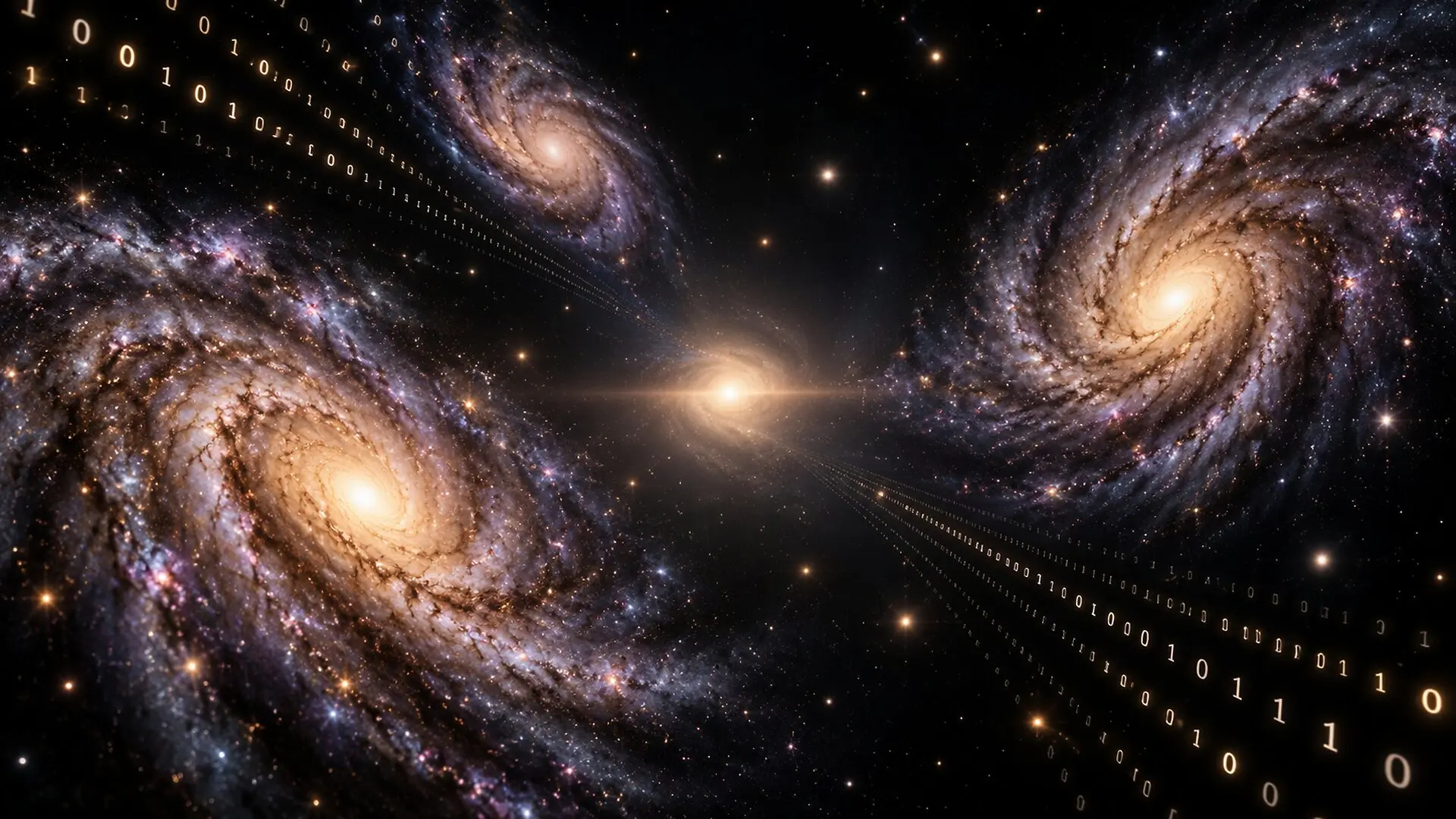
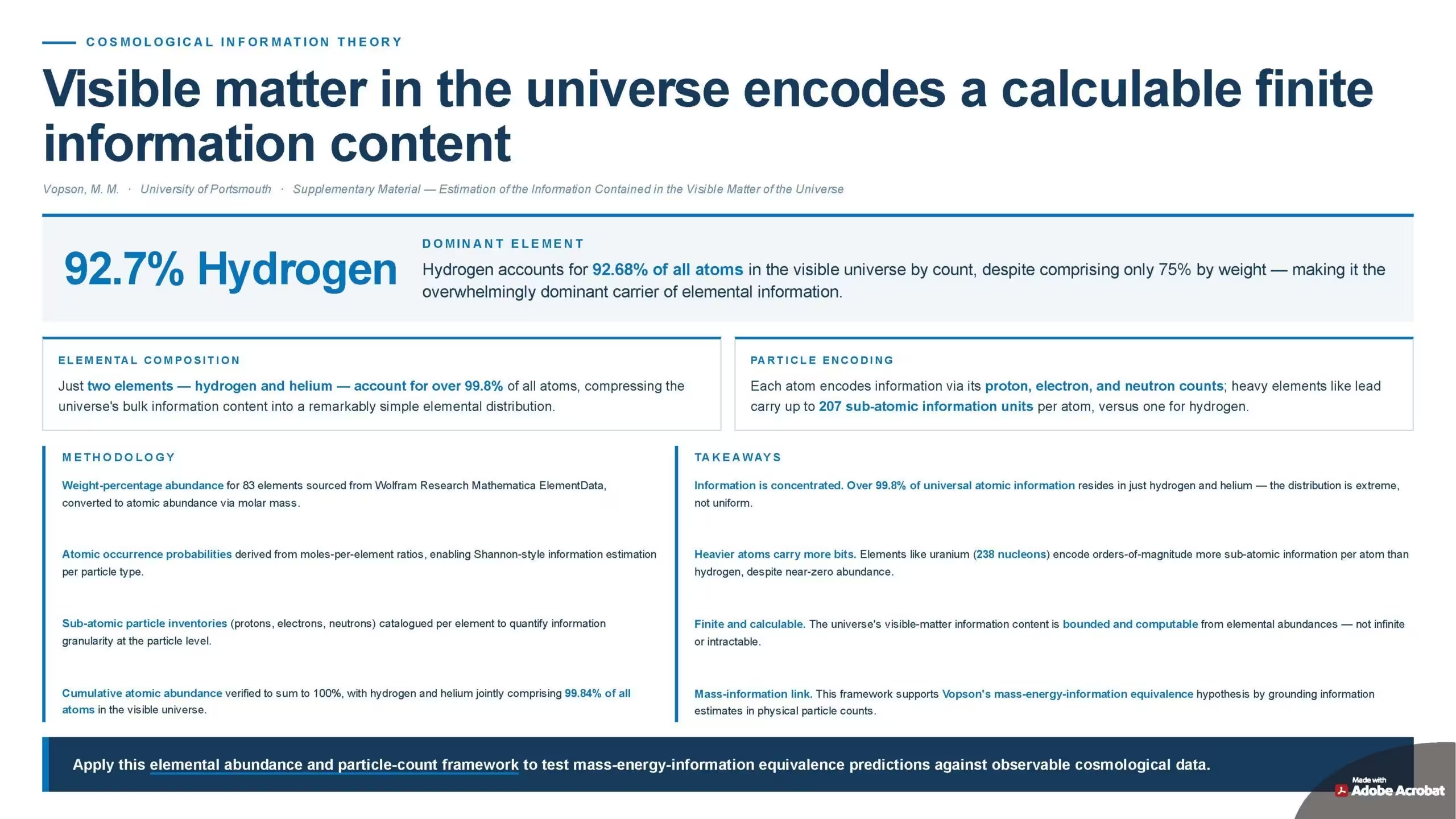
A new theoretical study suggests that the observable universe contains approximately 6 × 10⁸⁰ bits of information stored within its ordinary matter. By applying Claude Shannon’s foundational information theory to the fundamental particles that compose atoms, researchers have arrived at a cosmic tally that offers a fresh perspective on the information density of our physical reality.
The research, conducted by Melvin Vopson of the University of Portsmouth’s School of Mathematics and Physics and published in AIP Advances, does not aim to measure the absolute total of all information in existence. Instead, it provides a structured calculation based on the identification of specific elementary particles, such as electrons and the quarks that constitute protons and neutrons.

Quantifying the building blocks of reality
At the heart of the analysis is the question of how much data is required to uniquely distinguish one particle type from another. Vopson utilizes Shannon entropy—a mathematical framework that quantifies information based on the probability of specific outcomes—to assign an average value of 1.509 bits to each elementary particle in his sample. This approach treats the inherent properties that define a particle, such as its mass, charge, and spin, as observable information.
“The information capacity of the universe has been a topic of debate for over half a century,” Vopson noted. “There have been various attempts to estimate the information content of the universe, but in this paper, I describe a unique approach that additionally postulates how much information could be compressed into a single elementary particle.”
To reach the final cosmic estimate, the model accounts for the estimated abundance of baryonic matter—primarily hydrogen and helium—across the observable universe. By calculating the total number of constituent particles (approximately 4 × 10⁸⁰) and multiplying this by the average information per particle, the researchers derived the staggering figure of 6 × 10⁸⁰ bits.

Visualizing the digital scale
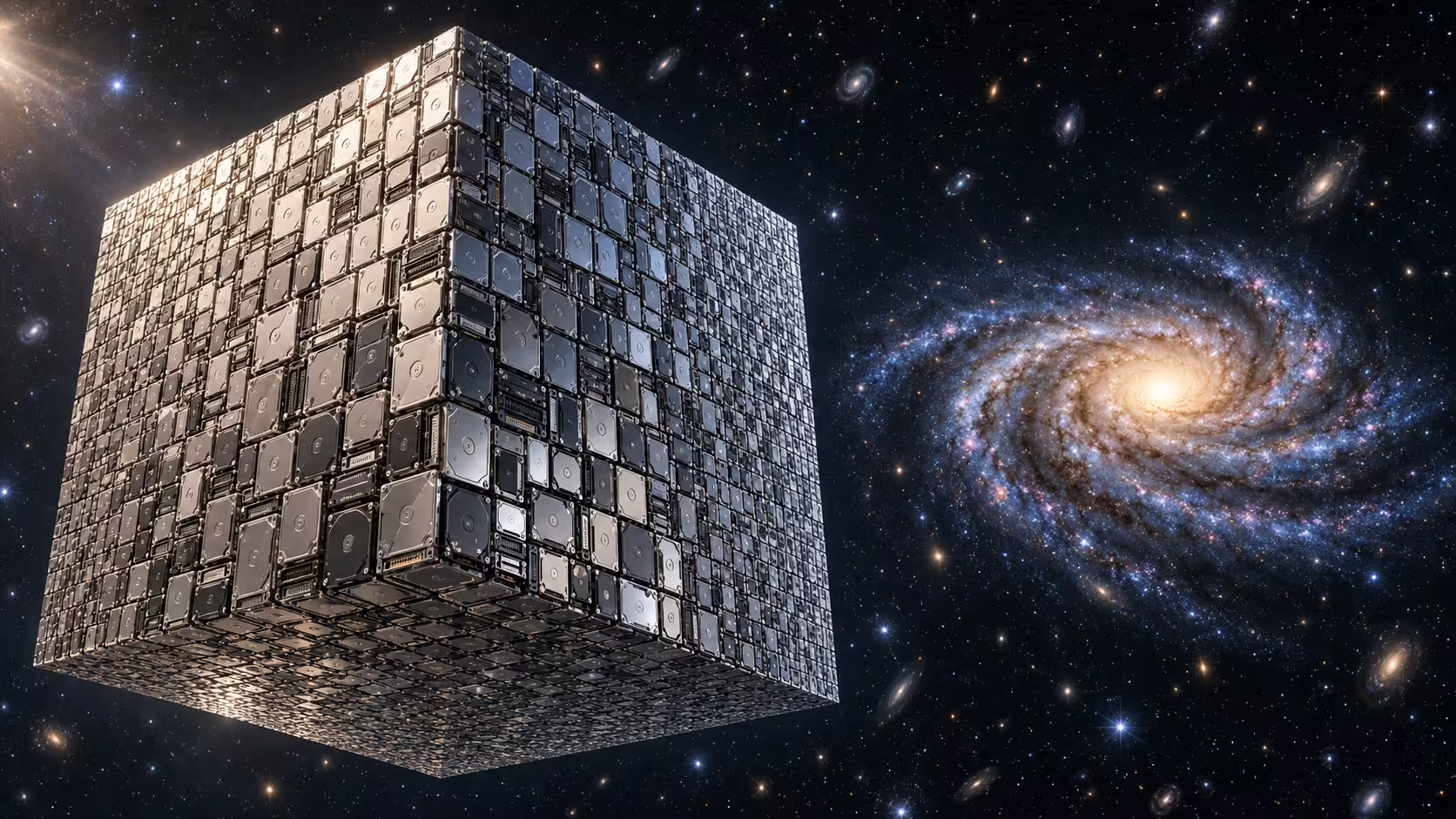
To contextualize such a massive number, the study offers a thought experiment involving digital storage. If this information were stored on standard one-terabyte hard drives, the cumulative hardware would create a cube roughly 163,000 light-years on each side—a structure significantly larger than the Milky Way galaxy. If each bit were instead packed into a tiny cube the size of a grain of sand, the resulting volume would span 90 million light-years, dwarfing our own galaxy by a factor of 900.
Defining the limits of the model
The researchers emphasize that this calculation is a specific theoretical exercise rather than a definitive cosmic census. The model excludes neutrinos and antiparticles, and it does not account for the information that might be encoded in the motion, positioning, or complex interactions between particles. Furthermore, while the study employs rigorous mathematics, it does not confirm that information constitutes a new, fundamental state of matter.
Previous efforts, such as the 2002 analysis by physicist Seth Lloyd, have attempted to quantify the universe’s computational capacity by examining limits on information processing over time. Vopson’s work takes a different path, focusing on static identity rather than dynamic computation.
While the link between information and thermodynamics has been bolstered by experiments—notably the 2012 verification of Landauer’s principle, which demonstrates that erasing information generates heat—a direct physical link between abstract data and the fabric of matter remains an open question. Vopson views this current estimate as a starting point, hoping that the numerical results will eventually invite experimental tests that could move these ideas from theoretical conjecture to empirical fact.
Recommended Resources
- A Mathematical Theory of Communication: The foundational paper by Claude Shannon establishing the bit as a unit of measurement.
- Computational Capacity of the Universe: A study on the fundamental limits of information processing in physical systems.
- Experimental verification of Landauer’s principle: Research demonstrating the physical relationship between information erasure and thermodynamic heat.
- Experimental protocol for testing the mass–energy–information equivalence principle: An outline of proposed methods to probe the physical properties of information.
This article has been fact checked for accuracy, with information verified against reputable sources. Learn more about us and our editorial process.
Last reviewed on .
Article history
- Latest version
Reference(s)
- <https://pubs.aip.org/aip/adv/article/11/10/105317/661214/Estimation-of-the-information-contained-in-the>.
- Lloyd, Seth. “Computational Capacity of the Universe.” Physical Review Letters, vol. 88, no. 23, May 24, 2002 American Physical Society (APS), doi: 10.1103/PhysRevLett.88.237901. <https://journals.aps.org/prl/abstract/10.1103/PhysRevLett.88.237901>.
- Shannon, C. E.. “A Mathematical Theory of Communication.” Bell System Technical Journal, vol. 27, no. 3, July 29, 2013, pp. 379-423. Institute of Electrical and Electronics Engineers (IEEE), doi: 10.1002/j.1538-7305.1948.tb01338.x. <https://doi.org/10.1002/j.1538-7305.1948.tb01338.x>.
- Bérut, Antoine. “Experimental verification of Landauer’s principle linking information and thermodynamics - Nature.”, vol. 483, no. 7388, pp. 187-189. Nature, doi: 10.1038/nature10872. <https://www.nature.com/articles/nature10872>.
- Vopson, Melvin M.. “Experimental protocol for testing the mass–energy–information equivalence principle.” AIP Advances, vol. 12, no. 3, March 4, 2022 AIP Publishing, doi: 10.1063/5.0087175. <https://doi.org/10.1063/5.0087175>.
Cite this page:
- Posted by Aisha Ahmed