NASA Unveils Stunning New Image of Centaurus A Revealing Black Hole Jets and Starburst Chaos
NASA’s new image of Centaurus A shows a nearby galaxy sculpted by intense star formation and powerful cosmic forces.
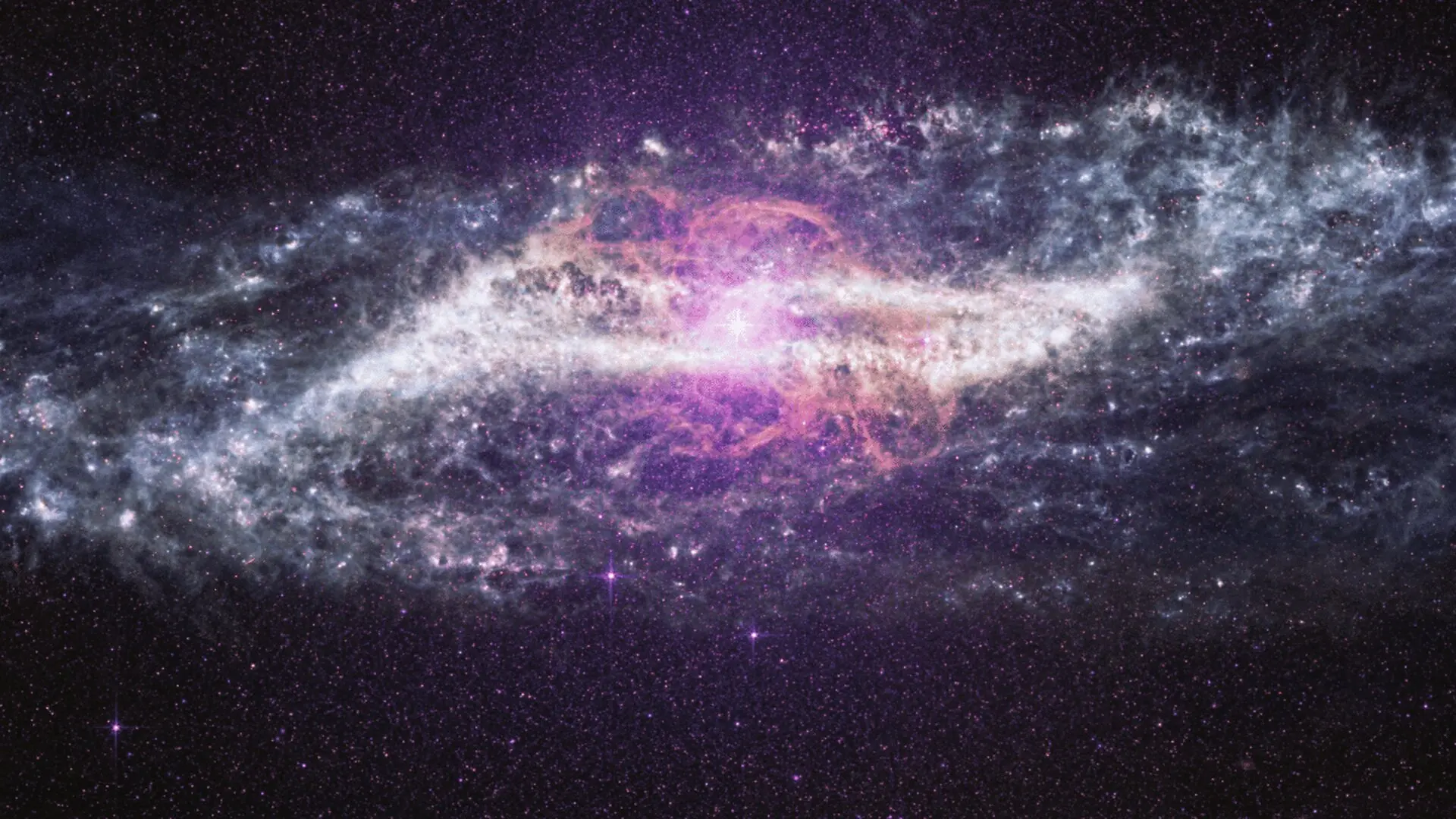
NASA has unveiled a high‑resolution composite of Centaurus A, one of the nearest active galaxies, revealing a tangled tapestry of newborn stars, obscuring dust lanes and energetic outflows from its central supermassive black hole that span thousands of light‑years.
Located roughly 12 million light‑years away in the southern constellation Centaurus, the system is classified as a starburst galaxy, undergoing a burst of stellar birth far more vigorous than that seen in average galaxies.
The fresh imagery offers researchers a sharper window into a heavily scrutinized neighbor, enabling deeper probes of galactic evolution, black‑hole feedback mechanisms, and the transformative impact of cosmic collisions.
Cosmic Violence Sculpted This Nearby Galaxy
Centaurus A catches the eye with a striking dark ribbon bisecting its core, a feature that blocks visible light from vast interior regions. By contrast, the Milky Way and other classic spirals lack such an opaque band (the Milky Way being a prime example).
Astronomers attribute this anomaly to a historic merger between two galaxies, an event that funneled copious amounts of gas and dust into the central zones, igniting a rapid wave of star formation.
At the heart of the system lies an active supermassive black hole whose relativistic jets pierce the surrounding medium, extending far beyond the visible disk and reshaping the interstellar environment.
The interplay of a past collision, intense star‑forming activity, and a voracious black hole makes Centaurus A an indispensable laboratory for decoding the forces that govern galaxy morphology across the cosmos.
NASA’s New Image Maps the Intricate Structure of Centaurus A
The composite was released by NASA, which highlighted the galaxy as a vivid case study of dramatic astrophysical transformation. The agency stresses that nearby systems like this serve as proxies for processes occurring in far‑more distant, less accessible galaxies.
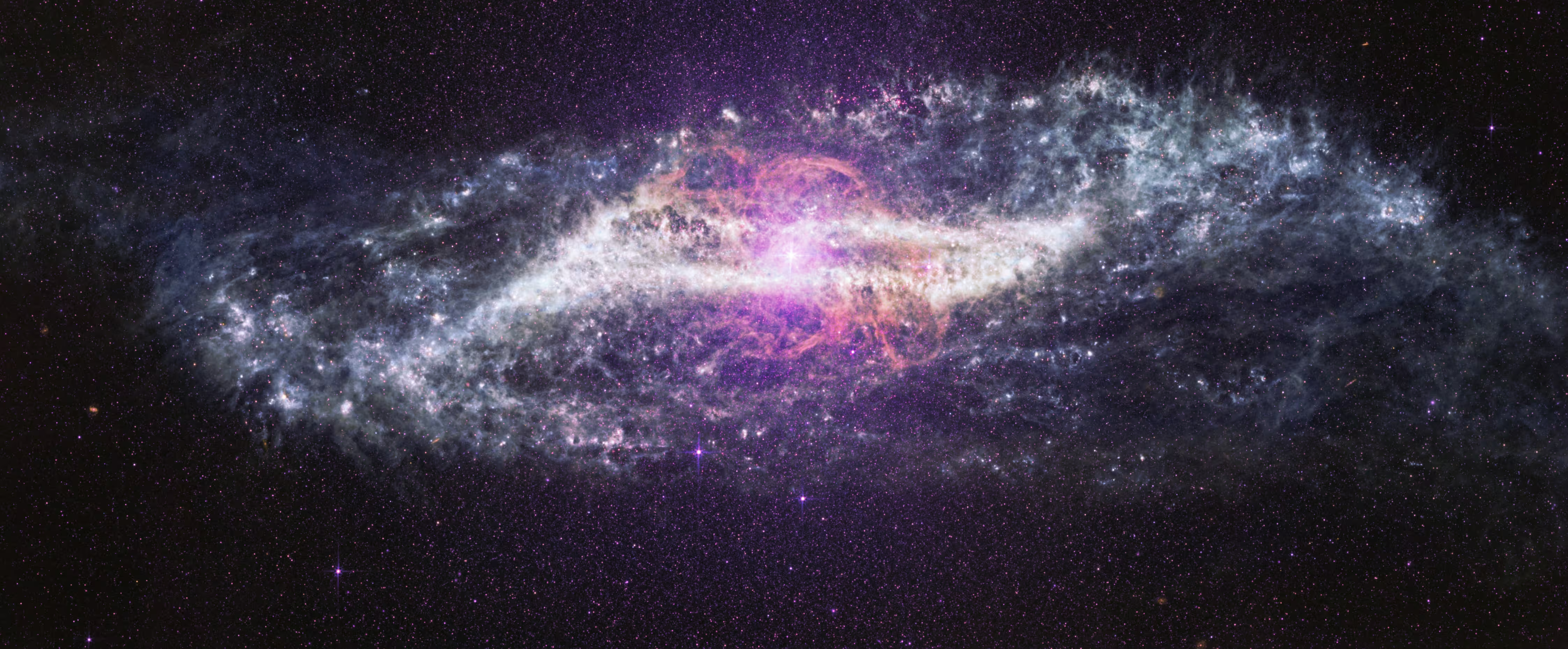
By combining observations from optical, infrared and other wavelength regimes, scientists can peer through the veil of dust, pinpointing pockets where stellar nurseries are actively assembling.
Multiple space‑based observatories have targeted Centaurus A because of its energetic nucleus and layered architecture, each dataset refining our picture of how black holes, gas reservoirs, and star‑forming regions interconnect.
Continued advances in astronomical imaging by NASA and its partners keep delivering ever‑more detailed portraits, enriching both the scientific community and public understanding of galactic life cycles.
Central Black Hole Powers Jets and Shapes Star‑Forming Regions
Encircling the galaxy’s core, a colossal black hole draws in surrounding matter, heating it to extreme temperatures before ejecting a fraction of the inflow as high‑energy particle streams.
These jets, among the most conspicuous features of Centaurus A, carve out expansive structures that stretch well beyond the visible galaxy, exemplifying how a single black hole can dictate conditions across an entire system.
The outflows also modulate the thermal state and motion of adjacent gas, thereby influencing the rate at which new stars emerge and the distribution of matter throughout the galaxy.
Examining this feedback loop provides critical insight into the broader relationship between supermassive black holes and the evolutionary pathways of their host galaxies.
This article has been fact checked for accuracy, with information verified against reputable sources. Learn more about us and our editorial process.
Last reviewed on .
Article history
- Latest version
Reference(s)
- “Starburst Galaxy Centaurus A - NASA.” NASA <https://www.nasa.gov/image-article/starburst-galaxy-centaurus-a/>.
Cite this page:
- Posted by Aisha Ahmed