Future Detector Networks Will Reveal How Supermassive Black Holes Grow
Combining space and ground observatories solves a major cosmic puzzle, showing that light and heavy black hole seeds leave distinct gravitational fingerprints.
A team of astrophysicists has shown that combining space- and ground-based gravitational-wave detectors can solve long-standing mysteries about how supermassive black holes grow. These cosmic giants, sitting with masses millions to billions of times that of our Sun at the centers of most galaxies, leave behind ripples in spacetime that future instruments will capture.
Alorika Kar and colleagues investigated how next-generation observatories operating across different frequency bands could map out the mass and redshift distribution of merging black hole binaries. Their study is available on the arXiv preprint server and outlines a comprehensive simulation of different black hole formation theories. By analyzing how well future networks can reconstruct these populations, the authors found that teamwork between detectors is essential for capturing lighter black hole seeds.
Catching Cosmic Ripples Across the Universe
Gravitational waves are invisible distortions of spacetime triggered by cataclysmic events such as the collision of two black holes. While current ground-based detectors like LIGO and Virgo observe stellar-mass black holes, future observatories will reach much further into the cosmos. The Laser Interferometer Space Antenna (LISA) is a space-based mission scheduled for launch in 2035 that will operate in the millihertz frequency band. Meanwhile, proposed decihertz detectors like the Lunar Gravitational Wave Antenna (LGWA) and next-generation ground-based facilities like the Einstein Telescope and Cosmic Explorer will target higher frequencies.
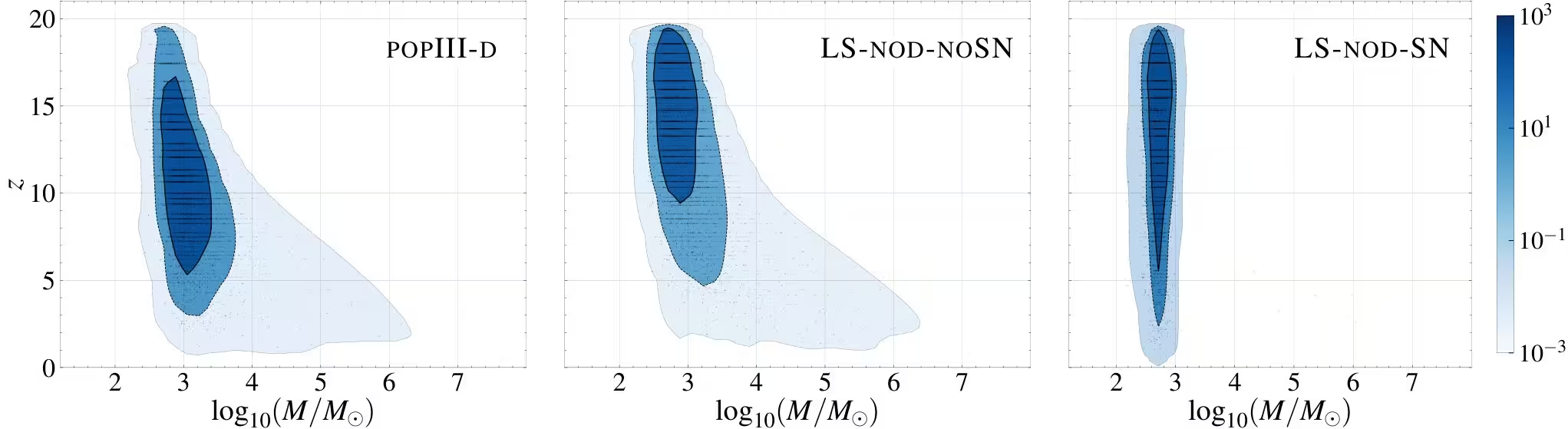
The researchers simulated various astrophysical models to see what happens when these detectors operate as a cooperative network. They tracked two primary hypotheses regarding the origin of supermassive black holes. Light-seed models suggest that black holes form as remnants of ancient, metal-free Population III stars with masses around 100 solar masses. Heavy-seed models propose that massive seeds weighing between 10,000 and one million solar masses emerge through the direct collapse of large gas clouds in primordial galaxies.
Why Light Seeds Require a Multiband Network
The team discovered that the success of future gravitational-wave astronomy depends heavily on which seeding mechanism built the universe. For light-seed scenarios, individual detectors fall short because the resulting black hole mergers span a massive and diverse range of masses and redshifts. A single instrument misses significant portions of this population.
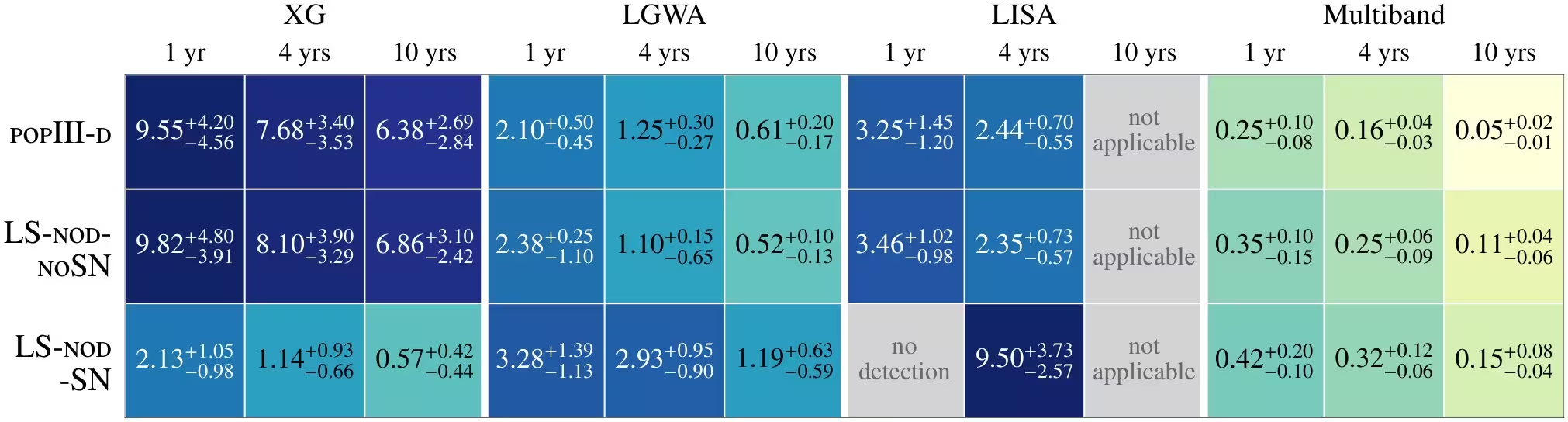
However, when the authors combined data from LISA, LGWA, and ground-based observatories using a nonparametric Bayesian inference tool called Figaro, the reconstruction quality improved dramatically. The multiband network successfully mapped out complex regions of the mass-redshift plane that no single observatory could handle alone. In fact, just one year of multiband observations outperformed a full decade of monitoring with any single instrument.
How Heavy Seeds Tell a Different Story
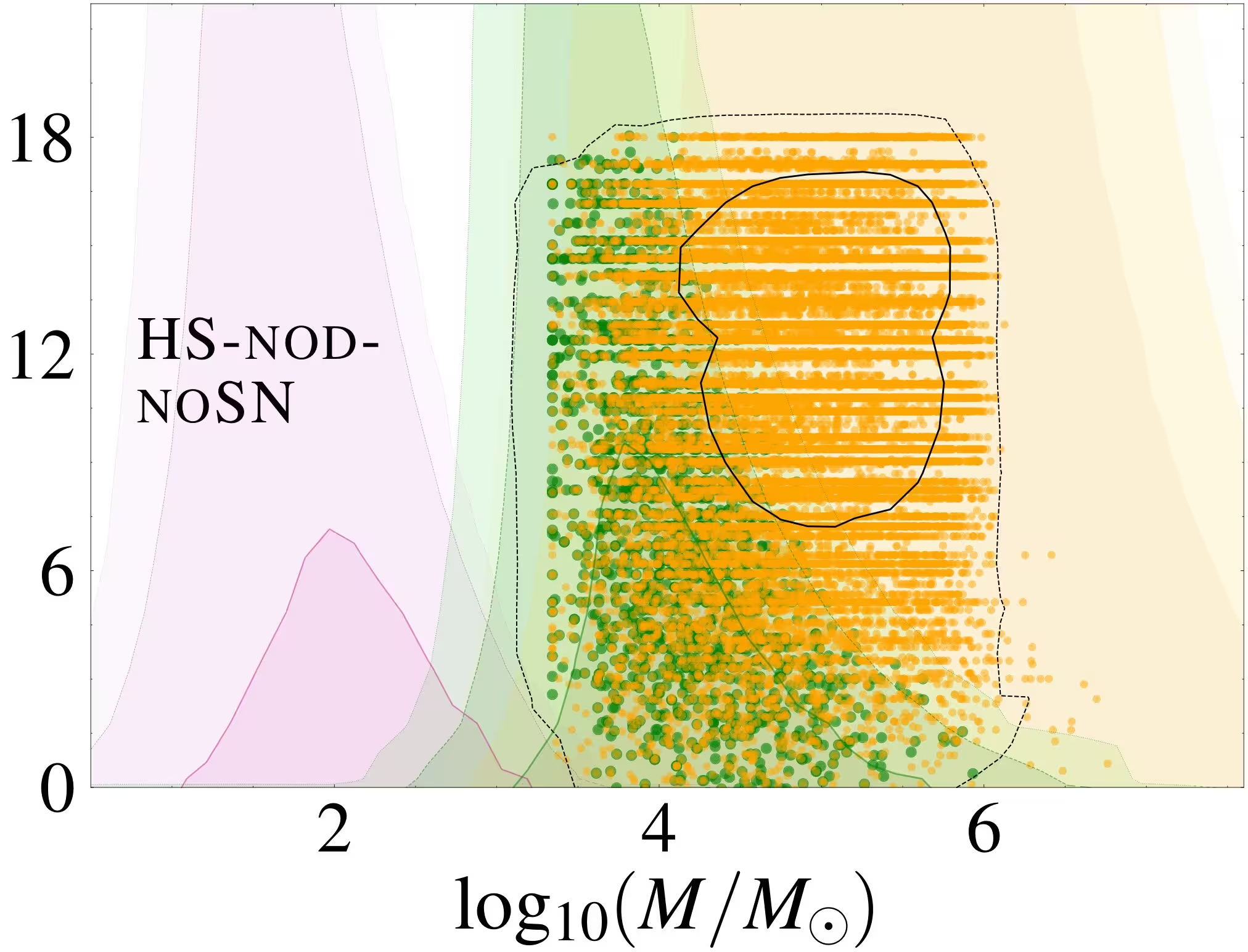
The situation changes entirely for heavy-seed models. Because heavy-seed black hole populations concentrate at much higher masses, LISA alone can detect the vast majority of these merging events during its nominal four-year mission. The space-based antenna captures enough signal to recover the underlying mass-redshift distribution with high fidelity, leaving little room for improvement from a wider multiband network.
The authors acknowledge several limitations in their current analysis. The forecasts rely on simplified Fisher-matrix likelihoods, fixed cosmological parameters, and approximated treatments of weak lensing, which is the gravitational bending of waves by intervening matter. Future work will require full Bayesian parameter estimation and more detailed modeling of detector duty cycles to refine these cosmic maps.
Unlocking the Earliest Chapters of Galaxy Evolution
Understanding how supermassive black holes assemble helps scientists piece together the co-evolution of galaxies and their central engines. While electromagnetic observatories like the James Webb Space Telescope continue to spot distant quasars, gravitational-wave astronomy offers a pristine, unobstructed view of black hole mergers.
By blending space-based listening posts with lunar and terrestrial detectors, astronomers will soon pierce through cosmic history. Whether the universe was seeded by stellar remnants or collapsing gas clouds, tomorrow’s gravitational-wave networks will provide the empirical proof needed to settle the debate.
The study was posted to the arXiv preprint server on November 18, 2026.
This article has been fact checked for accuracy, with information verified against reputable sources. Learn more about us and our editorial process.
Last reviewed on .
Article history
- Latest version
Reference(s)
- Kar, Alorika. “Reconstructing the mass-redshift distribution of supermassive black holes using multiband gravitational-wave observations.” arXiv.org <http://arxiv.org/abs/2611.24281v1>.
Cite this page:
- Posted by Karan Das