Astronomers Just Detected an Ancient Cosmic Whisper Hidden in Radio Waves
Using a 96-hour dataset from the MeerKAT telescope, astronomers have detected a faint, collective radio glow of hydrogen from two distinct cosmic eras.
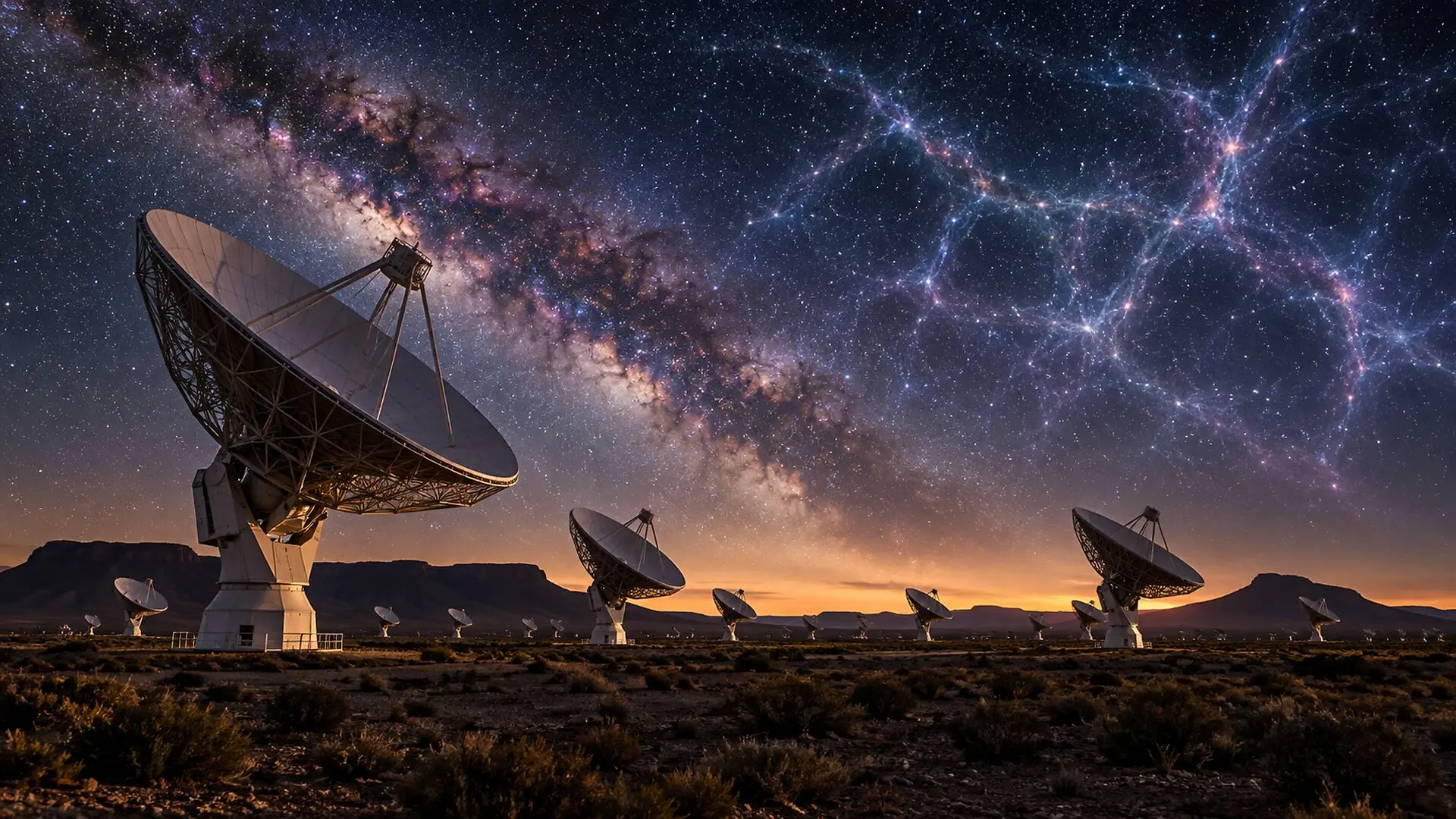
Astronomers have achieved a significant breakthrough in observational cosmology, successfully capturing the elusive radio signature of neutral hydrogen across vast spans of space. Using the MeerKAT radio telescope in South Africa, researchers have performed the first direct, standalone detection of the neutral-hydrogen intensity autopower spectrum, bypassing the need for traditional, labor-intensive optical galaxy surveys.
The findings, recently published in The Astrophysical Journal Letters, demonstrate that hydrogen intensity mapping is a viable, high-precision tool for tracing the distribution of matter across the cosmos. By analyzing approximately 96 hours of data collected in 2018, the international research team—led by experts from The University of Manchester and the University of the Western Cape—isolated the faint 21-centimetre signal emitted by hydrogen gas at redshifts of 0.32 and 0.44.
A Statistical Approach to Cosmic Mapping
Typically, astronomers track cosmic structures by pinpointing individual galaxies, a process that becomes increasingly difficult as the distance from Earth grows. Hydrogen intensity mapping changes the game by treating the universe as a continuous field of emission. Rather than isolating discrete sources, the team measured the aggregate radio glow of hydrogen gas, which provides a statistical snapshot of where matter is concentrated throughout the cosmic web.
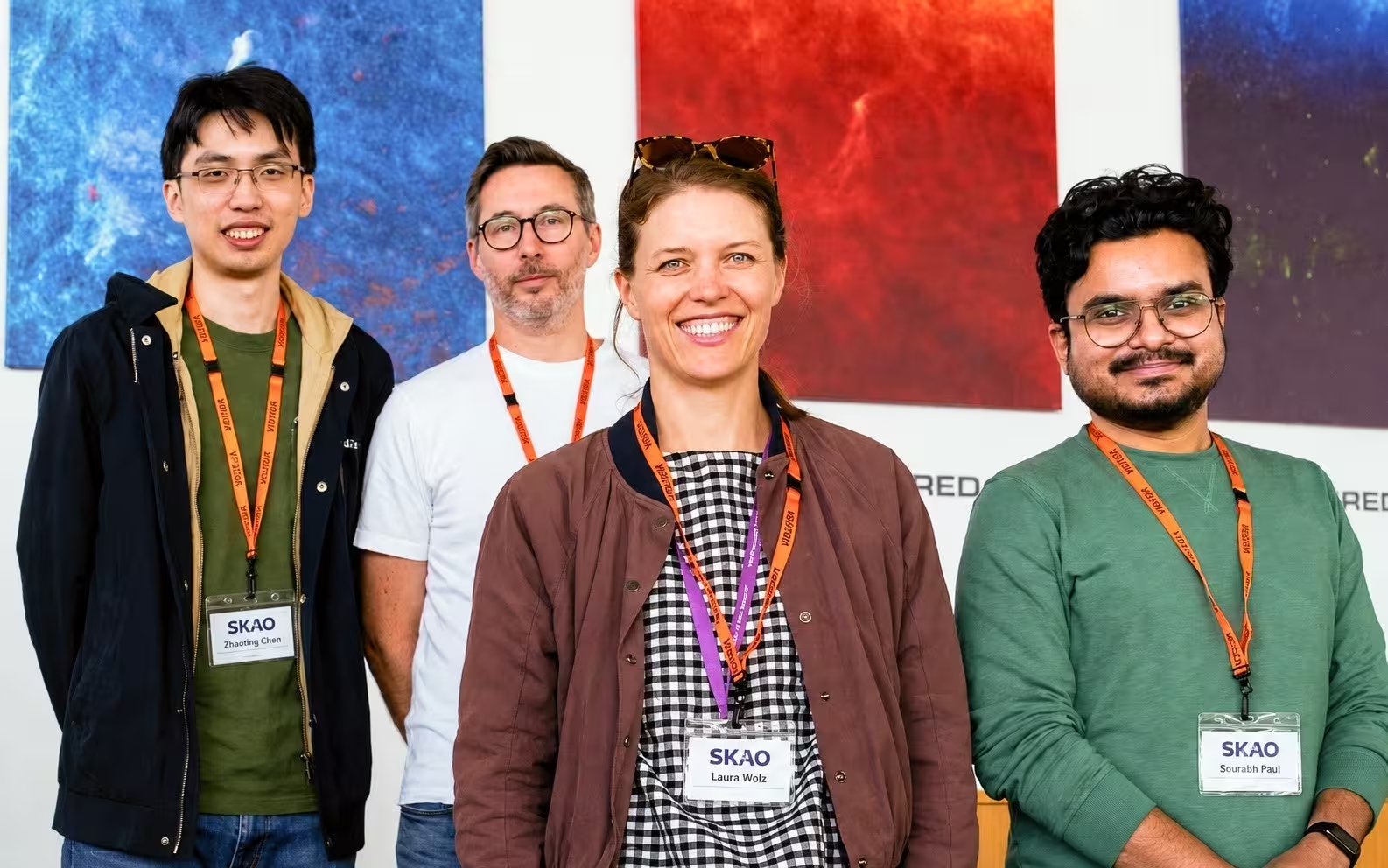
“This is a very exciting milestone,” said lead author Dr. Sourabh Paul. “Hydrogen intensity mapping has long been seen as a promising way to map the Universe efficiently, but the signal is extremely faint and difficult to isolate from foreground emission, human-made radio-frequency interference, and instrumental effects.”
Because the 21-centimetre signal is shifted to lower frequencies by the expansion of the universe (a phenomenon known as redshift), the frequency of the detected radio waves serves as a cosmic clock. By tuning into specific frequencies, the team was able to map hydrogen distribution from two distinct epochs in cosmic history.
Filtering the Cosmic Noise
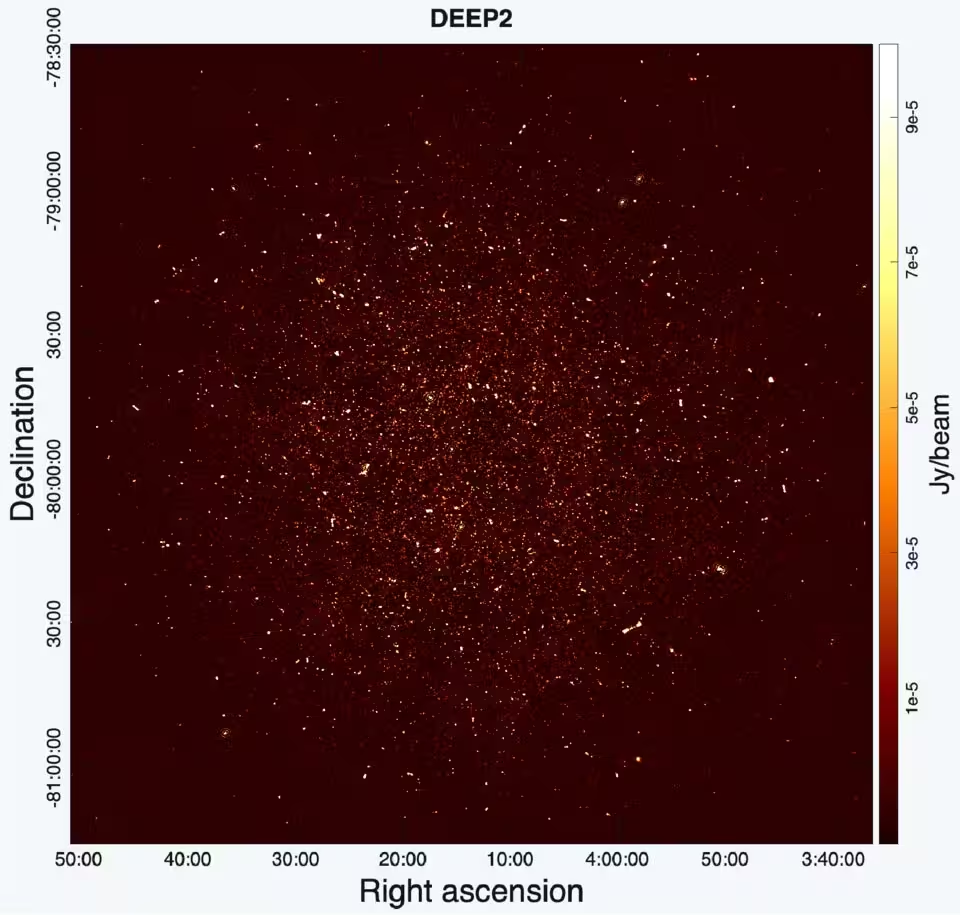
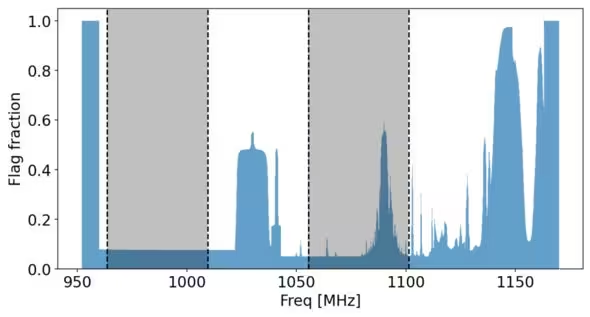
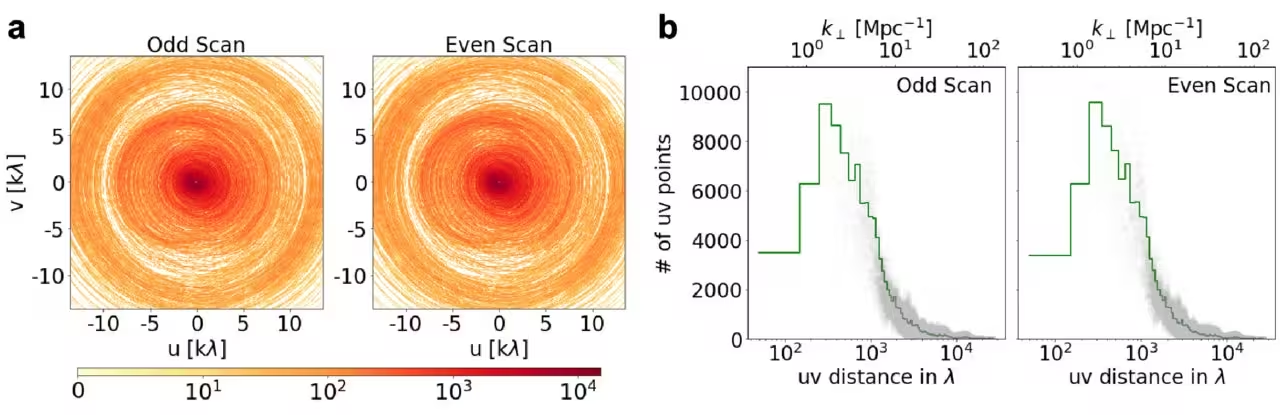
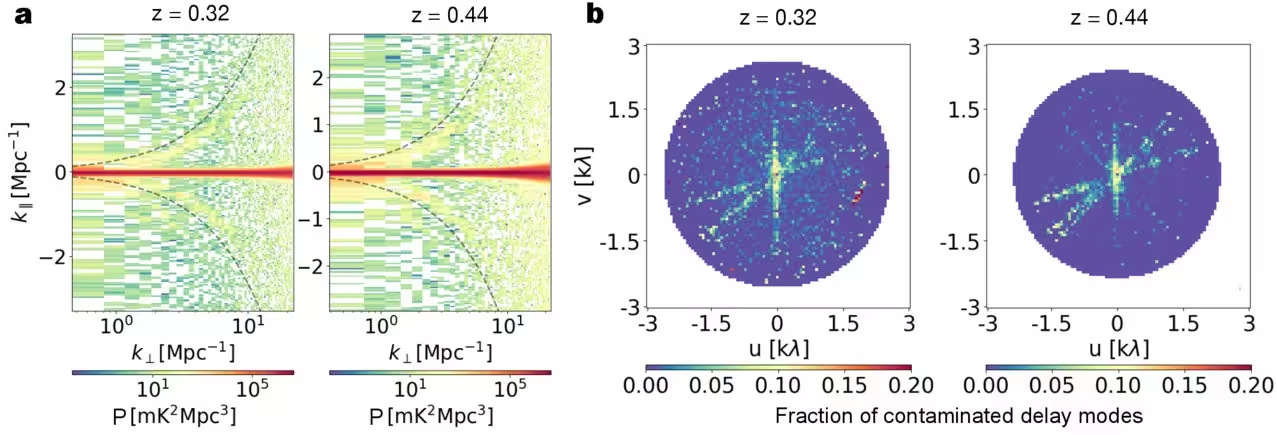
The primary challenge in this detection was the intense contamination from terrestrial radio-frequency interference (RFI) and the overwhelming brightness of astrophysical foregrounds like our own Milky Way. To overcome this, the researchers employed advanced cleaning protocols, including identifying problematic antenna pairs and isolating specific modes of interference within the data.
The team’s cross-correlation of independent time samples helped verify the signal, with results reaching high statistical significance—up to 9.18 sigma at the 0.44 redshift mark under refined analysis parameters. This consistency across different cleaning methods provides robust evidence that the detected signal is genuine and not a byproduct of data processing.
Broadening the Cosmic Perspective
The successful extraction of this signal serves as a proof of concept for the next generation of radio astronomy, specifically the Square Kilometre Array Observatory (SKAO). As a precursor to the SKAO, MeerKAT has demonstrated that current technology can perform this vital work without needing to rely on secondary optical data.
“MeerKAT continues to open new windows for cosmology,” noted co-author Dr. Laura Wolz. “The fact that this signal can be extracted from observations that were not originally designed for hydrogen intensity mapping is very encouraging.”
By moving beyond the limitations of individual galaxy catalogs, this methodology offers a faster, more expansive way to study the evolution of large-scale structures, the behavior of dark matter, and the way gas fuels star formation across billions of years of cosmic time.
Technical Insights and Further Reading
- Revealing cosmological fluctuations in 21 cm intensity maps with MeerKLASS: An in-depth look at the scientific goals of the MeerKLASS survey and the future of neutral-hydrogen research. (Astrophysics and Space Science, 2026)
- H I intensity mapping with MeerKAT: A previous study detailing the use of cross-correlation with optical surveys, marking the evolution toward today’s direct detection. (Monthly Notices of the Royal Astronomical Society, 2023)
- Forecast for delay power spectrum measurement: Modeling the challenges of isolating faint signals from instrumental noise. (Monthly Notices of the Royal Astronomical Society, 2023)
This article has been fact checked for accuracy, with information verified against reputable sources. Learn more about us and our editorial process.
Last reviewed on .
Article history
- Latest version
Reference(s)
- Paul, Sourabh., et al. “A Direct Detection of Neutral Hydrogen Intensity Mapping on Mpc Scales at z ≈ 0.32 and z ≈ 0.44.” The Astrophysical Journal Letters, vol. 1005, no. 2, July 6, 2026, pp. L56 American Astronomical Society, doi: 10.3847/2041-8213/ae808f. <https://iopscience.iop.org/article/10.3847/2041-8213/ae808f>.
- “The University of Manchester.” The University of Manchester <https://www.manchester.ac.uk/>.
- “Study at the University of the Western Cape | UWC.” <https://www.uwc.ac.za/>.
- Cunnington, Steven., et al. “Revealing cosmological fluctuations in 21 cm intensity maps with MeerKLASS: from maps to power spectra.” Astrophysics and Space Science, vol. 371, no. 2, February 10, 2026 Springer Science and Business Media LLC, doi: 10.1007/s10509-026-04547-7. <https://link.springer.com/article/10.1007/s10509-026-04547-7>.
- <https://academic.oup.com/mnras/article/518/4/6262/6783169>.
- <https://academic.oup.com/mnras/article/524/2/2420/7225968>.
Cite this page:
- Posted by Aisha Ahmed