Astronomers Discover Rare White Dwarf Stars That Shine in Neon Green and Pink
Astronomy

Astronomers Discover Rare White Dwarf Stars That Shine in Neon Green and Pink

Scientists have discovered that white dwarfs contaminated with planetary debris can emit a ghostly green glow, revealing how dense atmospheres alter color.

By Aisha Ahmed
Published:
Email this Article
The cool white dwarf WDJ1330+6435 has accreted sodium-rich rocky material from its planetary system into its atmosphere. The immense atmospheric density causes the sodium to absorb light over broad range of yellow, orange, and red wavelengths, giving the WDJ1330+6435 a ghostly green appearance. (CREDIT: Mark A. Garlick/University of Warwick)

While most stars follow a predictable color sequence dictated by their temperature—with cooler stars appearing orange, sun-like stars shining white, and hotter stars glowing blue—a new study reveals that some white dwarfs defy this conventional rule. Researchers at the University of Warwick have discovered that these dense stellar remnants can exhibit vibrant hues ranging from green and yellow to pink, purple, and cyan, depending on the chemical composition of their extreme atmospheres.

The research, published in RAS Techniques and Instruments, utilizes mathematical modeling to translate stellar spectra into colors perceivable by the human eye. By analyzing 152 nearby white dwarfs, the team determined that while most of these objects maintain a typical white appearance, their unique atmospheric conditions—often enriched by swallowed planetary debris—can reshape their light output in unexpected ways. arxiv.org
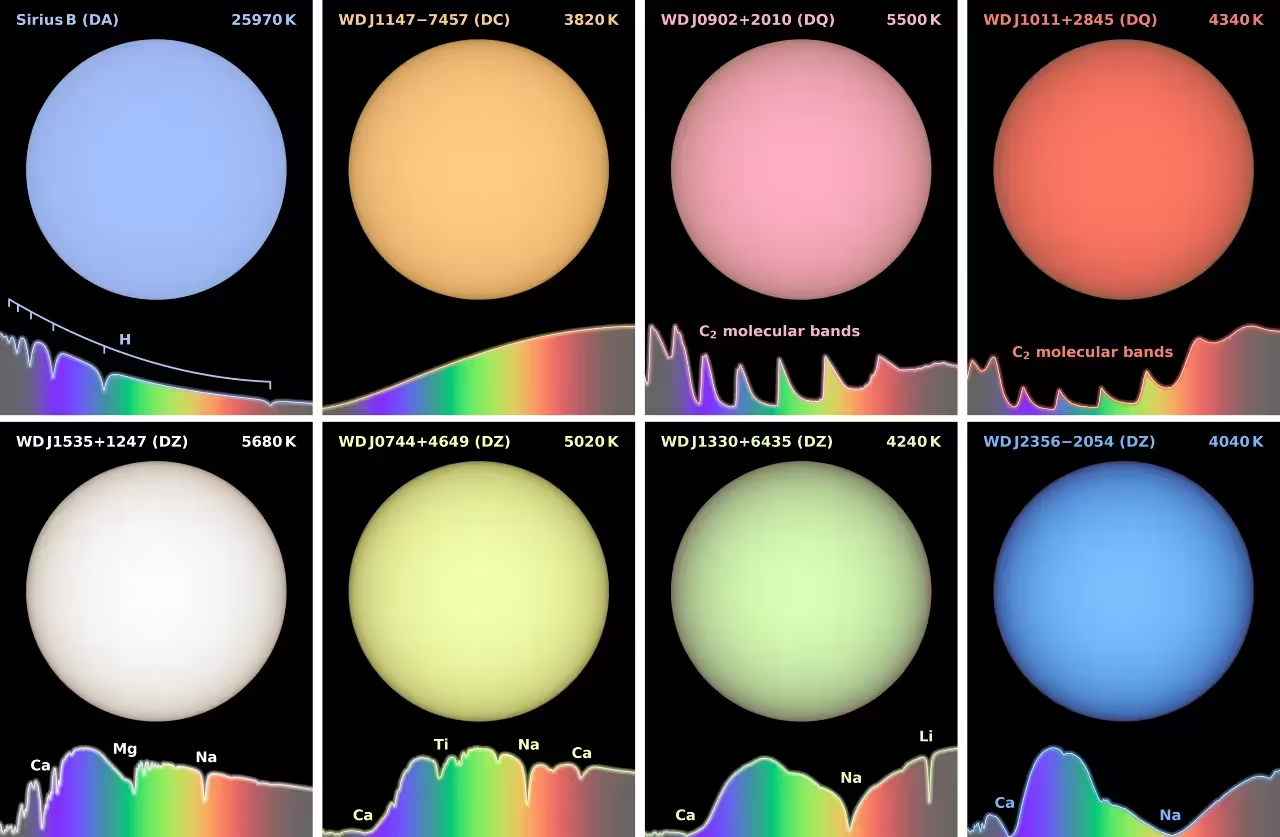
Colour-accurate simulated images of white dwarfs. Top Left panels: Sirius B is the nearest white dwarf to the Solar System, with a hot hydrogen atmosphere, resulting in a pale blue colour. WDJ1147-7449 is instead among the coolest nearby white dwarfs, giving it a featureless spectrum and an orange appearance. Top Right panels: Convective envelopes in these cool white dwarfs have dredged up carbon from their cores into their dense helium-dominated atmospheres, forming diatomic carbon molecules that lead to various pink hues. Bottom panels: Accretion of rocky debris from the white dwarf planetary systems enriches their cool helium atmospheres with elements such as calcium, magnesium, and sodium. The varying amounts/compositions of accreted material and white dwarf temperatures allow for a diverse array of colours, including green. In reality all stars would be many millions of times brighter than what can be shown on-screen.
Colour-accurate simulated images of white dwarfs. Top Left panels: Sirius B is the nearest white dwarf to the Solar System, with a hot hydrogen atmosphere, resulting in a pale blue colour. WDJ1147-7449 is instead among the coolest nearby white dwarfs, giving it a featureless spectrum and an orange appearance. Top Right panels: Convective envelopes in these cool white dwarfs have dredged up carbon from their cores into their dense helium-dominated atmospheres, forming diatomic carbon molecules that lead to various pink hues. Bottom panels: Accretion of rocky debris from the white dwarf planetary systems enriches their cool helium atmospheres with elements such as calcium, magnesium, and sodium. The varying amounts/compositions of accreted material and white dwarf temperatures allow for a diverse array of colours, including green. In reality all stars would be many millions of times brighter than what can be shown on-screen. (CREDIT: Mark A. Garlick/University of Warwick)

The Physics of Stellar Hues

White dwarfs represent the final evolutionary stage of stars like our Sun. As they cool, their atmospheric density can reach levels comparable to water, creating an environment where particle interactions broaden the absorption of specific light wavelengths. Lead author Mark Hollands, a Warwick Prize Fellow, noted that these high-density conditions allow for chemical signatures that can mask a star’s true temperature.

In the case of the white dwarf WD J1330+6435, the atmosphere has been “polluted” by rocky planetary remnants, introducing elements like calcium, sodium, and lithium. The sodium effectively absorbs orange light, while calcium traps violet wavelengths, leaving a distinct green glow in the visible spectrum. Similar phenomena occur in other stars, where carbon dredged up from the stellar core forms molecules that absorb light in the blue, green, and yellow ranges, resulting in striking pink or salmon-colored emissions.

Beyond Traditional Spectroscopic Analysis

To accurately visualize these findings, the research team applied color science methods to map spectral data into coordinates recognized by human vision. By accounting for the non-linear way human eyes and digital displays process light, the researchers ensured that the simulated colors represent authentic hues rather than simple brightness variations.
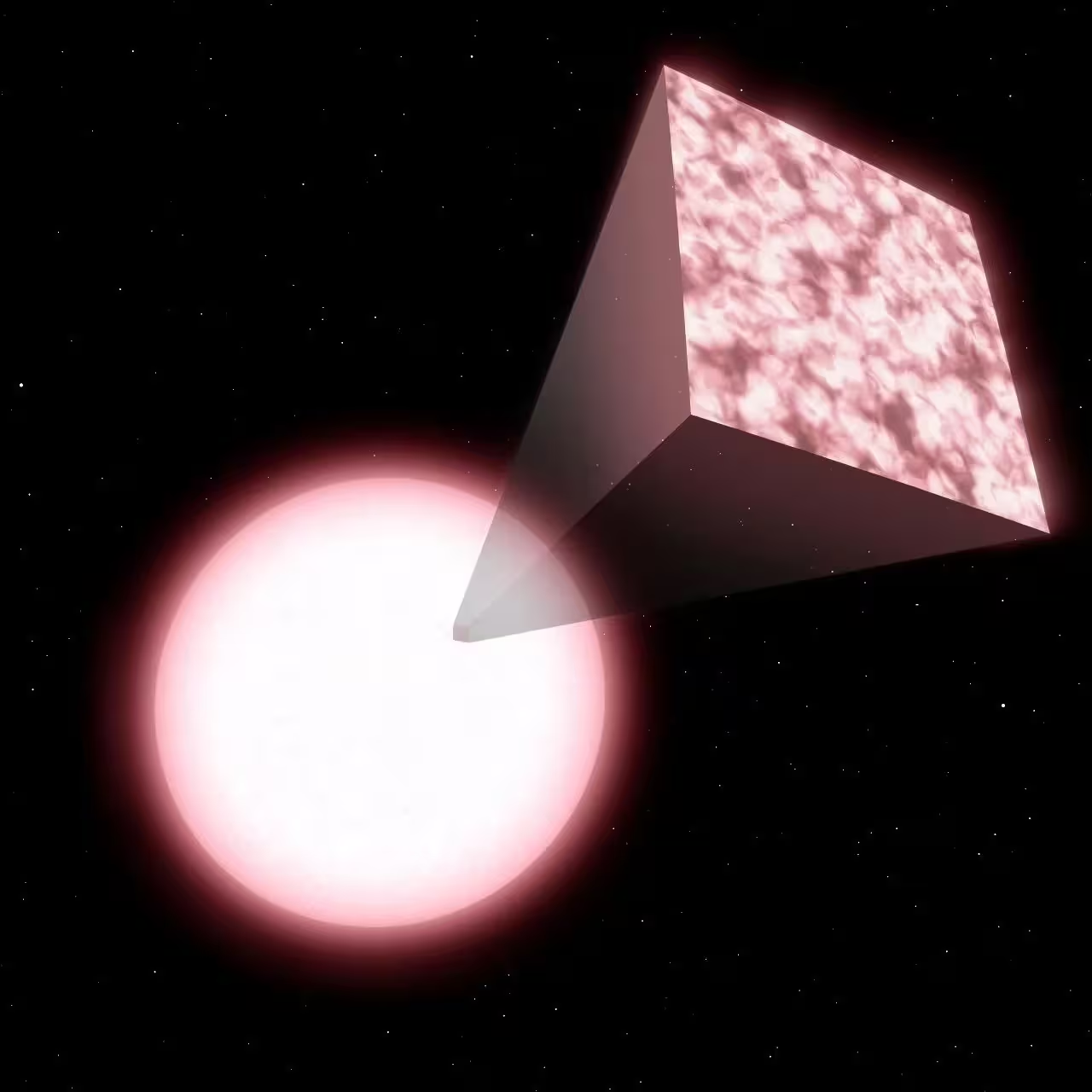
The cool white dwarf WDJ0902+2010 has a deep convection zone within its helium dominated outer envelope. The convection zone has reached the white dwarf core, lifting interior carbon to the surface, and forming carbon molecules. These C2 molecules strongly absorb light across the optical range, including blue, green, and yellow wavelengths, resulting in WDJ0902+2010 appearing pink to the human eye.
The cool white dwarf WDJ0902+2010 has a deep convection zone within its helium dominated outer envelope. The convection zone has reached the white dwarf core, lifting interior carbon to the surface, and forming carbon molecules. These C2 molecules strongly absorb light across the optical range, including blue, green, and yellow wavelengths, resulting in WDJ0902+2010 appearing pink to the human eye. (CREDIT: Mark A. Garlick/University of Warwick)

While five of the 152 studied white dwarfs showed extreme color deviations, the vast majority of the sample conformed to standard white-light expectations. This suggests that while non-white stars are rare—occurring in approximately one out of every 30 stars in the local neighborhood—they provide invaluable insights into the composition of planetary systems that were consumed by their parent stars long ago.

By studying these spectral signatures, astronomers are gaining a deeper understanding of the chemical diversity present in the remnants of distant planetary systems, proving that the lifecycle of a star is far more colorful than its name might suggest.
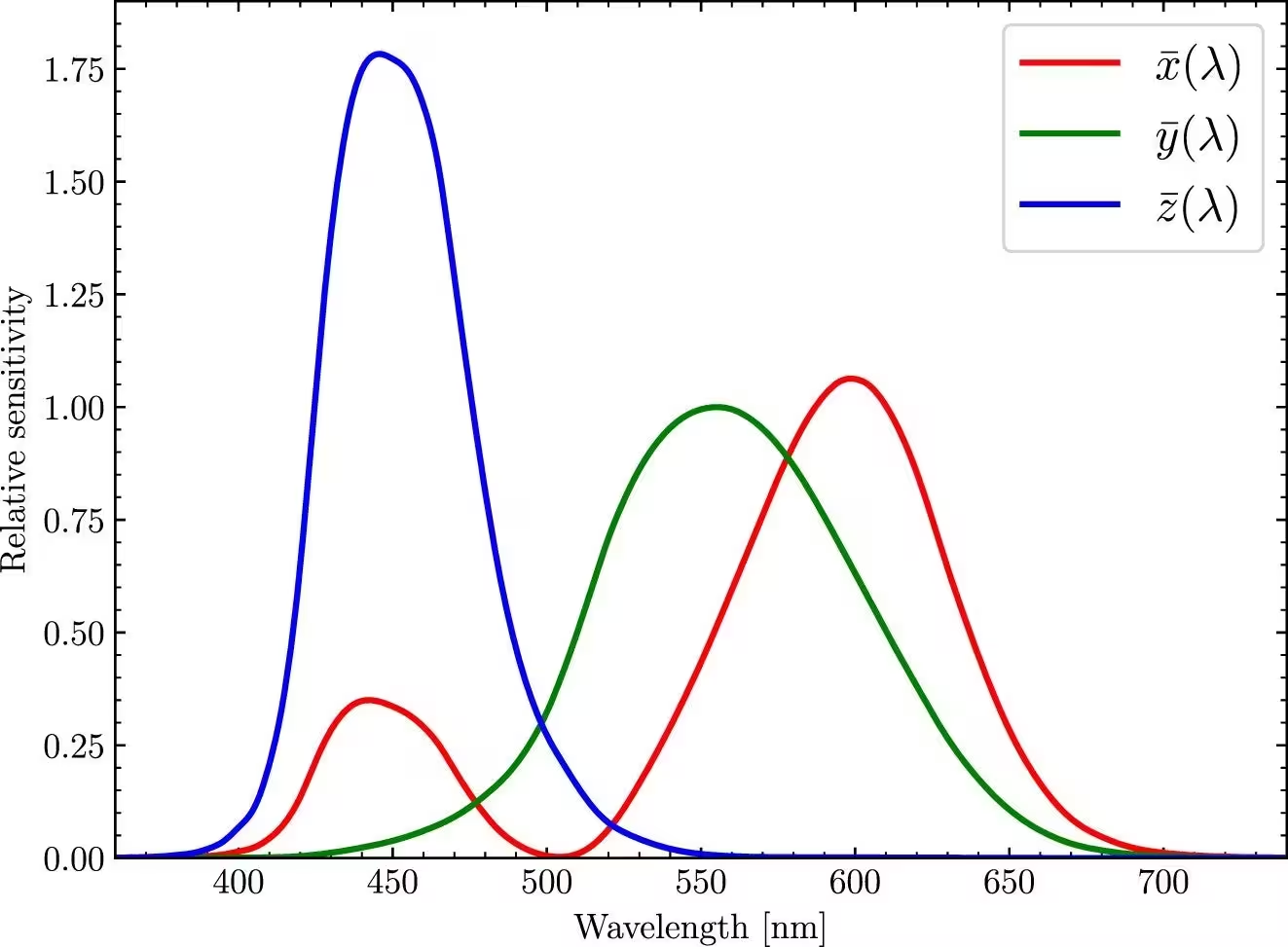
Colour matching functions for the 1931 CIE XYZ colour space. Integrating a spectrum over these curves results in the values of X, Y, and Z, which define the colour and intensity in the XYZ colour space.
Colour matching functions for the 1931 CIE XYZ colour space. Integrating a spectrum over these curves results in the values of X, Y, and Z, which define the colour and intensity in the XYZ colour space. (CREDIT: Dr Mark Hollands et al, RAS Techniques and Instruments 2026)
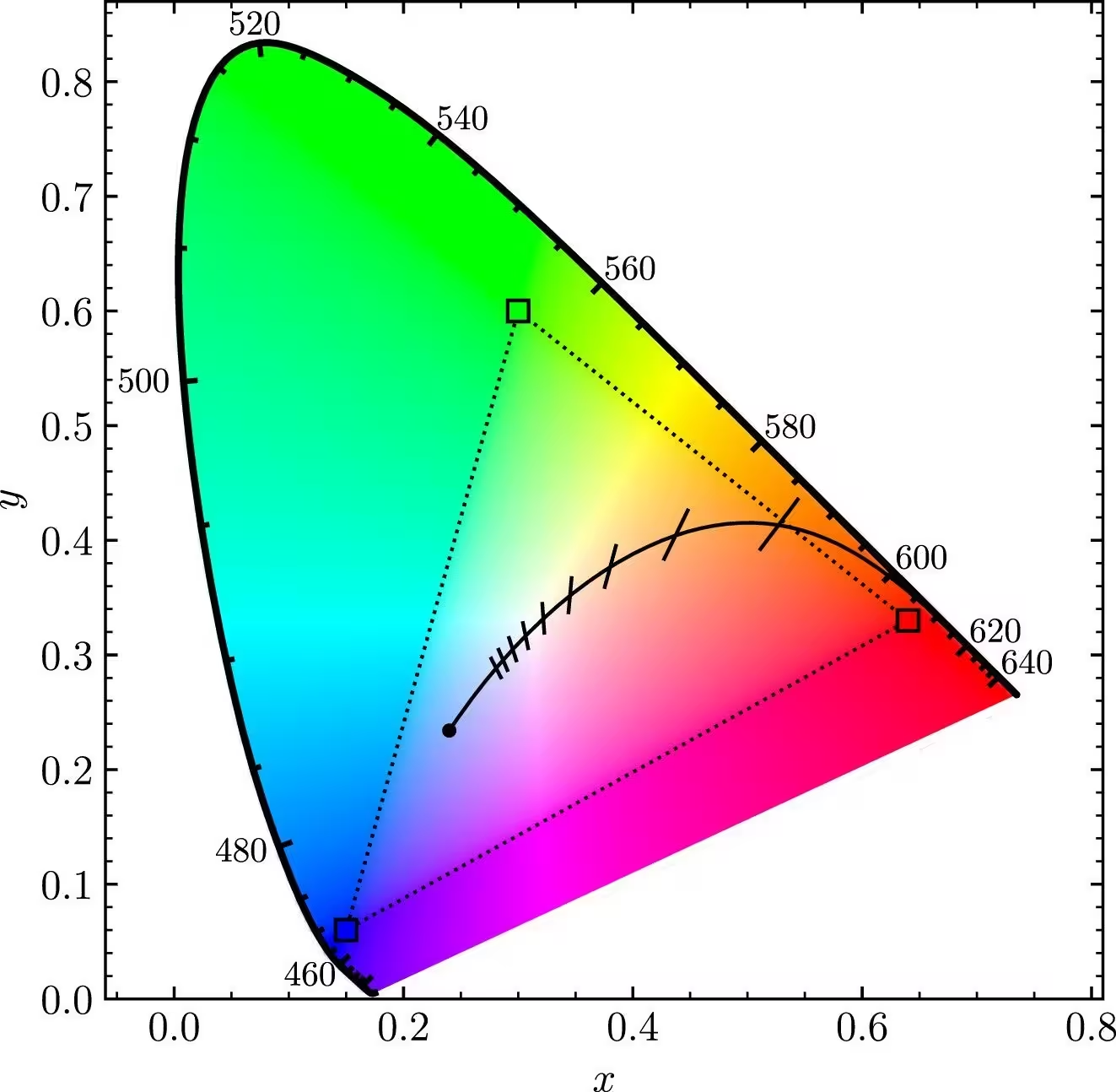
CIE 1931 chromaticity diagram in the x–y  plane. The black curve bounding the filled region corresponds to monochromatic colours. The sRGB primaries are shown by the squares, defining a triangular region (dotted) which bounds the gamut of displayable chromaticities in the sRGB colour space.
CIE 1931 chromaticity diagram in the x–y plane. The black curve bounding the filled region corresponds to monochromatic colours. The sRGB primaries are shown by the squares, defining a triangular region (dotted) which bounds the gamut of displayable chromaticities in the sRGB colour space. (CREDIT: Dr Mark Hollands et al, RAS Techniques and Instruments 2026)
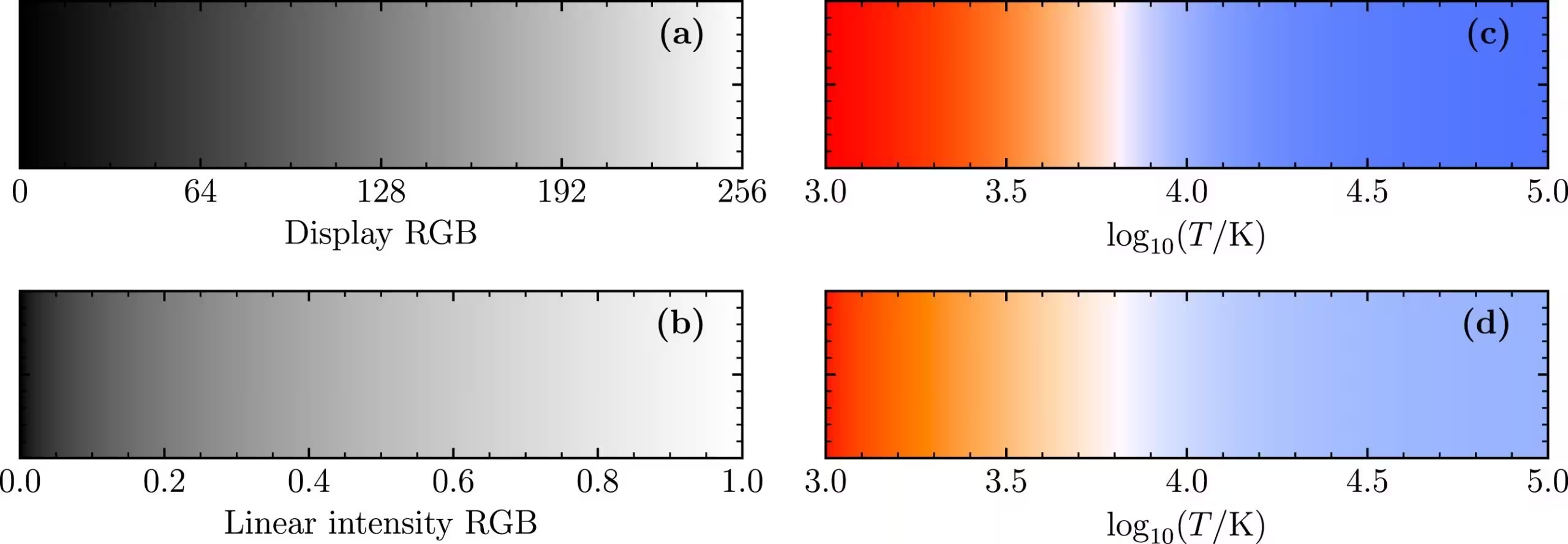
Comparison between not using (top) and applying (bottom) the sRGB OETF for greyscale (left) and blackbodies (right).
Comparison between not using (top) and applying (bottom) the sRGB OETF for greyscale (left) and blackbodies (right). (CREDIT: Dr Mark Hollands et al, RAS Techniques and Instruments 2026)

Further Reading

Fact Checked

This article has been fact checked for accuracy, with information verified against reputable sources. Learn more about us and our editorial process.

Last reviewed on .

Article history

  • Latest version

Reference(s)

  1. Hollands, Mark A., et al. “Any colour you like: the diverse chromaticities of white dwarfs.” RAS Techniques and Instruments, vol. 5, October 15, 2026 Oxford University Press (OUP), doi: 10.1093/rasti/rzag069. <https://doi.org/10.1093/rasti/rzag069>.
  2. Hollands, Mark. “Any colour you like: The diverse chromaticities of white dwarfs.” arXiv.org <https://arxiv.org/abs/2610.18966?utm_source=chatgpt.com>.
  3. <https://academic.oup.com/mnras/article/480/3/3942/5066191>.
  4. Hollands, Mark. “Alkali metals in white dwarf atmospheres as tracers of ancient planetary crusts - Nature Astronomy.”, vol. 5, no. 5, pp. 451-459. Nature, doi: 10.1038/s41550-020-01296-7. <https://www.nature.com/articles/s41550-020-01296-7>.
  5. <https://academic.oup.com/mnras/article/517/3/4557/6795240>.
  6. Bédard, Antoine. “The spectral evolution of white dwarfs: where do we stand?.” Astrophysics and Space Science, vol. 369, no. 4, April 26, 2024 Springer Science and Business Media LLC, doi: 10.1007/s10509-024-04307-5. <https://link.springer.com/article/10.1007/s10509-024-04307-5>.
  7. <https://academic.oup.com/mnras/article/527/4/11521/7511973>.

Cite this page:

Ahmed, Aisha. “Astronomers Discover Rare White Dwarf Stars That Shine in Neon Green and Pink.” BioScience. BioScience ISSN 2521-5760, 17 October 2026. <https://www.bioscience.com.pk/en/subject/astronomy/a-white-dwarfs-unusual-atmosphere-gives-it-a-ghostly-green-glow>. Ahmed, A. (2026, October 17). “Astronomers Discover Rare White Dwarf Stars That Shine in Neon Green and Pink.” BioScience. ISSN 2521-5760. Retrieved October 17, 2026 from https://www.bioscience.com.pk/en/subject/astronomy/a-white-dwarfs-unusual-atmosphere-gives-it-a-ghostly-green-glow Ahmed, Aisha. “Astronomers Discover Rare White Dwarf Stars That Shine in Neon Green and Pink.” BioScience. ISSN 2521-5760. https://www.bioscience.com.pk/en/subject/astronomy/a-white-dwarfs-unusual-atmosphere-gives-it-a-ghostly-green-glow (accessed October 17, 2026).
End of the article