Astronomers Spot Ultramassive Black Hole Duo Carving 3,200‑Light‑Year Void in Distant Galaxy
Astronomers discover a massive starless void in a distant galaxy, once mistaken for dust, may conceal a violent hidden phenomenon.
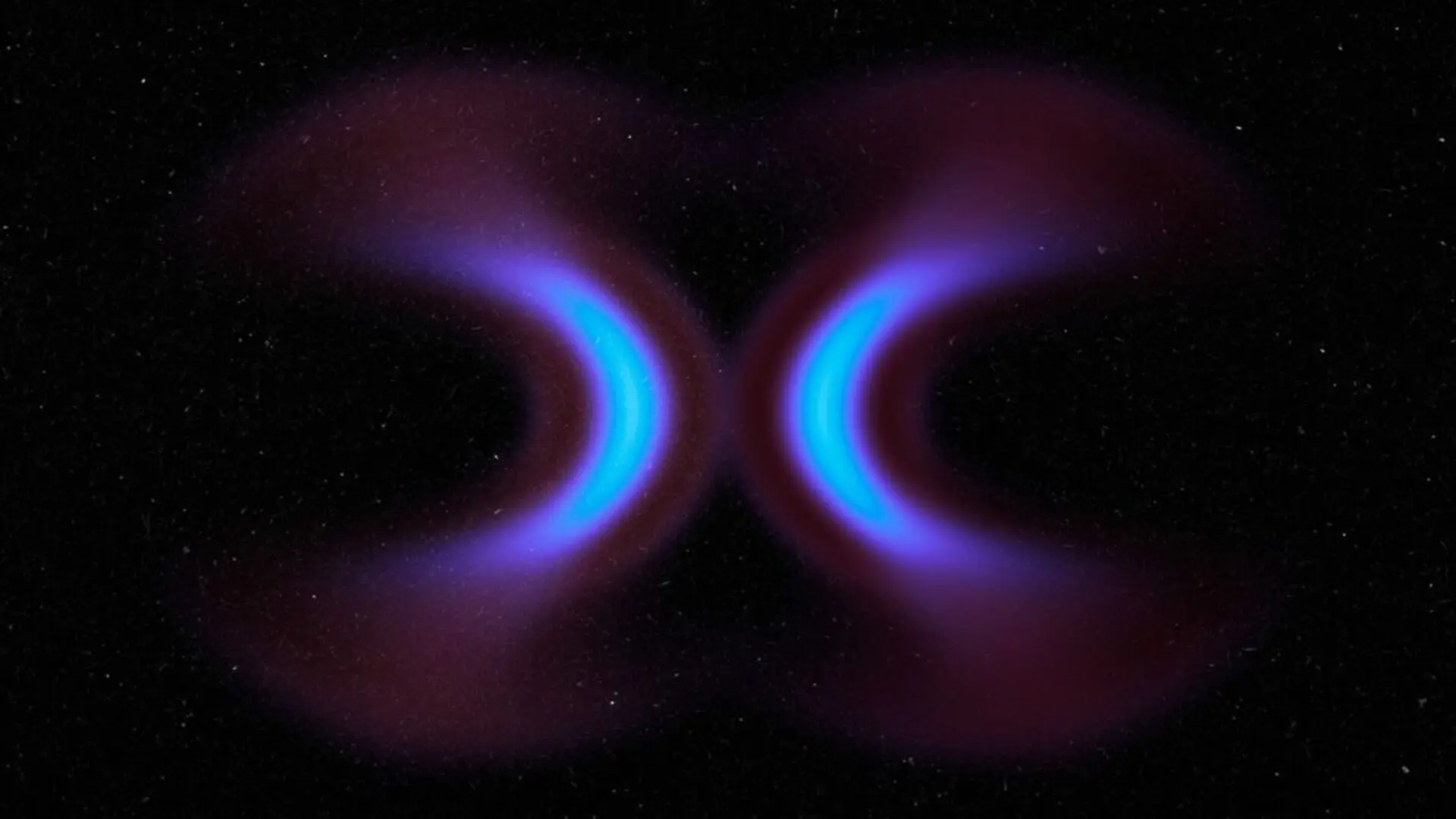
Deep within the massive elliptical galaxy known as Abell 402‑BCG, researchers have uncovered a star‑free cavity spanning roughly 3,200 light‑years. First noticed in 2018, the void was initially thought to be a veil of interstellar dust, but new data indicate that a pair of colliding ultramassive black holes is carving out the emptiness as they spiral toward each other.
The host galaxy sits at the core of the Abell 402 cluster, an assemblage located about 4 billion light‑years from Earth according to Sky & Telescope, while Futura‑Sciences estimates a distance of 4.4 billion light‑years. The two suspected black holes together are thought to weigh around 60 billion solar masses, a combined heft that would eclipse the next‑largest known binary by at least a factor of two.
Infrared Observations Disprove Dust Hypothesis
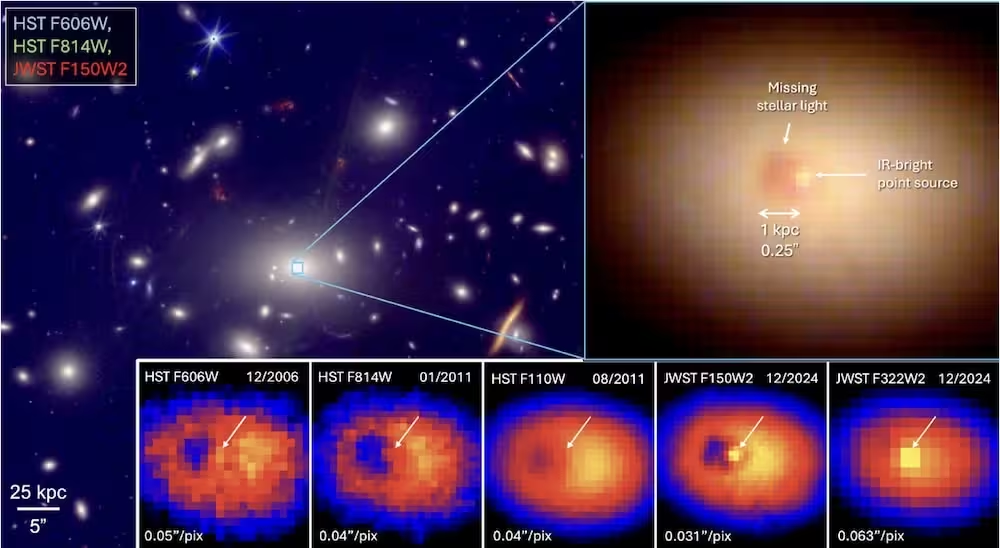
When the dark spot at the galaxy’s nucleus was first imaged in 2018, astronomers leaned toward a dense dust cloud as the most plausible explanation, given how common such structures are in galactic centers. At the time, there was no direct way to test that idea against alternative scenarios, leaving the feature as an unexplained anomaly.
A team led by MIT astronomer Michael McDonald returned to the question using the James Webb Space Telescope in concert with the Very Large Telescope at the European Southern Observatory. Their findings, released on 23 April 2026 in The Astrophysical Journal Letters, were specifically designed to test whether dust could still account for the darkness captured earlier by Hubble.
Dust absorbs and scatters visible light more strongly than near‑infrared radiation, so a genuine dust veil should appear less opaque in JWST’s infrared images than in Hubble’s optical frames. Instead, the cavity remained equally black across both wavelength regimes, a behavior inconsistent with typical dust extinction, as reported by Sky & Telescope.
With the dust explanation ruled out, the team concluded that the void is genuinely empty of stars. Their calculations suggest that roughly 2 billion solar masses of stars are missing from the region—about 1 % of the galaxy’s total stellar content—a surprisingly large deficit for such a localized area.
Dual Black Holes Identified at Cavity Edges
JWST’s infrared view revealed a bright point source along one side of the empty zone, displaying the spectral signature of an actively accreting black hole—radiation emitted as surrounding gas heats up before disappearing beyond the event horizon.
Further spectroscopic data from the MUSE instrument on the VLT uncovered a second, distinct source of ionized gas on the opposite side of the cavity, consistent with a second active nucleus. The two sources exhibit a relative velocity of about 370 km s⁻¹, indicating they are orbiting a common center rather than remaining stationary.
Sky & Telescope notes that the broader central region, roughly 6,500 light‑years across, was likely excavated earlier by an even more massive black hole—estimated at 50 billion solar masses—that resulted from a prior merger event.
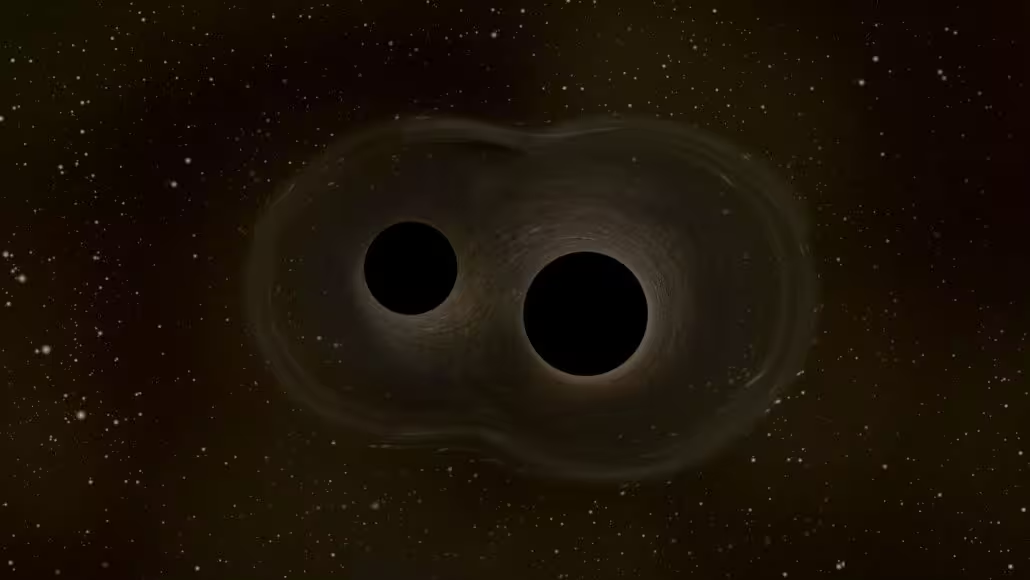
When galaxies collide, their central black holes are drawn together by mutual gravity. As the pair tightens its orbit, the combined gravitational forces fling nearby stars outward, creating a star‑free gap like the one observed in Abell 402‑BCG, according to Futura‑Sciences.
McDonald’s group estimates that the current binary has been orbiting a shared center of mass for only a few tens of millions of years—a fleeting moment on cosmic timescales—implying that the system is still in the early stages of its gradual coalescence.
Future Merger of Two Giant Black Holes
Eventually the two objects will merge into a single black hole of unprecedented mass. Black holes exceeding 60 billion solar masses have been documented only a handful of times, making both the present pairing and its projected combined mass exceptional, as noted by Futura‑Sciences.
Science News emphasizes that while theories have long predicted merging supermassive black holes, direct observations of a binary in such a tight, late‑stage orbit are exceedingly rare. The rarity is underscored by simulations cited by Sky & Telescope, which suggest that only about 0.5 % of massive galaxies are caught in this brief evolutionary phase at any given moment.
The discovery offers a new benchmark for estimating how frequently dramatic galactic collisions occur throughout the cosmos and for refining models of how such events reshape their host galaxies. Moreover, the identified star‑free cavity provides astronomers with a template for locating similar black‑hole binaries in other distant systems.
This article has been fact checked for accuracy, with information verified against reputable sources. Learn more about us and our editorial process.
Last reviewed on .
Article history
- Latest version
Reference(s)
- Nova, AAS. “Into the Void: Investigating the Heart of a Giant Elliptical Galaxy.”, June 24, 2026 Sky & Telescope <https://skyandtelescope.org/astronomy-news/into-the-void-investigating-the-heart-of-a-giant-elliptical-galaxy/>.
- McDonald, Michael., et al. “A Kiloparsec-scale Stellar Cavity in the Center of A402-BCG May Be Caused by Dynamic Interactions with an Ultramassive Black Hole.” The Astrophysical Journal Letters, vol. 1002, no. 1, April 23, 2026, pp. L19 American Astronomical Society, doi: 10.3847/2041-8213/ae5bbe. <https://iopscience.iop.org/article/10.3847/2041-8213/ae5bbe>.
- Morehouse, Macon. “Astronomers may have found a record-breaking pair of black holes.”, May 11, 2026 Science News Magazine <https://www.sciencenews.org/article/largest-pair-black-holes-collision?utm_source=chatgpt.com>.
Cite this page:
- Posted by Aisha Ahmed