Radio Waves Reveal Star’s Final Years Before Rare Type Ibn Supernova Explosion
Astronomers detect an odd signal from a distant supernova, challenging theories on massive star death.
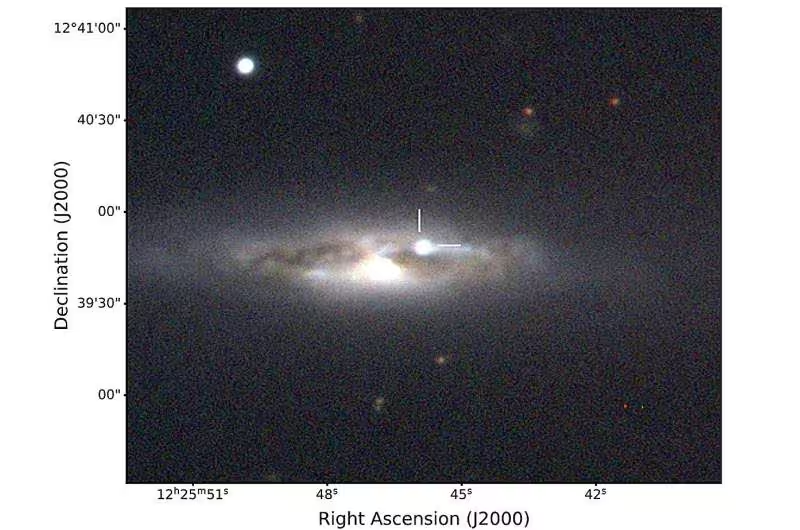
A team of astronomers has captured radio emissions from a Type Ibn supernova for the first time, offering an unprecedented glimpse into the late‑stage behavior of a massive star that expelled helium‑rich gas shortly before its death. The explosion, designated SN 2023fyq, is allowing researchers to study the star’s pre‑supernova environment as well as the blast itself.
These rare Type Ibn events are poorly understood because they appear infrequently and are typically discovered only after the explosion has faded. They arise from massive progenitors that shed a dense shell of helium‑laden material in the years leading up to core collapse, a circumstellar veil that shapes the observable flash.
Radio Detection Sheds Light on the Circumstellar Cloud
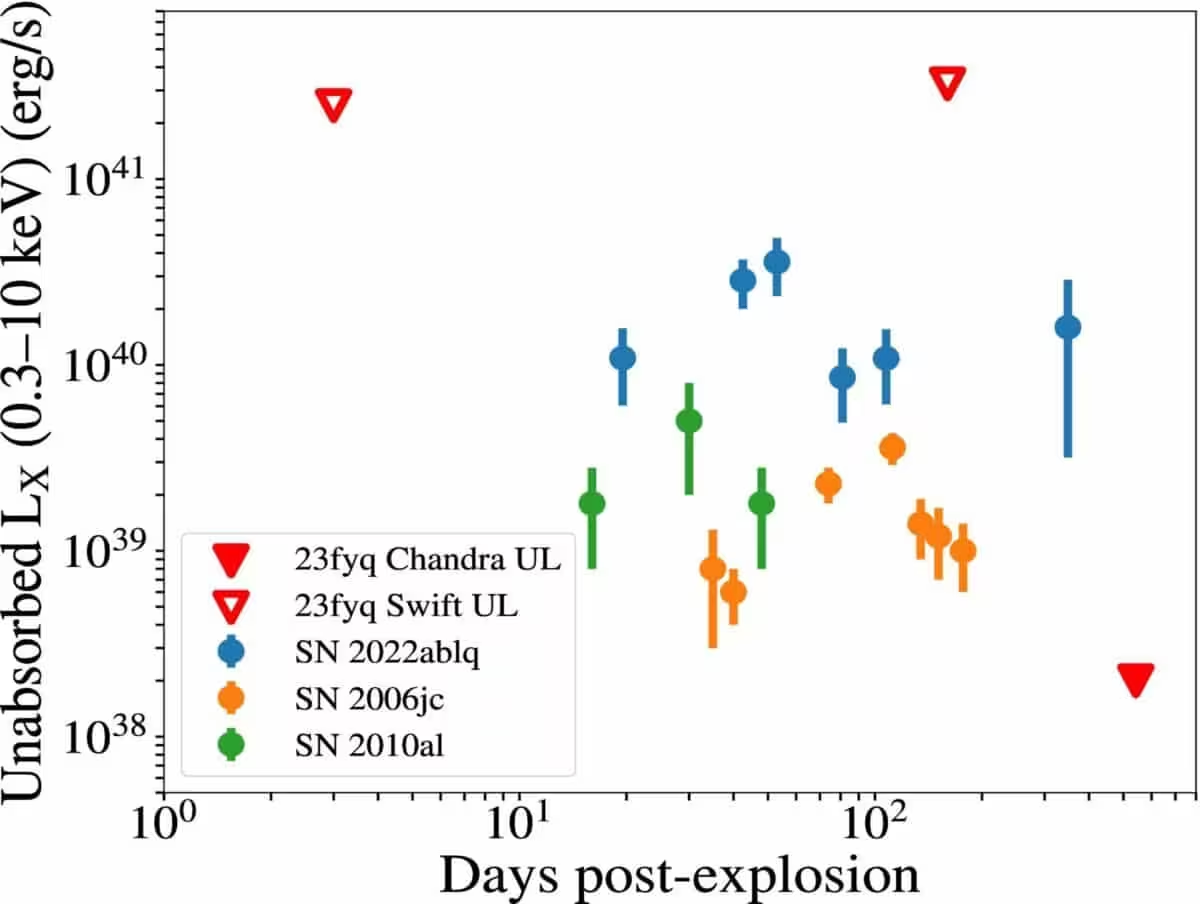
Using the National Science Foundation’s Very Large Array in New Mexico, investigators monitored faint radio output from SN 2023fyq over roughly a year and a half. The observations, spanning 3–35 GHz and recorded from 58 to 525 days post‑explosion, are detailed in The Astrophysical Journal Letters. The radio signal originates from the shockwave colliding with the previously ejected helium‑rich shell, a process that produces radio waves tracing the density and distribution of the surrounding gas.
Raphael Baer‑Way, a Ph.D. candidate at the University of Virginia and lead author of the study, described the discovery as a “time‑machine” view of the star’s final decade.
“We were able to use radio observations to ‘view’ the final decade of the star’s life before the explosion,” he said, emphasizing that the most telling signals arise from the last few years when the star’s mass‑loss rate surged.
Reconstructing the Star’s Last Years
The radio light curve indicates that the progenitor did not emit a steady wind; instead, a heightened episode of mass ejection likely occurred within the final five years before core collapse. Baer‑Way likens the radio data to a reconstruction of the star’s terminal timeline, revealing a dense, helium‑rich envelope that amplified the radio output when struck by the blast.
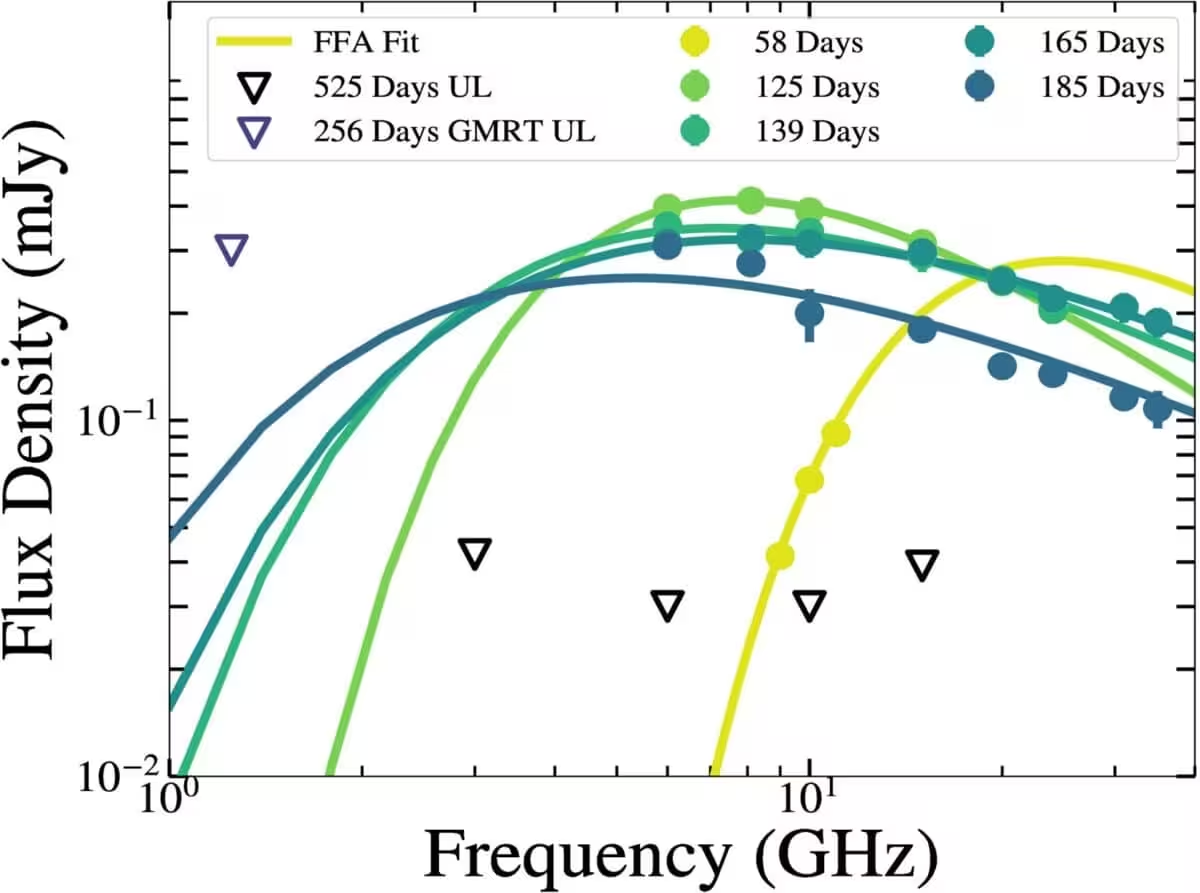
The underlying principle is straightforward: denser circumstellar gas yields stronger radio emission when overrun by the supernova shock. By mapping this interaction, the team gains insight into the structure of the material the star expelled before its death.
Could a Companion Star Have Driven the Mass Loss?
One hypothesis for the rapid, extensive shedding of material involves a nearby stellar companion. Baer‑Way notes that a binary partner could have gravitationally disturbed the outer layers, accelerating the loss of helium‑rich gas in the years leading up to the explosion. This scenario would be difficult to reconcile with a solitary massive star.
Maryam Modjaz, professor at the University of Virginia and co‑author, highlighted the broader implication that radio astronomy is becoming essential for probing the final stages of massive stars.
“Raphael’s paper has opened a new window to the universe for studying these rare, but crucial supernovae, by revealing that we must point our radio telescopes much earlier than previously assumed to capture their fleeting radio signals.”
This article has been fact checked for accuracy, with information verified against reputable sources. Learn more about us and our editorial process.
Last reviewed on .
Article history
- Latest version
Reference(s)
- Baer-Way, Raphael., et al. “The First Radio View of a Type Ibn Supernova in SN 2023fyq: Understanding the Mass-loss History in the Last Decade before the Explosion.” The Astrophysical Journal Letters, vol. 995, no. 2, December 12, 2025, pp. L49 American Astronomical Society, doi: 10.3847/2041-8213/ae1cb8. <https://iopscience.iop.org/article/10.3847/2041-8213/ae1cb8>.
- <https://www.maryammodjaz.com/>.
Cite this page:
- Posted by Aisha Ahmed