Hubble Spots Tiny Galaxy Blasting UV Light, Illuminating the Early Universe’s Transparency
Hubble’s view of a tiny galaxy provides the clearest evidence yet of how the early Universe cleared its primordial cosmic fog.
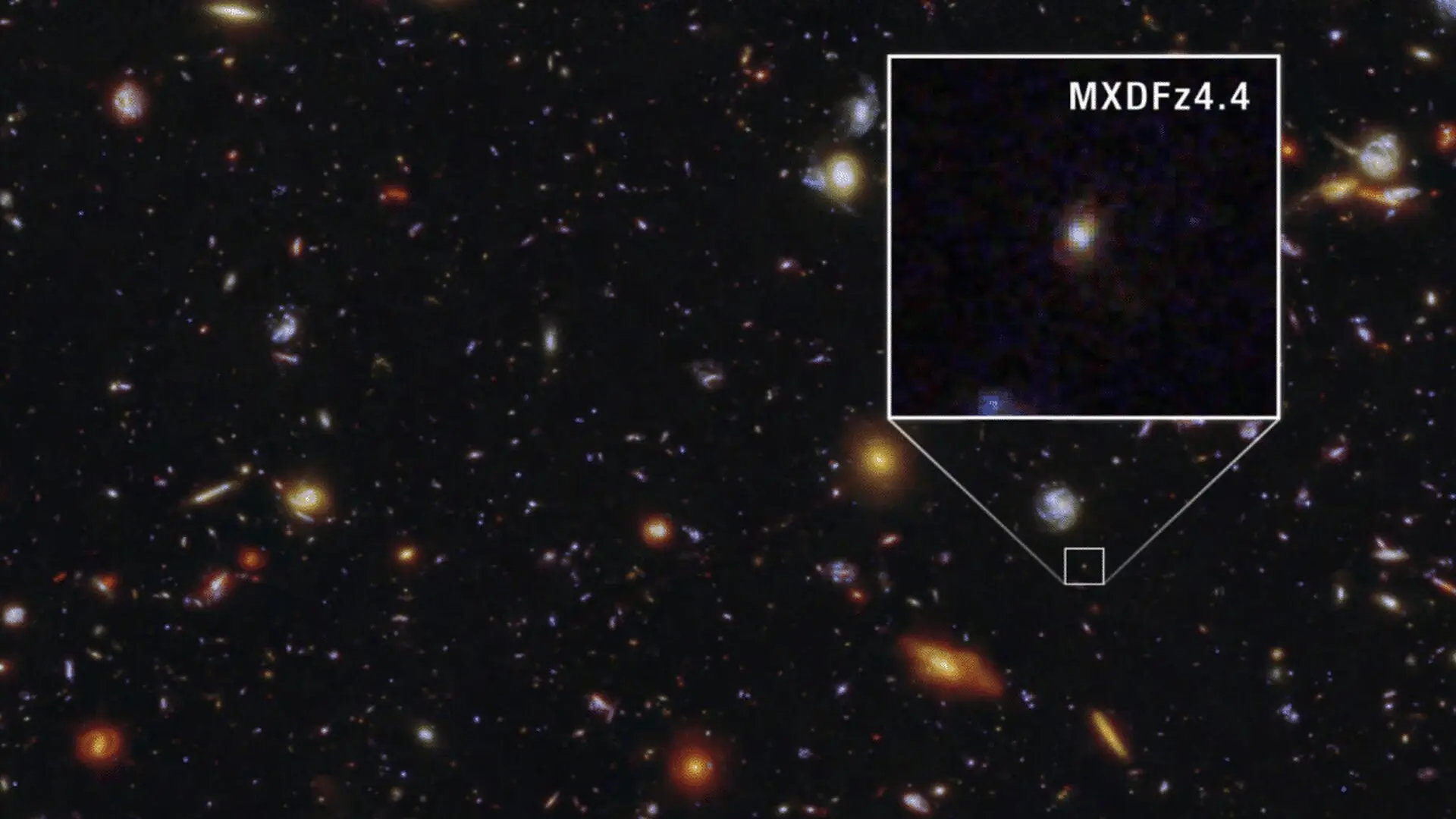
A dwarf galaxy barely a hundredth the mass of the Milky Way has provided astronomers with one of the clearest looks yet at a transformative epoch in the early Universe. By exploiting deep imaging from the Hubble Space Telescope, an international team detected escaping ultraviolet photons from the remote system MXDFz4.4, delivering direct evidence of how the first generations of galaxies helped re‑ionize the cosmos merely 1.4 billion years after the Big Bang. The results appear in the Astrophysical Journal and shed fresh light on the so‑called cosmic reionization era.
A Minuscule Galaxy Illuminates a Pivotal Era
For decades researchers have sought to explain how the early Universe transitioned from a dark, hydrogen‑filled fog to the transparent expanse we observe today. This transformation, the Epoch of Reionization, unfolded within the first billion years after the Big Bang, when nascent stars and galaxies bathed space in energetic ultraviolet radiation. Capturing that escaping radiation from galaxies at such distances has long been a formidable observational hurdle.
The object under study, MXDFz4.4, lived roughly 1.4 billion years after the Big Bang, placing it near the tail end of reionization. Though its total size is about one‑hundredth that of the Milky Way, its star‑forming activity outpaces our own galaxy by a factor of ten. A rapid burst of stellar birth packed a wealth of massive, short‑lived stars into an exceptionally compact region, generating the intense ultraviolet flux needed to punch through surrounding gas and stream into intergalactic space. Those liberated photons match the type thought to have gradually ionized the neutral hydrogen that once cloaked the cosmos, offering a rare glimpse into processes that shaped countless early galaxies.
Hubble Spots Elusive Ultraviolet Emission
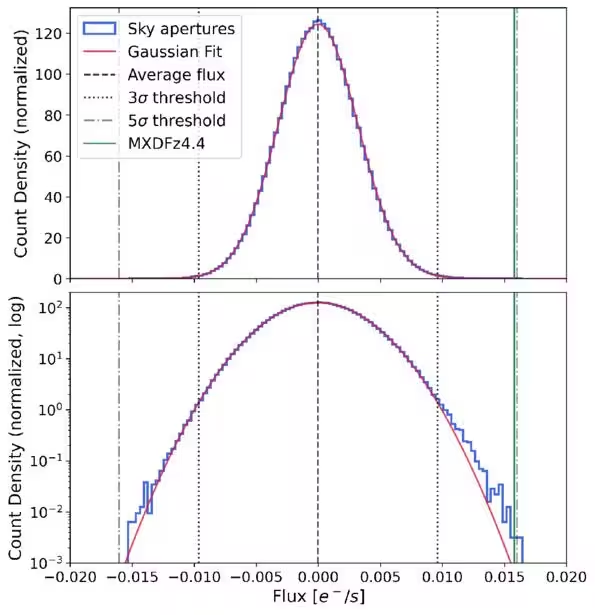
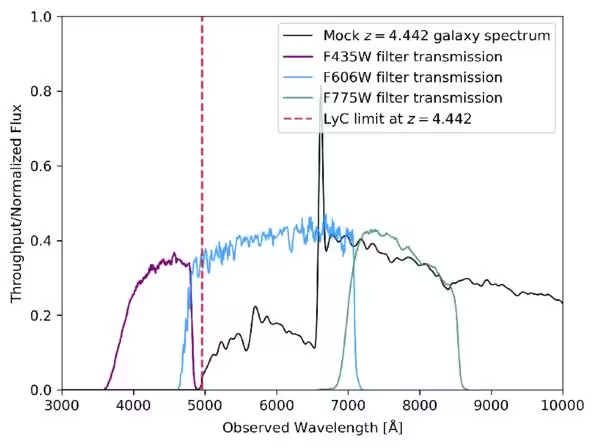
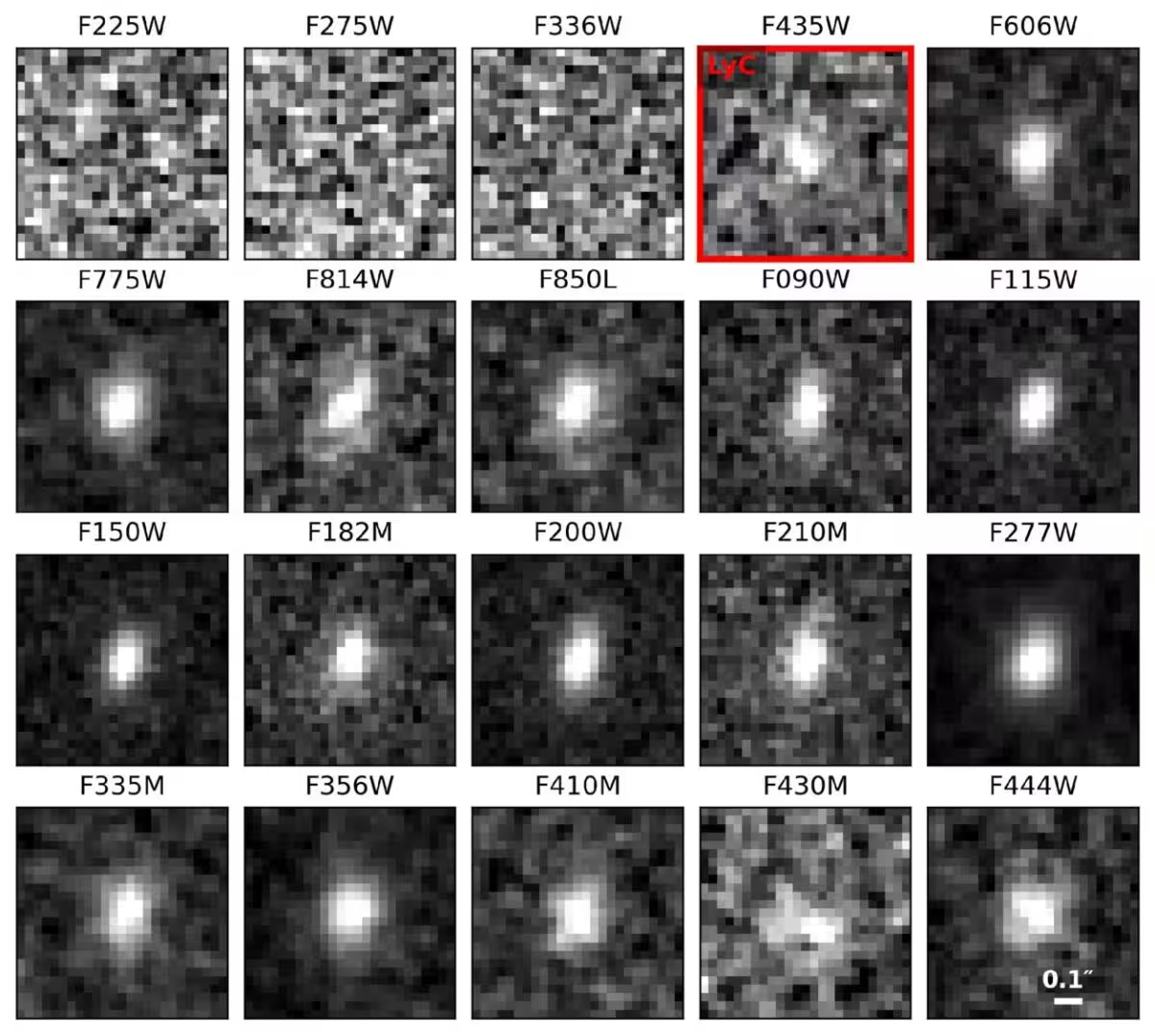
The breakthrough relied on ultra‑deep Hubble Space Telescope imaging gathered over several long‑duration surveys. The extraordinary depth of those data enabled the team to detect ionizing ultraviolet light that would otherwise be absorbed before reaching Earth. In addition to confirming the presence of escaping photons, Hubble’s resolution revealed clusters of newly born stars that serve as the source of this energetic radiation.
“Observing a galaxy like this was thought to be impossible,” said Dr. Ilias Goovaerts, a postdoctoral fellow at the Space Telescope Science Institute.
“Researchers expected the ‘fog’ or neutral hydrogen that filled the early Universe would be too thick and obscure our view of its ionizing light.”
“Hubble not only spotted that light, but it also helped reveal incredible details about the galaxy’s characteristics.”
The study, appearing in the Astrophysical Journal, illustrates how advances in deep‑field imaging are turning theoretical conjectures about the early Universe into observable facts. Rather than merely confirming the existence of ionizing photons, the data expose how a galaxy’s internal makeup and star‑formation timeline may carve channels that let ultraviolet light break free into the surrounding medium.
What Makes MXDFz4.4 Unique Among Early Galaxies
While dozens of galaxies from the same epoch have been catalogued, catching escaping ionizing photons has remained exceptionally rare. Neutral hydrogen enveloping most of these ancient systems typically absorbs such radiation before it can travel to Earth. MXDFz4.4 therefore stands out as a compelling case study for understanding why some galaxies were more effective at driving reionization.
“Astronomers have found many galaxies that existed at this point in the history of the Universe, but we haven’t detected ionizing photons from any of them, making MXDFz4.4 one of a kind,” said Dr. Marc Rafelski, also from the Space Telescope Science Institute.
High‑resolution Hubble images reveal that multiple, recent bursts of star formation have carved out low‑density pathways in the surrounding gas, allowing ultraviolet radiation to escape more readily. Because the massive, hot stars are confined to a very small volume, the radiation density is dramatically amplified compared with larger, more diffuse systems. This blend of compact size, high stellar density, and vigorous star‑forming activity likely explains why MXDFz4.4 succeeds where other galaxies remain invisible to direct LyC detection.
Insights Into the Dawn of Cosmic Transparency
The discovery bolsters a growing consensus that a multitude of small, intensely star‑forming galaxies—rather than a few massive ones—were the main drivers behind the end of the cosmic “dark ages.” Though each individual dwarf is faint, together they could have supplied enough ultraviolet photons to gradually ionize the hydrogen filling intergalactic space. If galaxies like MXDFz4.4 were common in the early Universe, they likely played a decisive role in the transition to a transparent cosmos that later allowed the formation of stars, galaxies, and planetary systems.
“A lot of young, hot, massive stars in a small space do a better job of blasting through opaque gas,” Dr. Goovaerts said.
Looking ahead, the James Webb Space Telescope and forthcoming observatories will hunt for additional objects resembling MXDFz4.4. Each new detection will help determine whether this dwarf is an outlier or part of a broader population that sculpted the early Universe’s evolution, ultimately paving the way for the cosmos we observe today.
This article has been fact checked for accuracy, with information verified against reputable sources. Learn more about us and our editorial process.
Last reviewed on .
Article history
- Latest version
Reference(s)
- Goovaerts, Ilias., et al. “MXDFz4.4: A LyC Emitter 250 Myr after the Epoch of Reionization and a First Test of Ly α Morphology as a Tracer of LyC Escape at High Redshift.” The Astrophysical Journal, vol. 1005, no. 1, June 23, 2026, pp. 34 American Astronomical Society, doi: 10.3847/1538-4357/ae75b0. <https://iopscience.iop.org/article/10.3847/1538-4357/ae75b0>.
Cite this page:
- Posted by Aisha Ahmed