Webb Telescope Captures Stunning New Details of a Dying Star Reshaping the Lion Nebula
NASA’s James Webb Space Telescope reveals stunning new infrared details of the Lion Nebula, capturing the complex, dusty remains of a dying star in action.
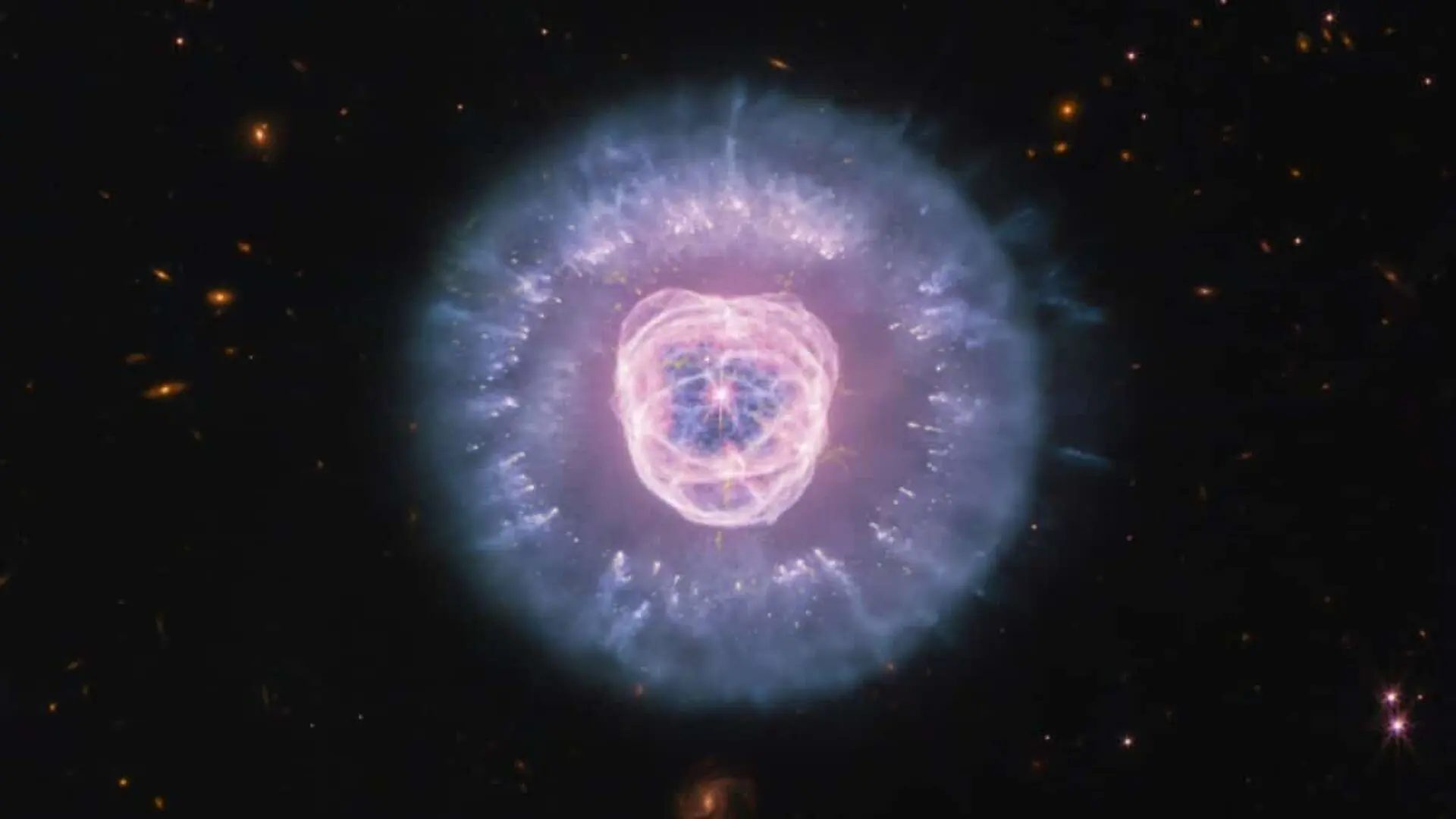
New infrared observations from the James Webb Space Telescope have provided an unprecedented look at the Lion Nebula, also known as NGC 2392. While the object was famously captured in visible light by the Hubble Space Telescope over two decades ago, Webb’s sophisticated suite of instruments has peeled back layers of cosmic dust to reveal the dynamic, volatile processes currently shaping this planetary nebula.
By utilizing the Near Infrared Camera (NIRCam) and the Mid-Infrared Instrument (MIRI), astronomers can now distinguish between the ionized gas clouds and the dense pockets of material that were previously obscured. These observations confirm that the nebula is not a static relic, but a rapidly evolving environment defined by the violent final stages of a dying star.
The Engine Behind the Cosmic Display
The striking structure of the Lion Nebula—which features a distinct face-like center and a sweeping, comet-like mane—is the result of a stellar death sequence occurring roughly 5,000 light-years away in the constellation Gemini. When a low-mass star exhausts its nuclear fuel, it becomes gravitationally unstable, pulsing and casting off its outer atmospheric layers into the void. This material forms the shells of gas and dust characteristic of planetary nebulae.
At the heart of this expansion sits the exposed stellar core, now a white dwarf. According to NASA, this white dwarf was once an oxygen-rich star. Today, it remains intensely hot, emitting powerful radiation that ionizes the surrounding ejected gas. This ionization creates a luminous bubble, which manifests in Webb’s imagery as the lion’s face. As this bubble pushes outward, it collides with and destroys existing dust, forming the complex rings and layered structures that have long puzzled researchers.
The “mane” of the nebula consists of inner dust shells illuminated by the central white dwarf. Within these shells, researchers have identified distinct, compact clumps that resemble tufts of hair or tails. ESA scientists note that these features are dense enough to shield themselves from the intense radiation of the white dwarf, acting as protective barriers for the material located directly behind them.
Webb’s MIRI instrument has been critical in mapping these variations, highlighting the contrast between the smooth haze of ionized gas and the sharp, resilient filaments of dust. These images provide a transient snapshot of a much broader timeline. The material currently being pushed away from the white dwarf will eventually disperse into the interstellar medium. Experts estimate that the nebula will dissipate entirely within the next 10,000 years, marking the end of its current, highly recognizable form.
Lion Nebula (NGC 2392) — Webb
5,000 light-years away in Gemini. A planetary nebula from a dying star.
Webb NIRCam + MIRI composite. A hot white dwarf ionizes a lion-face bubble; glowing dust forms the mane. pic.twitter.com/vKtfWxvGxc
Ahmed, Aisha. “Webb Telescope Captures Stunning New Details of a Dying Star Reshaping the Lion Nebula.” BioScience. BioScience ISSN 2521-5760, 19 August 2026. <https://www.bioscience.com.pk/en/subject/astronomy/james-webb-captures-a-dying-star-transforming-a-nebula-from-the-inside>.
Ahmed, A. (2026, August 19). “Webb Telescope Captures Stunning New Details of a Dying Star Reshaping the Lion Nebula.” BioScience. ISSN 2521-5760. Retrieved August 19, 2026 from https://www.bioscience.com.pk/en/subject/astronomy/james-webb-captures-a-dying-star-transforming-a-nebula-from-the-inside
Ahmed, Aisha. “Webb Telescope Captures Stunning New Details of a Dying Star Reshaping the Lion Nebula.” BioScience. ISSN 2521-5760. https://www.bioscience.com.pk/en/subject/astronomy/james-webb-captures-a-dying-star-transforming-a-nebula-from-the-inside (accessed August 19, 2026).