Protein Dosage Controls Embryonic Axis Elongation and Symmetry Breaking in Human Stem Cell Models
Altering nuclear YAP activity can either accelerate tissue elongation or trap developing cells in an unresolved mixed state.
When human embryonic stem cells aggregate in a dish, they undergo a remarkable self-organization process that mirrors the earliest stages of embryonic development, breaking symmetry and elongating along an axis. A team led by Conchi Estaras at the Lewis Katz School of Medicine at Temple University has discovered that the dosage of a critical mechanical signaling protein called YAP controls this entire elongation process. By fine-tuning YAP nuclear activity in three-dimensional human gastruloids, the researchers found they could either accelerate tissue elongation or arrest development entirely in a spherical state.
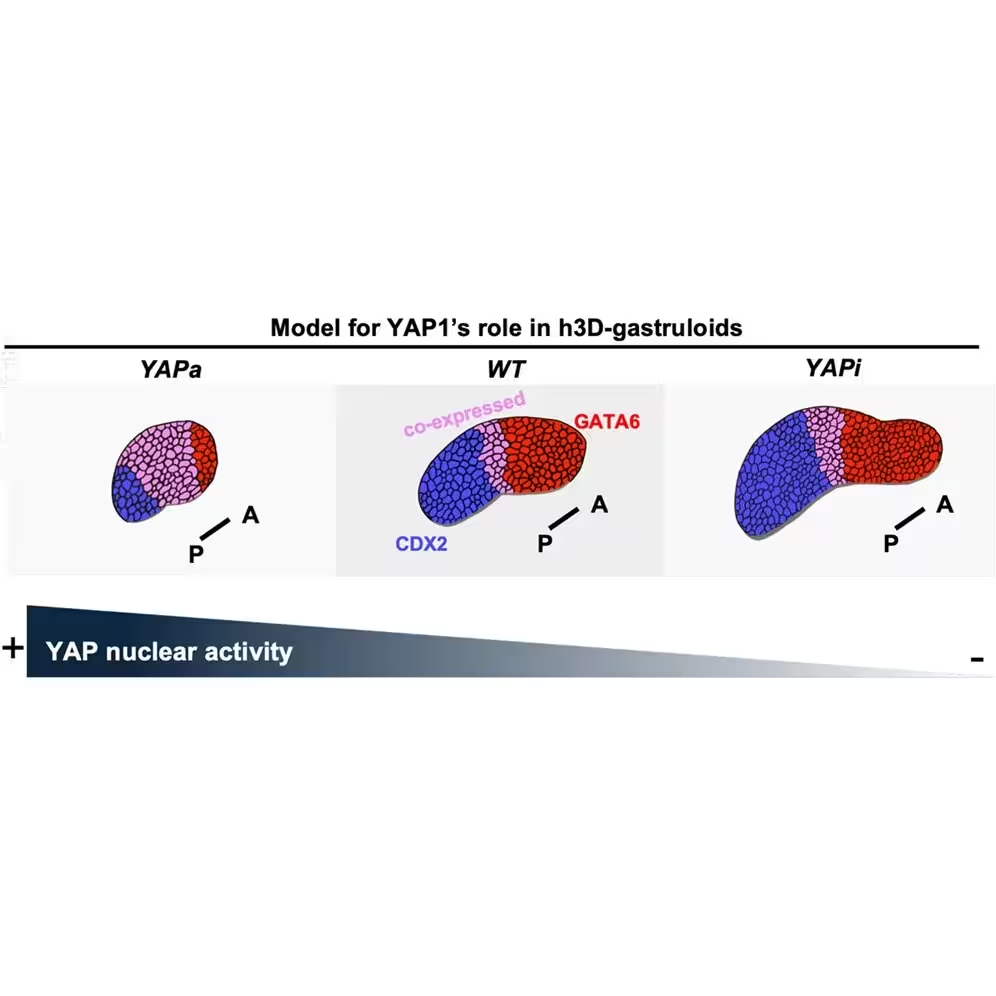
During normal human embryogenesis, a uniform ball of pluripotent cells transforms into a patterned embryo during gastrulation, specifying the three primary germ layers known as the ectoderm, mesoderm, and endoderm, while simultaneously establishing the anterior-posterior body axis. Because direct experimental study of post-implantation human embryos is impossible, scientists rely on three-dimensional stem cell models called human gastruloids. These structures break symmetry following a brief pulse of WNT signaling, a major developmental pathway, and organize distinct cell populations along their main axis. The posterior pole typically expresses markers such as CDX2 and active WNT signaling, while the anterior pole exhibits markers like GATA6 and BMP signaling.
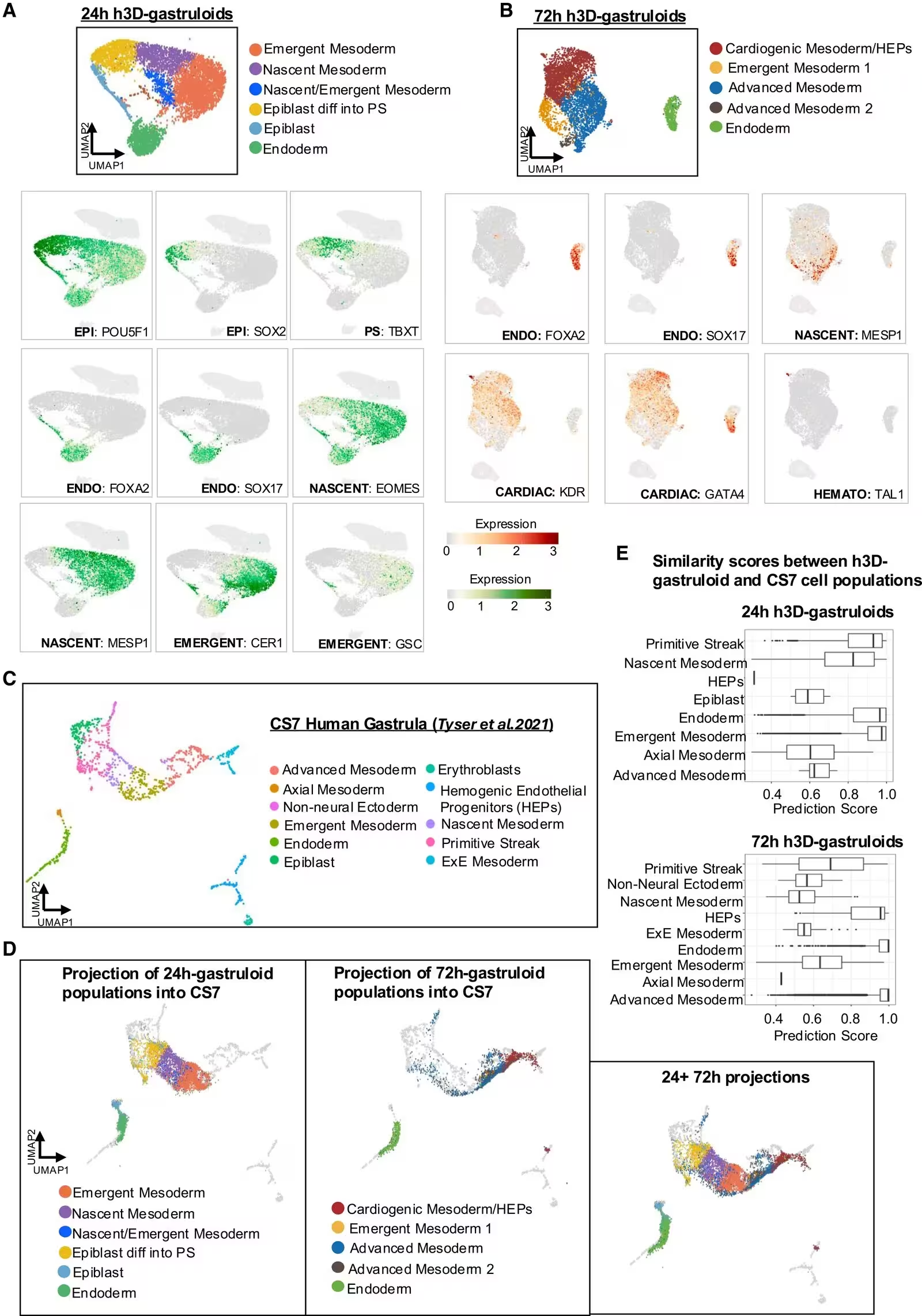
The new study, published in iScience, investigated the role of the Hippo signaling pathway effector YAP, a transcriptional co-activator that translocates into the cell nucleus when Hippo kinase activity is low. Using complementary genetic knockout models and pharmacological compounds such as dasatinib to inhibit YAP and XMU-MP-1 or TRULI to activate it, the researchers analyzed how varying YAP levels affect morphogenesis. Single-cell RNA sequencing and reporter lines revealed that YAP is broadly distributed across all cell populations during gastruloid formation, but its localized activity dictates whether cells can properly segregate their identities.
How Does YAP Dosage Dictate Embryonic Axis Elongation?
When the researchers inhibited YAP activity using dasatinib or through genetic deletion across multiple stem cell lines including RUES2 and H1, the resulting gastruloids exhibited significantly enhanced anteroposterior elongation. Single-cell transcriptomic analyses showed that YAP inhibition promoted the exit of cells from an epiblast-like state and accelerated their differentiation toward primitive streak and mesodermal lineages. This enhanced differentiation correlated with a marked increase in WNT signaling pathway activity, which normally drives axial extension.
Conversely, sustained YAP activation using pharmacological activators produced the exact opposite effect. Gastruloids treated with these compounds failed to break symmetry, remaining locked in a rounded, spherical shape instead of elongating. While these YAP-activated structures still managed to specify basic germ layer progenitors, they completely failed to establish polarized domains of gene expression.
Why Do Overactive YAP Levels Trap Cells in Mixed States?
To uncover why activated YAP prevents proper shaping, the team examined the spatial distribution of anterior and posterior molecular markers. In normal development, anterior markers like EOMES and GATA6 cleanly segregate from posterior markers like TBXT and CDX2. However, gastruloids with sustained YAP activation displayed widespread co-expression of opposing markers, with nearly half of the cells simultaneously expressing both GATA6 and CDX2 at twenty-four hours.
This persistent co-expression indicates that high nuclear YAP activity traps cells in an unresolved, transitional mixed state rather than allowing them to resolve into distinct embryonic lineages. The authors noted that YAP strongly represses specific key regulators such as EOMES, which normally helps drive anterior mesendodermal fates while keeping posterior programs balanced. By suppressing these critical transitions, excessive YAP activity halts morphogenesis and prevents the physical elongation required for proper body plan establishment.
The research was published in iScience on November 11, 2026.
This article has been fact checked for accuracy, with information verified against reputable sources. Learn more about us and our editorial process.
Last reviewed on .
Article history
- Latest version
Reference(s)
- Abraham, Elizabeth., et al. “YAP dosage controls anteroposterior axis elongation in human 3D gastruloids.” iScience, vol. 29, no. 11, November 1, 2026, pp. 118149 Elsevier BV, doi: 10.1016/j.isci.2026.118149. <https://doi.org/10.1016/j.isci.2026.118149>.
Cite this page:
- Posted by Faisal Qureshi