Distant Microquasar Cygnus X‑3 May Power the Highest‑Energy Gamma‑Ray Glow in the Cygnus Bubble
Astronomers suggest distant binary Cygnus X-3 may power the Cygnus Bubble’s highest‑energy gamma rays, challenging the usual link to nearby Cygnus X and OB2.
A fresh analysis zeroes in on gamma‑ray photons above 400 tera‑electronvolts, proposing that the microquasar Cygnus X‑3 offers a more plausible origin than previously suggested. The July 21 paper in The Astrophysical Journal Letters argues that particles accelerated by the binary can escape, wander through the surrounding interstellar medium, and generate an extensive gamma‑ray halo by colliding with ambient gas.
Remote Microquasar May Account for Ultra‑High‑Energy Gamma Rays
Cygnus X‑3 comprises a compact object—either a black hole or a neutron star—orbiting a massive stellar companion every 4.8 hours. The system ejects powerful jets that transport large amounts of kinetic energy into its environment.
The hypothesis gained traction after LHAASO detected variable ultra‑high‑energy gamma rays linked to Cygnus X‑3. The signal’s intensity waxed and waned on the same 4.8‑hour period, indicating that particle acceleration and gamma‑ray production are confined to a compact zone within the binary.
Those measurements also revealed a spectrum stretching into the peta‑electronvolt range. The authors describe Cygnus X‑3 as a hadronic super‑PeVatron, capable of propelling protons to energies of several tens of PeV. Electrons are unlikely to explain the PeV emission, because rapid energy losses would prevent them from attaining the required energies inside the binary.
In their model, Cygnus X‑3 acts as a steady source of high‑energy protons for intervals ranging from 100 000 to 400 000 years. After escaping the system, the particles diffuse through interstellar gas; collisions with gas nuclei then produce the observable gamma rays.
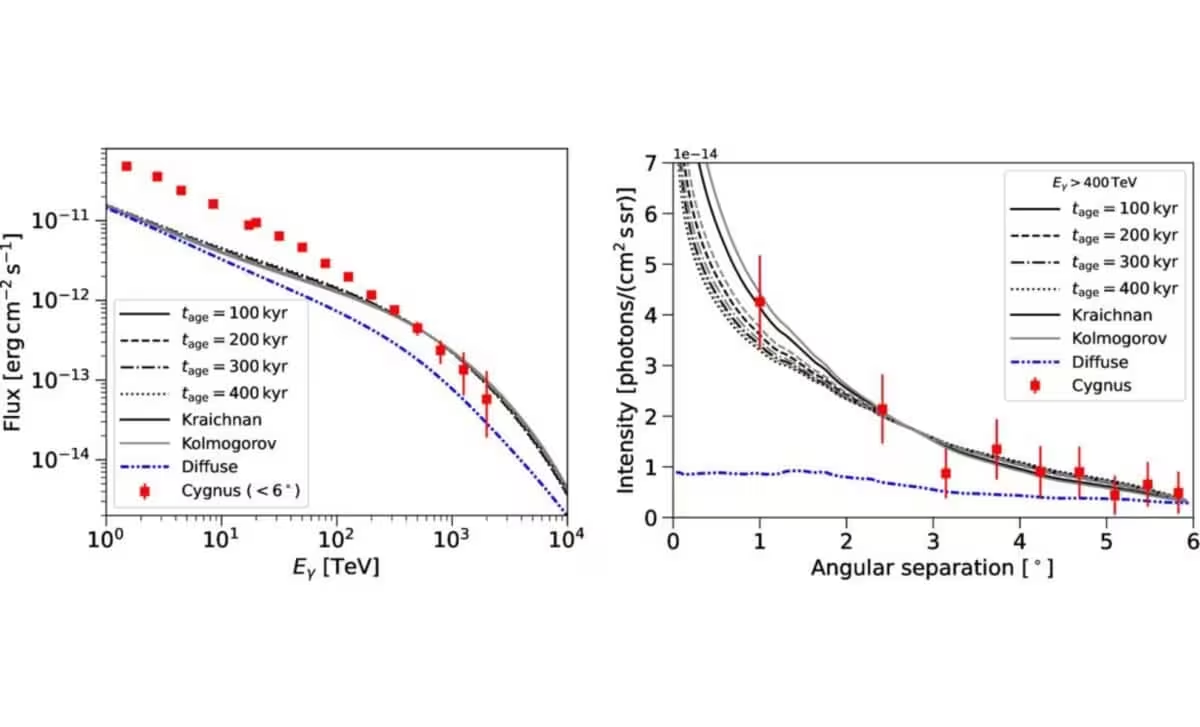
Adopting a diffusion coefficient of 3 × 10^29 cm² s⁻¹ at 1 PeV, the simulation reproduces both the observed gamma‑ray flux above 400 TeV and the radial decline in emission intensity away from the bubble’s centre.
For a uniform gas density of one particle per cubic centimetre, the model requires a cosmic‑ray acceleration efficiency between 0.7 % and 1.6 %. Introducing a vertically stratified gas profile—averaging roughly 0.38 particles per cubic centimetre—raises the needed efficiency to 1.6 %–3.2 %.
Existing Data Still Blur Distinct Sources
The authors stress that Cygnus X‑3 does not have to account for every gamma‑ray photon emanating from the Cygnus Bubble. They separate the >400 TeV component from lower‑energy radiation observed in the same sky region.
According to the paper, GeV‑to‑TeV emission can be treated as foreground radiation associated with the massive stellar association Cygnus OB2, whereas the highest‑energy signal may originate much farther out around Cygnus X‑3. The overlapping line of sight makes it difficult for current instruments to disentangle the two contributions.
The model also presumes that cosmic rays diffuse more slowly around Cygnus X‑3 than they typically do throughout the Milky Way. At 1 PeV, the chosen diffusion coefficient is one to two orders of magnitude lower than values extrapolated from standard Galactic diffusion rates, depending on the assumed turbulence scenario. The authors suggest that intense turbulence generated by the microquasar’s jets could suppress diffusion, while acknowledging that particle transport at these energies remains uncertain.
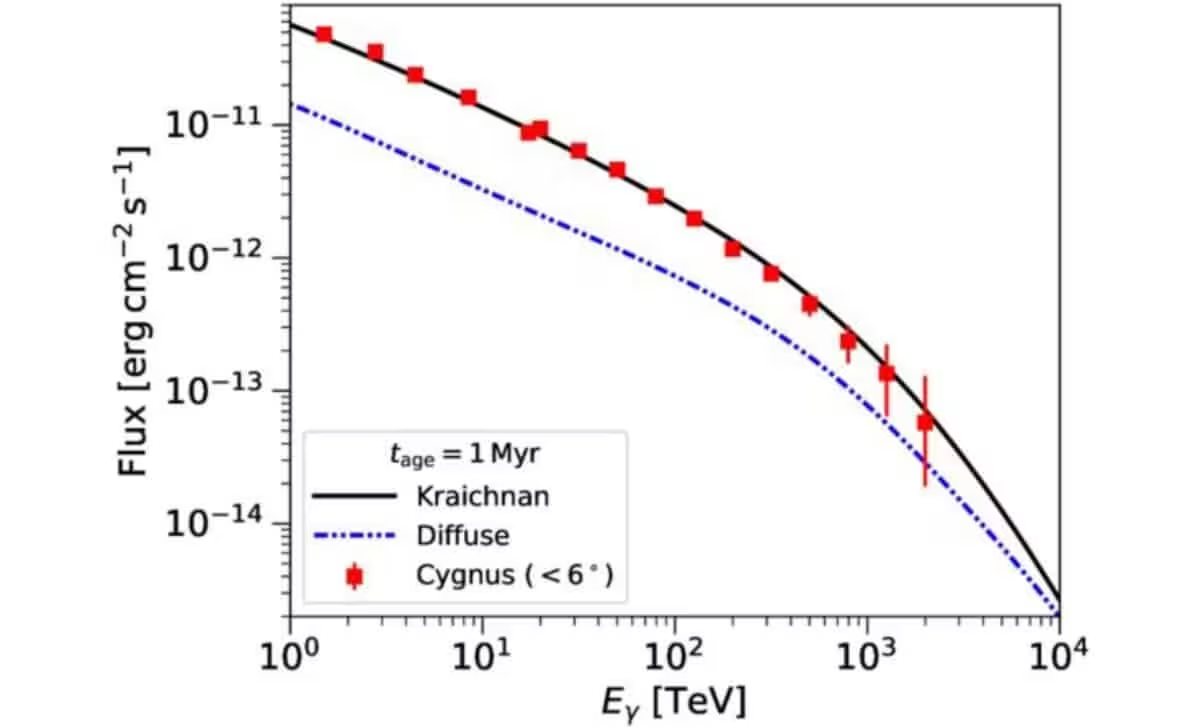
To test whether Cygnus X‑3 could also explain the broader 1 TeV–2 PeV spectrum, the team examined a scenario requiring a softer injected cosmic‑ray spectrum, an assumed injection period of one million years, and a cosmic‑ray power above 1 TeV amounting to about 11 % of the system’s estimated kinetic luminosity.
Current LHAASO observations lack the angular resolution needed to cleanly separate foreground emission from the Cygnus region and the more distant microquasar signal. The researchers point to upcoming facilities such as CTA, ASTRI and the proposed Large Array of Cherenkov Telescopes as capable of providing the finer resolution and detailed spectral measurements required to evaluate the hypothesis.
This article has been fact checked for accuracy, with information verified against reputable sources. Learn more about us and our editorial process.
Last reviewed on .
Article history
- Latest version
Reference(s)
- Shi, Zhaodong., et al. “Microquasar Cygnus X-3 as the PeVatron Powering the Cygnus Bubble.” The Astrophysical Journal Letters, vol. 1006, no. 2, July 21, 2026, pp. L31 American Astronomical Society, doi: 10.3847/2041-8213/ae878e. <https://iopscience.iop.org/article/10.3847/2041-8213/ae878e>.
Cite this page:
- Posted by Aisha Ahmed