Supermassive Black Holes May Be Birthplaces for Millions of Giant Planets and Stars
New research reveals that the dense, dusty disks surrounding supermassive black holes may play a far more complex role than simply feeding the void.
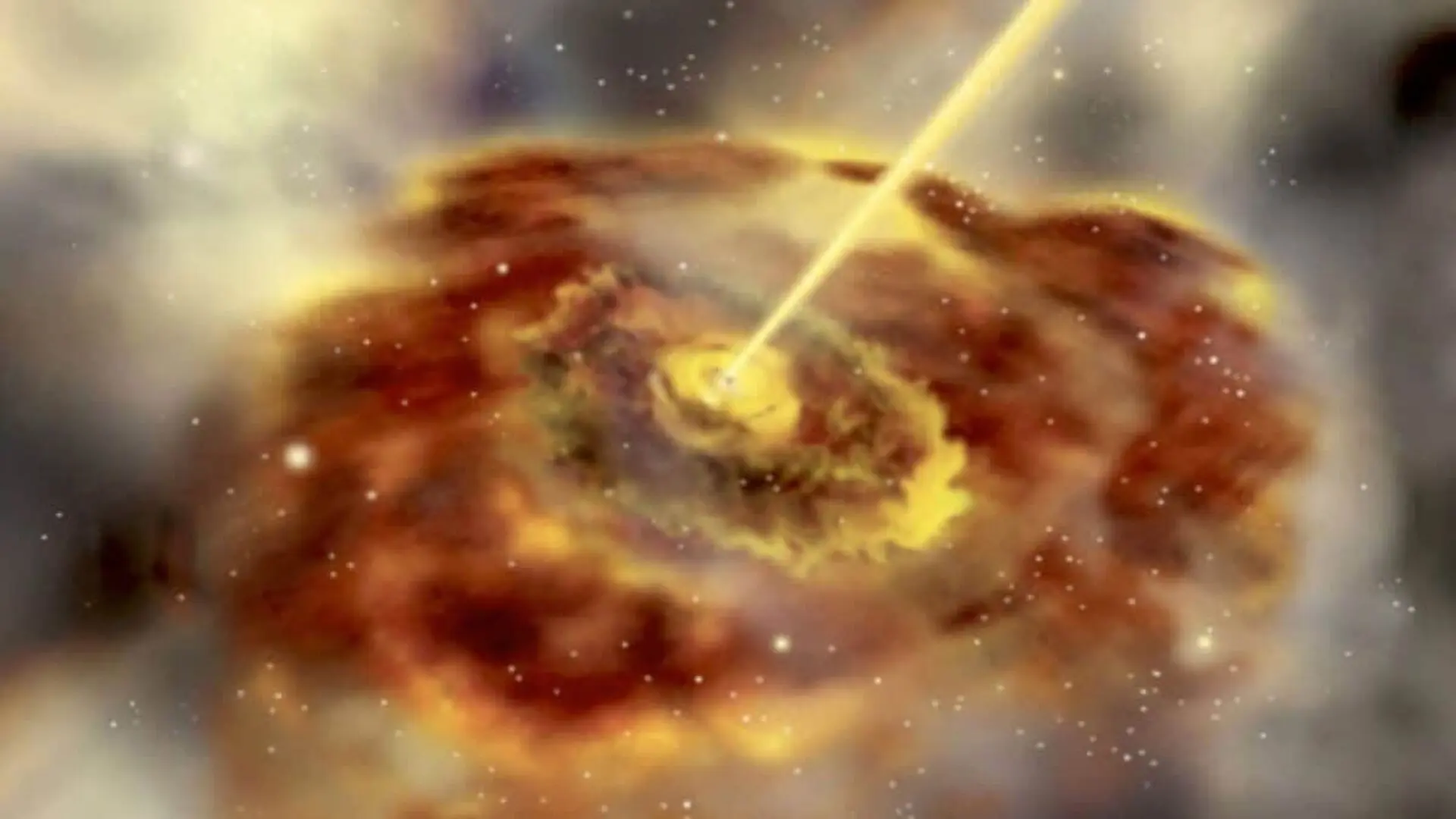
The chaotic, high-energy regions surrounding supermassive black holes may be acting as cosmic nurseries, forging massive planetary objects and stars from swirling clouds of dust. New computer simulations reveal that active galactic nuclei (AGN), which are known for their blinding brilliance and massive gravity, could harbor environments capable of birthing tens of millions of planet-sized bodies.
A research team led by astrophysicist Wladimir Lyra of New Mexico State University, working alongside partners at the Nicolaus Copernicus Astronomical Center and CUNY Borough of Manhattan Community College, investigated whether the fundamental processes of planet formation—typically associated with calm, young stars—could survive the extreme conditions of an AGN. Their findings, published in The Astrophysical Journal, suggest that even in such hostile surroundings, the basic laws of physics facilitate the growth of solid matter.
From Microscopic Grains to Cosmic Giants
The researchers modeled a magnetized disk of dust circulating around a supermassive black hole. They observed that particles ranging from just a few nanometers to a fraction of a millimeter do not remain dispersed. Instead, they undergo a phenomenon known as streaming instability, which causes the dust to concentrate into dense filaments. Under the influence of their own gravity, these clusters collapse to form solid bodies, ranging from the size of Earth to massive, super-Jupiter entities.
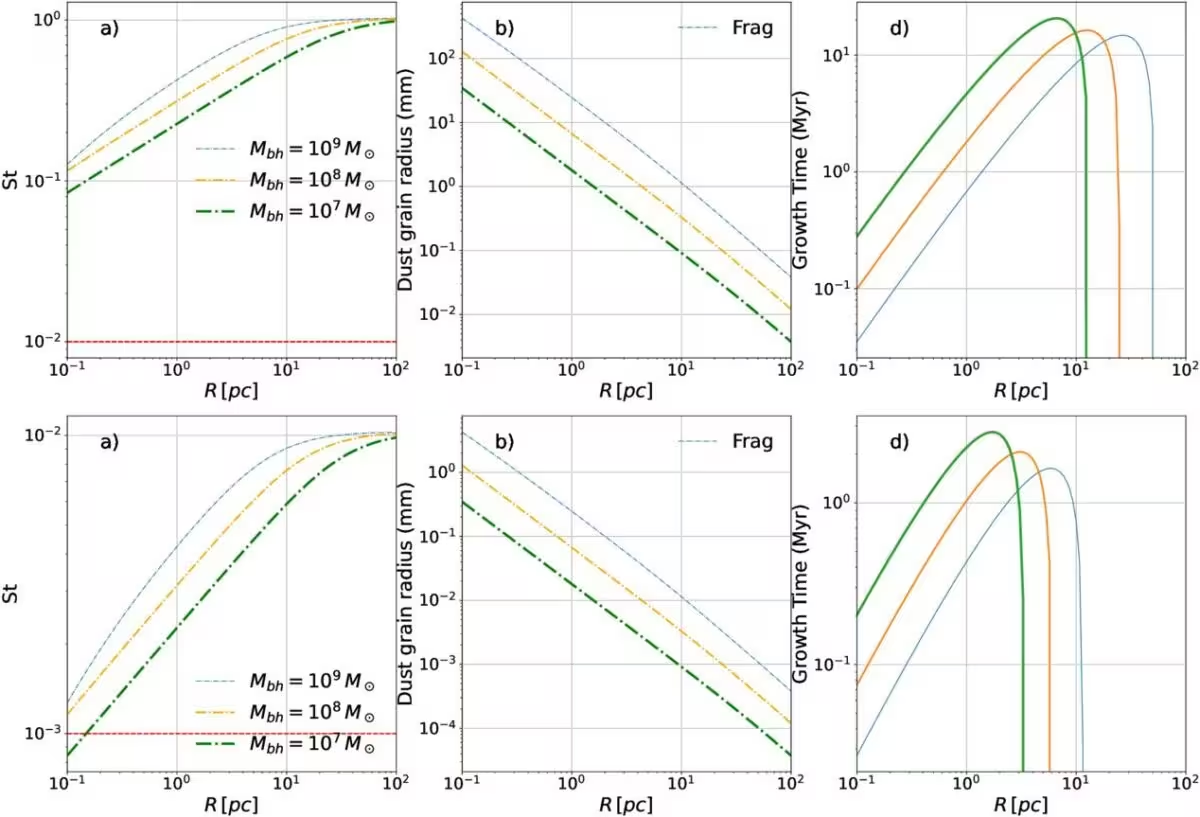
Lyra notes that these objects, which can reach a thousand times the mass of Earth, are constructed entirely of dust. Over the 1-to-10-million-year lifespan of an AGN episode, these bodies can further increase their size through the accretion of surrounding pebbles and gas.
A Bottom-Up Path to Stellar Formation
The simulation results challenge traditional models of star formation, which typically begin with the gravitational collapse of a massive, diffuse gas cloud. In an AGN disk, the sequence is inverted: the dust serves as a structural foundation, accreting material until the object reaches the critical hydrogen-burning threshold. According to Lyra, this “bottom-up” approach represents a novel pathway for creating stars that has not been previously documented in astrophysical literature.
The “AGN Channel” and Gravitational Waves
The evolution of these objects may extend far beyond planetary or stellar scales. The team suggests that stars formed within these disks can ultimately collapse into black holes. When these black holes interact within the disk—migrating, colliding, and merging—they create a unique environment dubbed the “AGN channel,” which acts as a forge for exceptionally heavy black holes.
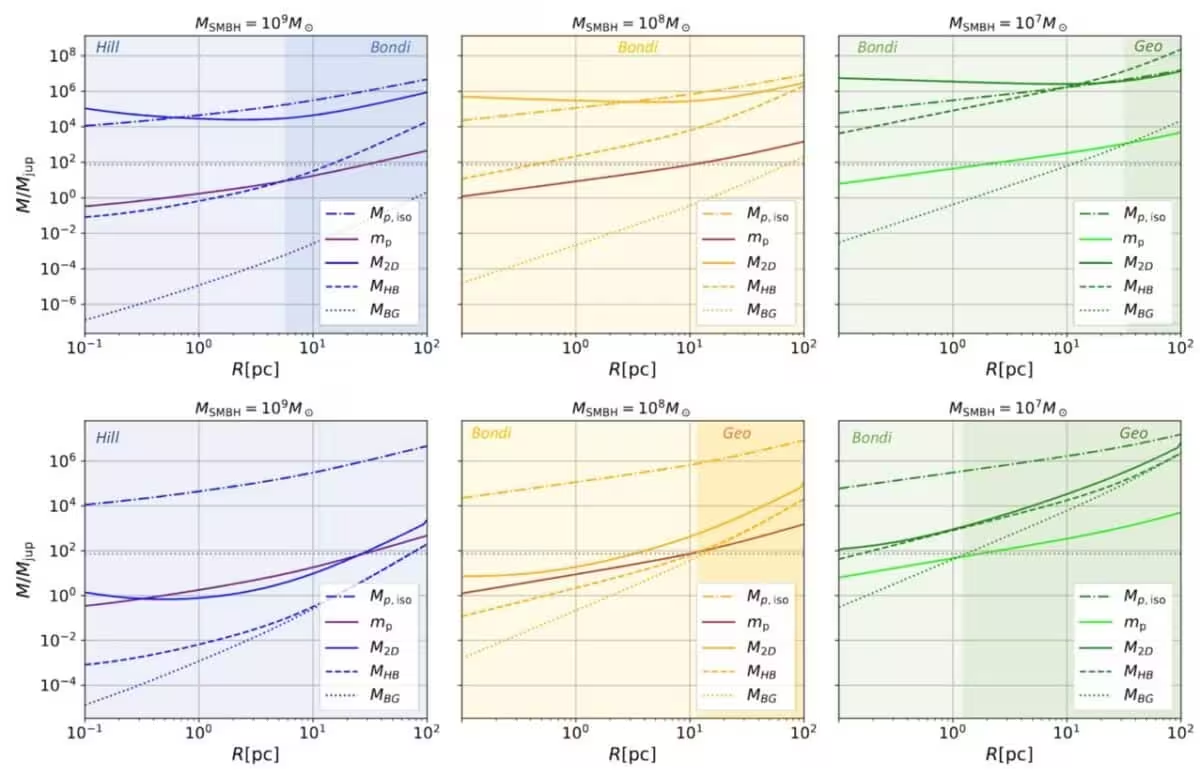
Researcher Bhupendra Mishra highlights that these entities could reach masses hundreds or thousands of times greater than our Sun. As these massive objects drift toward the central supermassive black hole, they are expected to produce distinct gravitational-wave signatures. These ripples in spacetime may eventually be detectable by the ESA’s Laser Interferometer Space Antenna (LISA), a mission currently slated for launch in the mid-2030s.
This article has been fact checked for accuracy, with information verified against reputable sources. Learn more about us and our editorial process.
Last reviewed on .
Article history
- Latest version
Reference(s)
- Mishra, Bhupendra., et al. “Active Galactic Nucleus Tori: Potential Birthplace to Millions of Planets.” The Astrophysical Journal, vol. 1005, no. 1, June 29, 2026, pp. 99 American Astronomical Society, doi: 10.3847/1538-4357/ae6f0b. <https://iopscience.iop.org/article/10.3847/1538-4357/ae6f0b>.
- <https://www.esa.int/Science_Exploration/Space_Science/LISA>.
Cite this page:
- Posted by Aisha Ahmed